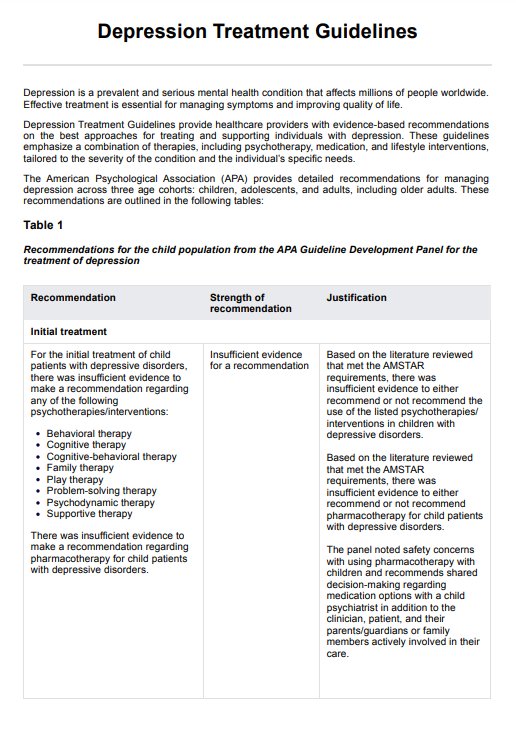
Treatment guidelines for major depressive disorder (MDD)
As mentioned, major depressive disorder is a major mental health illness that affects millions of individuals worldwide. It is characterized by persistent melancholy and a loss of interest in previously loved activities. The American Psychiatric Association's Clinical Practice Guidelines for treating MDD offer a comprehensive strategy including pharmaceutical and psychological therapy. Here are some treatment guidelines for MDD (Mcquaid et al., 2019):
Initial treatment options
Antidepressant drugs and psychotherapy are commonly used as first-line treatments for MDD. Selective serotonin reuptake inhibitors are popular antidepressants due to their demonstrated efficacy and mild side effect profiles.
Cognitive behavioral therapy (CBT) is a leading psychotherapy for treating depression, as it helps patients change negative thought patterns that contribute to depressive symptoms. Other psychotherapies, including Interpersonal Psychotherapy (IPT), mindfulness-based cognitive therapy, and psychodynamic therapy, are also considered based on individual needs (Mcquaid et al., 2019).
For more severe cases, combined treatment involving both antidepressants and psychotherapy is often recommended. The APA guidelines emphasize the use of CBT or IPT alongside antidepressant treatment for optimal results.
Treatment-resistant depression
When patients do not respond to initial treatments, they are considered to have treatment-resistant depression. In such cases, adjunctive treatments, like electroconvulsive therapy (ECT) or repetitive transcranial magnetic stimulation (rTMS), may be recommended, particularly for those with severe depression or psychotic symptoms. These treatments provide additional support when standard medications and therapies have not produced adequate results.
Addressing symptom severity
The APA guidelines propose adjusting treatment strategies based on the severity of depression symptoms. For people with mild depression, therapy alone, such as behavioral activation or problem-solving therapy, may suffice. However, for moderate to severe depression, a combination of medication and psychotherapy is frequently required to effectively treat symptoms.
Depression with comorbid conditions
Many individuals with MDD also have comorbid conditions, such as anxiety disorders or substance use disorders. Treatment plans should address these comorbidities to improve overall outcomes. For example, CBT can be adapted to treat both depression and anxiety. Additionally, supportive psychotherapy can help patients manage the emotional burden of these co-occurring conditions.
Long-term management and prevention
For patients who respond positively to initial treatments, preventing relapse is crucial. The APA guidelines recommend psychotherapy (e.g., CBT or mindfulness-based cognitive therapy) as the primary strategy for preventing relapse rather than relying solely on antidepressant medication. Maintenance therapy is particularly important for individuals with chronic or recurrent depressive symptoms, as it helps maintain long-term mental health and reduce the likelihood of recurrence.
Patient preferences and treatment adherence
A critical aspect of treatment is shared decision-making between the clinician and the patient, ensuring patient preferences are considered when developing the treatment plan. This approach enhances treatment adherence, essential for improving depression outcomes (Mcquaid et al., 2019). It's vital that patients feel empowered and confident in their treatment choices to ensure the best possible outcomes.
To learn more about Depression Treatment Guidelines, download our handout by clicking the “Use template” where you can access it via the Carepatron app. For a PDF copy, click the "Download" button.