





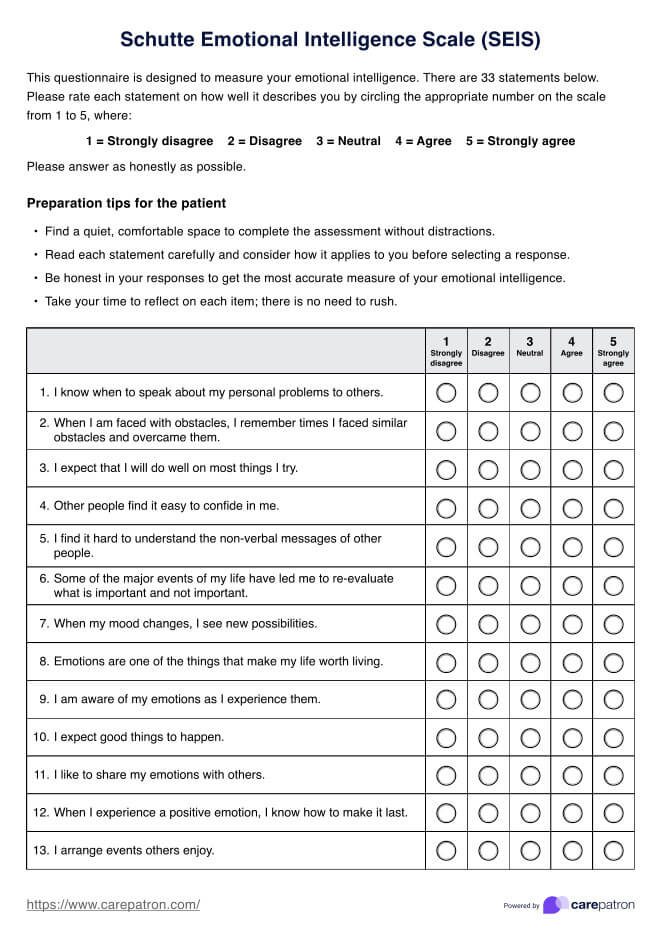




What is the Schutte Emotional Intelligence Scale (SEIS)?
The Schutte Emotional Intelligence Scale (SEIS), also known as the Schutte Self-Report Emotional Intelligence Test (SSEIT) is a 33-item self-report measure that assesses emotional intelligence using a 1 (strongly disagree) to 5 (strongly agree) scale. It measures four factors of emotional intelligence: emotion perception, utilizing emotions, managing self-relevant emotions, and managing others' emotions (Schutte et al., 1998). Schutte and her colleagues founded this inventory on the model of the emotional intelligence developed by Salovey and Mayer in 1990.
The SSEIT has demonstrated good reliability, with Schutte et al. reporting a reliability rating of 0.90 for their emotional intelligence scale. However, the utilizing emotions sub-scale has shown poor reliability in some studies. The SSEIT has also shown mediocre correlations with constructs like self-estimated EI, the Big Five EI scale, and life satisfaction (Petrides & Furnham, 2000).
Validation studies have supported the SSEIT's four-factor structure in various cultural contexts, including South Africa (Jonker & Vosloo, 2008) and Zambia (Musonda et al., 2019). These studies found the instrument reliable, with Cronbach's alpha coefficients ranging from 0.74 to 0.79.
What is the goal of the SEIS?
The primary goal of the SEIS is to provide a reliable and valid measure of the characteristic emotional intelligence. It aims to help individuals:
- Recognize and understand their own emotions.
- Manage and regulate emotions effectively.
- Understand and influence the emotions of others.
- Utilize emotions to solve problems and make decisions.
The SEIS contributes to personal development, improved interpersonal relationships, and enhanced emotional well-being through these objectives.
How is the SEIS scored?
Scoring the SEIS involves summing the ratings for all 33 items. Each item is scored on a scale from 1 (strongly disagree) to 5 (strongly agree), resulting in a total score that reflects an individual's overall emotional intelligence. The SEIS doesn't differentiate between subscales, instead providing a single comprehensive score. Higher scores indicate greater emotional intelligence, while lower scores suggest areas for potential growth and development.
Next steps after using this scale
Once the SEIS assessment is complete, there are several steps psychologists and healthcare professionals can take:
- Interpret the results: Analyze the total score to identify strengths and areas for improvement in emotional intelligence.
- Develop personalized interventions: Create tailored strategies to enhance emotional skills based on the individual's score.
- Monitor progress: Use the SEIS periodically to track changes and improvements in emotional intelligence over time.
- Educate and empower clients: Provide clients with insights and resources to help them understand and develop their emotional intelligence.









