
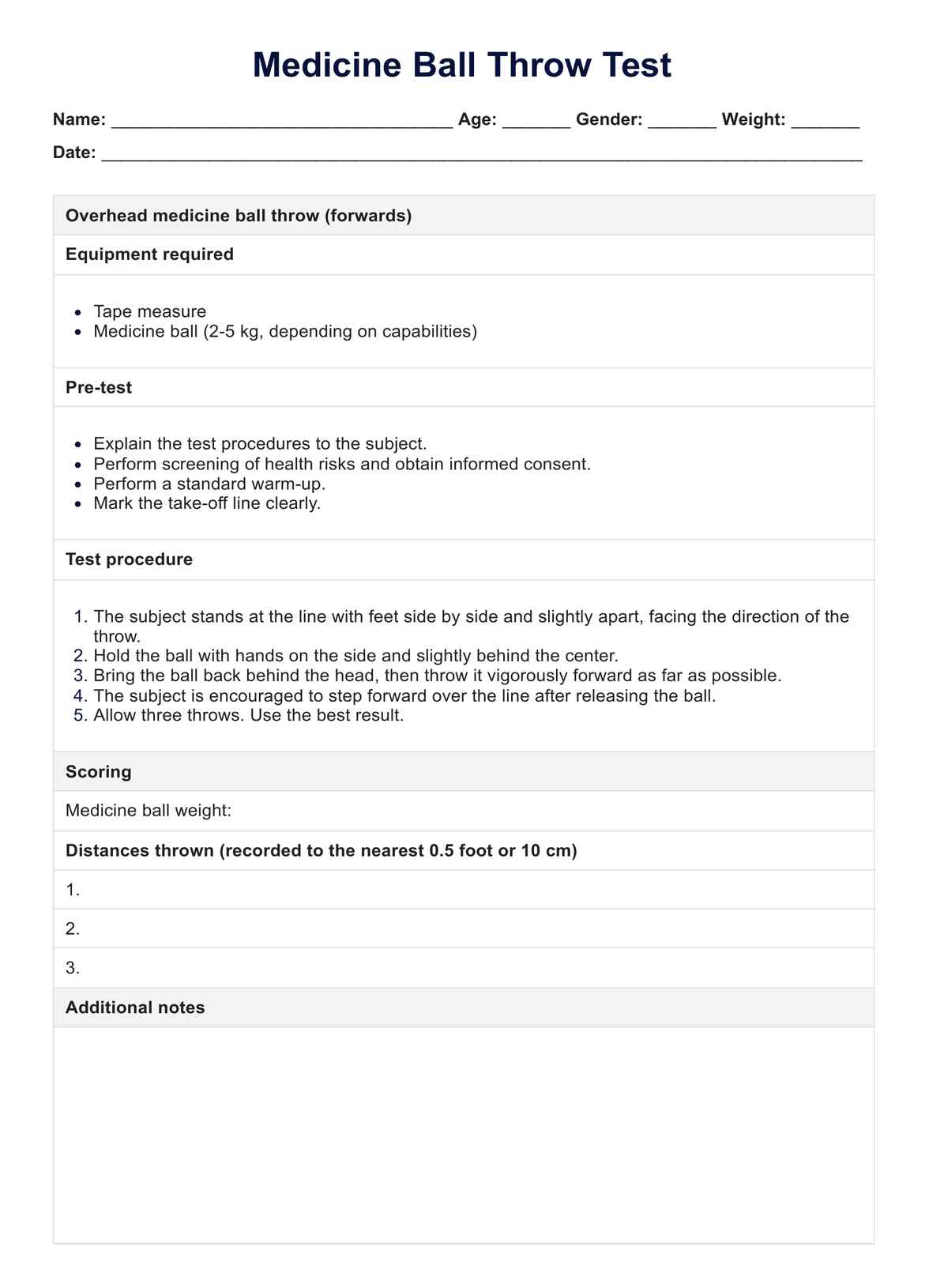




What is the Medicine Ball Throw Test?
The Medicine Ball Throw Test is used to assess upper body power and explosive power. It involves throwing a medicine ball in various ways to measure physical capabilities across different patient or client groups. Here are the main variants of the test:
- Overhead/concentric throw: This variant measures the explosive power of the upper body by having the participant throw the ball forward from an overhead position. It is commonly used among athletes and active adults.
- Eccentric-concentric throw: Focuses on the ability to absorb force eccentrically and then immediately release it concentrically, simulating many sports-related movements.
- Reactive-elastic eccentric-concentric throw: Enhances the previous variant by adding a dynamic bounce to the throw, requiring quick reaction and higher power output.
- Seated throw: Often referred to as the “power throw” or the chest pass, this test measures arm and upper body strength in a fixed posture, making it suitable for those with limited mobility or lower body injuries.
- Kneeling throw: Similar to the seated throw, this variant also isolates the upper body in a kneeling position, adding slightly more stability challenge and core engagement.
These tests target different patient groups based on their physical capabilities and rehabilitation, conditioning, or training goals. Medicine ball training is crucial for developing power and improving sport-specific movements.
Advantages and disadvantages of the Medicine Ball Throw Test
The Medicine Ball Throw Test is highly adaptable, allowing for multiple variations that suit various individuals, from athletes to rehabilitation patients. It requires minimal equipment and is relatively easy and quick to administer, providing immediate feedback on an individual's physical condition.
One limitation is the reliance on technique, which can vary widely between individuals and can affect results and consistency. Additionally, the need for physical space and potentially different weights of medicine balls might limit where and how the test can be administered.









