








What is a Finger Anatomy Diagram?
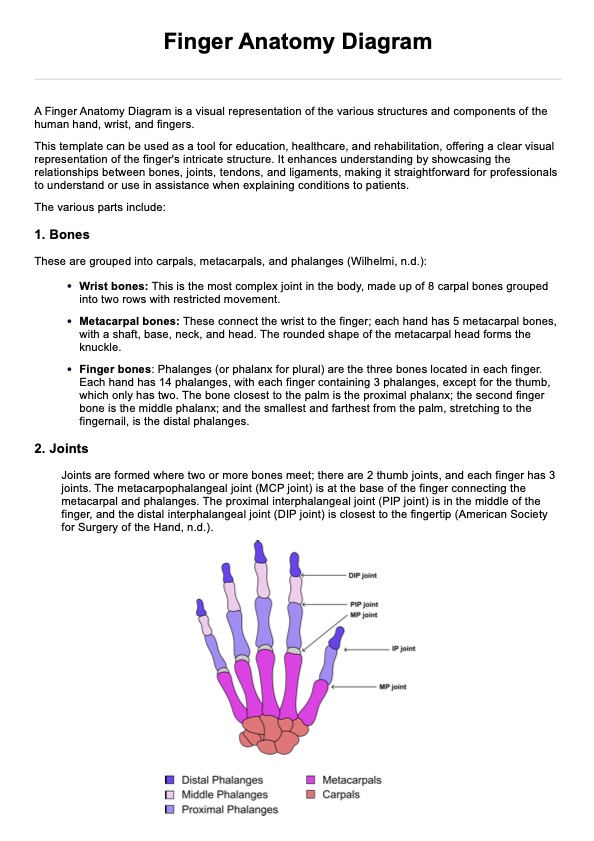
A Finger Anatomy Diagram is a visual representation of the various structures and components of the human hand, wrist, and fingers. Healthcare professionals can use it to label and illustrate various parts of the hand and wrist. The various parts include:
Bones
These are grouped into carpals, metacarpals, and phalanges (Wilhelmi, n.d.):
- Wrist bones: This is the most complex joint in the body, made up of 8 carpal bones grouped into two rows with restricted movement.
- Metacarpal bones: These connect the wrist to the finger; each hand has five metacarpal bones, with a shaft, base, neck, and head. The rounded shape of the metacarpal head forms the knuckle.
- Finger bones: Phalanges (or phalanx for plural) are the three bones in each finger. Each hand has 14 phalanges, with each finger containing three phalanges, except for the thumb, which only has two. The bone closest to the palm is the proximal phalanx; the second finger bone is the middle phalanx; and the smallest and farthest from the palm, stretching to the fingernail, is the distal phalanges.
Joints
Joints are formed where two or more bones meet; there are two thumb joints, and each finger has three joints. The metacarpophalangeal (MCP) joint is at the finger's base, connecting the metacarpal and phalanges. The proximal interphalangeal joint (PIP joint) is in the middle of the finger, and the distal interphalangeal joint (DIP joint) is closest to the fingertip (American Society for Surgery of the Hand, n.d.).
Tendons
Tendons are bands of connective tissue that attach the muscle to the bone, enabling bone movement. The main tendons related to the fingers are the extensor tendons, which attach to the middle and dorsal phalanx and extend the wrist joints (Arthritis Foundation, n.d.). Nine flexor tendons pass through the carpal tunnel from the forearm to the wrist, separating in the palm. Two are associated with each finger, and one goes to the thumb.
Ligaments
Ligaments are rugged bands of connective tissue that connect the bones to support and stabilize. The main ligaments related to the fingers are the collateral ligaments located on either side of the finger and thumb, preventing sideways movement (Arthritis Foundation, n.d.). Further, the radial and ulnar collateral ligaments bind the bones of the wrist and provide stability.









