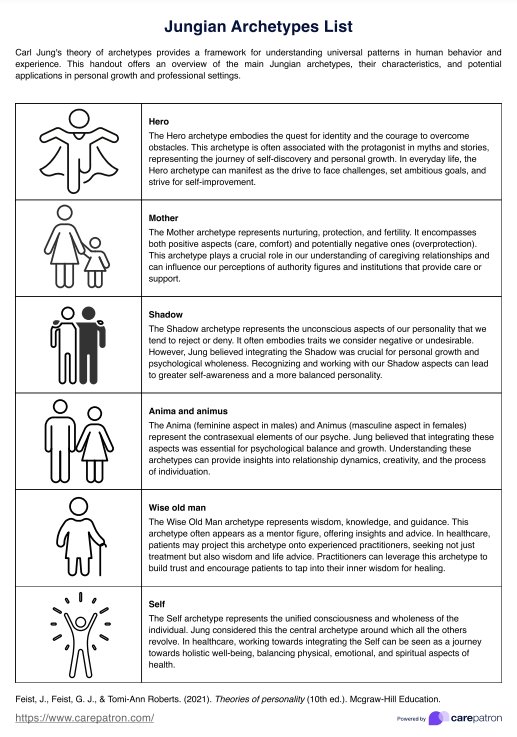
How to use our Jungian Archetypes List Handout
The following is a step-by-step guide on how to use this handout:
Step 1: Familiarize yourself with the archetypes
Begin by thoroughly reviewing the Jungian Archetypes List Handout. Understand each archetype's key characteristics and manifestations, such as the hero's quest for identity, the mother's nurturing aspects, or the shadow's representation of unconscious traits. This allows you to recognize archetypal patterns in patient behaviors and narratives.
Step 2: Observe and listen actively
During patient interactions, pay close attention to recurring themes, behaviors, and language that might align with specific archetypes. For instance, a patient consistently framing their health journey as a battle might be expressing the Hero archetype, while someone struggling with unacknowledged aspects of their personality could be struggling with their Shadow.
Step 3: Apply archetypes to patient narratives
Use the Jungian archetypes list as a framework to analyze patient stories and experiences. Identify which archetypes seem most prominent in a patient's life or current situation. Remember that individuals often embody multiple archetypes, and their dominant archetype may shift depending on life circumstances or the specific health challenge they're facing.
Step 4: Integrate insights into care
Use your archetypal observations to tailor your approach to each patient. For example, if you've identified a strong Wise Old Man archetype in a patient, you might frame treatment recommendations as valuable wisdom to be integrated into their life. Always use these insights as a complementary tool to evidence-based practices, enhancing your ability to connect with patients and provide personalized care.