
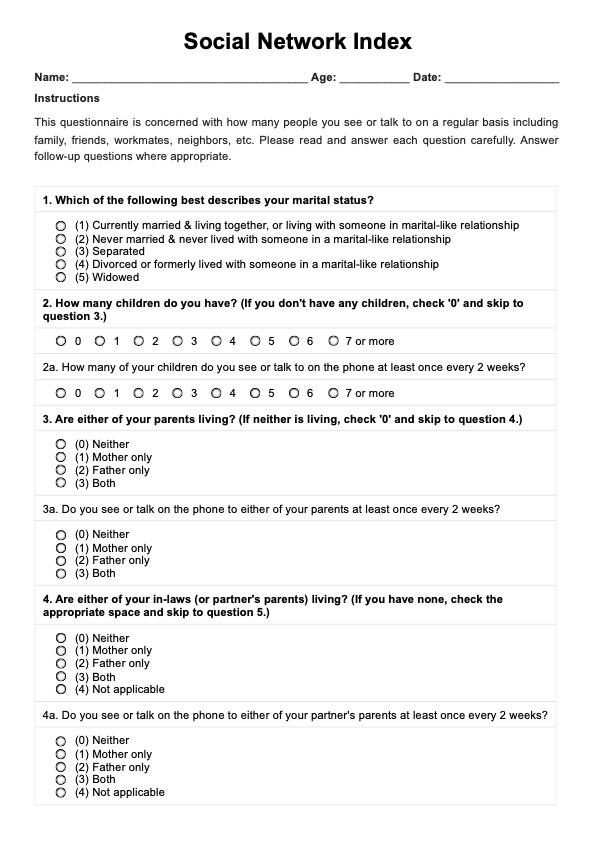




What is the Social Network Index?
The Social Network Index (SNI) is a self-reported questionnaire designed to assess the type, size, closeness, and frequency of interactions within an individual’s social network. It classifies individuals according to their level of social connectedness, enabling researchers to identify those at risk of social isolation.
Cohel et al. (1997) introduced the SNI in their study, Social Ties and Susceptibility to the Common Cold, to examine whether sociability can predict resistance to infectious diseases and if this relationship is influenced by the quality and quantity of social interactions and relationships.
The index consists of 12 questions with various sub-questions. It aims to assess an individual’s social network diversity, including their number of close ties, frequency of interactions, and the type of support they receive from others.
The index measures the following components:
- Number of high-contact roles (Network diversity): This refers to the number of social roles in which the respondent engages regularly, defined as having contact with at least one person at least once every two weeks.
- Number of people in social network: This figure represents the total number of individuals with whom the respondent maintains regular contact, defined as at least once every two weeks.
- Number of embedded networks: This metric is designed to capture the variety of network domains in which a respondent is engaged.









