Everyone has a story to tell, and here we share and celebrate those who chose care as their life's work.
These are their words, their work and we're grateful to share them.
Elizabeth and Dennis handed their billing to Carepatron and grew My Therapeutic Concepts from five clients to seventy in two months, without losing their evenings.
Looking for an assessment that can help you gather a patient/client's medical history, including biological, psychological, and social factors that might be relevant to the patient's current physical and mental health status? Read our guide to learn more about what Biopsychosocial Assessments are and how they can help you gather a wide range of information about your patients/clients to help you create a well-informed treatment plan.
## **What is a Biopsychosocial Assessment?**
A Biopsychosocial Assessment is a comprehensive assessment tool used by clinicians and social workers to gather essential information about a patient/client during the intake process whenever they are handling a patient/client seeking treatment from them. This type of assessment organizes client-reported information across three key domains of the biopsychosocial model: biological, psychological, and social factors (Borrell-Carrio et. al., 2004). It helps mental health professionals gain a holistic understanding of the individual's overall functioning and needs. To streamline this assessment process, a standardized template is available to ensure information is captured reliably and consistently for each client.
### **The three domains of a Biopsychosocial Assessment**
A thorough Biopsychosocial Assessment assesses three domains, the key aspects that make up the biopsychosocial framework, which gives healthcare professionals a comprehensive understanding of a patient.
The biological factors domain addresses physical health-related elements such as mental health history, personal and family history, current medical treatments they're taking, current physical health, potential drug interactions, genetics, age, infections, any (chronic) illnesses they have, substance use (if applicable), nutrition, hormone levels, sleep patterns, and exercise habits. These details provide insight into the client's mental and physical health and how it may impact their mental health (Peterson et al., 2015).
The psychological factors domain focuses on cognitive and emotional processes. This includes previous mental health treatment, the client's current emotional state, mental health issues, mental health diagnoses, personality traits, coping mechanisms, mental health symptoms, emotional well-being, emotional challenges they have, psychological trauma, cognitive functioning, and stress levels. Understanding these aspects helps clinicians evaluate the client's internal experiences, trauma history (if any), and behavioral patterns related to mental health conditions and mental health disorders (Peterson et al., 2015). One can learn about a patient's coping strategies by assessing this domain.
The social factors domain explores environmental and interpersonal influences on the client's mental health/how social factors interact and affect their lives. Areas assessed may include family dynamics, peer relationships, social support networks/social support systems they have (like a few close friends, family, etc.), living conditions, religious or spiritual beliefs, recreational activities, community resources they have access to, sexual and legal history, educational background, employment status, and socioeconomic status. These factors play a critical role in shaping behavior and supporting or hindering recovery, particularly in cases involving substance abuse, chronic pain, and mental illness (Peterson et al., 2015).
By evaluating these interconnected domains/key areas, conducting a Biopsychosocial Assessment supports mental health treatment, holistic case formulation, and treatment plan development tailored to each patient's/client's unique circumstances. It's a helpful and comprehensive approach to assessing patients/clients.
### **The 4 P's of Biopsychosocial Assessment**
This assessment also touches on the 4 P's, which include predisposing, precipitating, perpetuating, and protective factors (Huang et. al., 2022). This is a very common framework used within academic research and real clinical practice to understand the presenting problem in a person's life.
This Biopsychosocial Assessment example is in the form of a self-reported questionnaire, which you can provide to your clients in order for them to complete it prior to their first session with you. It supports thorough clinical documentation and may be integrated with a mental status exam or Patient Health Questionnaire as needed.
### **Why should I use a Biopsychosocial Assessment template?**
Using a structured, pre-formatted template allows you to keep all the information gathered in this Biopsychosocial Assessment well-organized. This will ultimately help you and others in your client's care team when you need to refer back to this information, ensuring you can find what you need on time.
Having the same template for every client's Biopsychosocial Assessment ensures you are giving the same level of attention to every client upon intake, ultimately helping you standardize your procedures across your practice.
It allows for easy collaboration with other family members (especially since assessments will cover family medical history) or care providers who may be involved in the client's mental health treatment. This PDF is easily shareable, accessible, and readable for other practitioners, improving the coordination of your mental health care.
Finally, this assessment template provides solid evidence of your clinical health psychology procedures in the event of a legal situation or if you are required to provide documentation on the information gathered from your patient.
## **How does our free Biopsychosocial Assessment template work?**
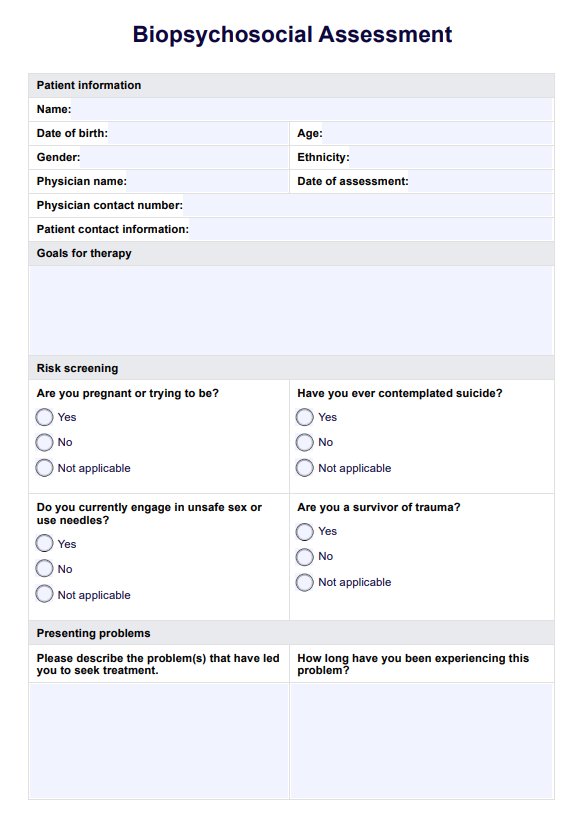
Our Biopsychosocial Assessment template is easy to use, and it is divided into different sections, each focusing on aspects of each domain.
It begins with the clerical information that forms are usually asked from the patient, like their name, age, contact number, etc.
The sections that follow will ask for the following:
- Their goals for therapy
- Risk screening section that asks four specific questions
- Presenting problems they would like to discuss
- Their medical history, including medications they take, if they've been hospitalized before, what allergies they have, etc.
- Information about their psychiatric history, if any, including if their family has had people who've had psychiatric/psychological problems
- Substance abuse/addiction information, if any. If they have a history of substance abuse, they will be asked to indicate the specific substances, when they started using them, and how frequently they use them
- Descriptions of their social/interpersonal relationships
- Information about any developmental problems they've had
- Education, employment, and any legal problems they've been involved in
The patient/client will have enough space to write about all of these things.
Clinicians and social workers can begin incorporating the Biopsychosocial Assessment Template into their practice by following these simple steps:
### **Step 1: Download the PDF**
To get started, download the Biopsychosocial Assessment Template in PDF format using the link provided on this page. You can click on "Use template" to customize it within the Carepatron platform before printing or sending it to clients.
### **Step 2: Provide the template to your client**
The template is designed for clients to complete in their own words. It is recommended that you provide comprehensive Biopsychosocial Assessment questions to clients prior to the initial session, typically as part of the intake process.
Make sure to discuss what they can expect when engaging with the assessment form, then give them enough time and space for them to fill it out.
### **Step 3: Assess completed template**
After the client returns the completed assessment, you should review it carefully. Using clinical judgment and the principles of the biopsychosocial model, you can identify relevant insights that relate to the client's presenting problem and the client's mental health, and discuss these insights accordingly.
You can also determine next steps to take, like specific tests that need to be conducted, what treatments should be provided, etc.
### **Step 4: Store the assessment securely**
The completed assessment may serve as a valuable reference throughout the course of treatment. It should be stored securely and accessibly, as it contains sensitive and confidential patient information.
## **Biopsychosocial Assessments and HIPAA compliance**
Speaking of storing the assessment securely, this is important because this assessment serves as a comprehensive record of the patient/client's biological, psychological, and social factors. These may also include highly sensitive information, such as histories of physical and mental illnesses (personal and family), potential histories of substance abuse/addiction, and past legal trouble. You are obligated to keep all of this confidential. You must discuss the access permissions for the information on this sheet with your client (U.S. Department of Health and Human Services, 2024).
Even if you're not operating in the United States of America, you still need to acknowledge and uphold patient dignity and rights. You can only divulge this information among your colleagues who are handling the same patient, or to whomever the patient designates as okay to have access to the information.
## **References**
Borrell-Carrio, F., Suchman, A., & Epstein, R. (2004). The biopsychosocial model 25 years later: Principles, practice, and scientific inquiry. The Annals of Family Medicine, 2(6), 576–582. https://doi.org/10.1370/afm.245
Huang, E., Edgar, N. E., MacLean, S. E., & Hatcher, S. (2022). Workplace assessment scale: Pilot validation study. International Journal of Environmental Research and Public Health, 19(19), 12408. https://doi.org/10.3390/ijerph191912408
Peterson, A. L., Goodie, J. L., & Andrasik, F. (2015). Introduction to biopsychosocial assessment in clinical health psychology. In F. Andrasik, J. L. Goodie, & A. L. Peterson (Eds.), Biopsychosocial assessment in clinical health psychology (pp. 3–7). The Guilford Press.
U.S. Department of Health and Human Services. (2024). Summary of the HIPAA Security Rule. U.S. Department of Health and Human Services. https://www.hhs.gov/hipaa/for-professionals/security/laws-regulations/index.html
Commonly asked questions
This assessment should be completed upon intake into your practice. This is because it will gather information such as treatment goals and medical history that will be crucial in informing your treatment decisions for your client. Additionally, completing this assessment prior to seeing you will save you both time during your first session.
If some sections are not applicable to your client/patient, they should feel free to skip the question or section that does not apply. Additionally, if they are uncomfortable answering any questions, they should know that it is fine to leave it blank and discuss it in person with you if they prefer.
Yes, you can keep this template digital and distribute it electronically to your client. This saves both of you time scanning and printing, and means your client does not have to come in to return the form in person. Regardless of whether you print out the template or email a digital copy to your client, you are responsible for doing so in a secure manner that will not jeopardize the confidential information they are sharing with you as their mental health practitioner.