









What is the Eysenck Personality Questionnaire?
The Eysenck Personality Questionnaire (EPQ) is a tool used to assess an individual's personality traits. It was developed by psychologists Hans Jürgen Eysenck and Sybil B. G. Eysenck. Eysenck's theory primarily focuses on physiology and genetics.
While Eysenck acknowledged the significance of learned behaviors, he believed that genetic inheritance plays a crucial role in determining personality differences (1982), making temperament his primary area of interest. Although Eysenck's theory is rooted in temperament, he did not entirely dismiss the idea that certain aspects of personality could be learned.
Eysenck's model of personality consists of three key dimensions: E for extraversion/introversion, N for neuroticism/stability, and P for psychoticism/socialization.
Extraversion involves being outgoing and needing external stimulation, while introverts require peace to perform optimally. Neuroticism relates to high levels of negative emotions like anxiety, with neurotic individuals having low activation thresholds, whereas emotionally stable people maintain calm under stress. Psychoticism is linked to traits like aggression and non-conformity, with testosterone levels influencing this dimension. A fourth scale, L, measures social desirability but lacks the same theoretical grounding as the others (Barrett et al., 1998).
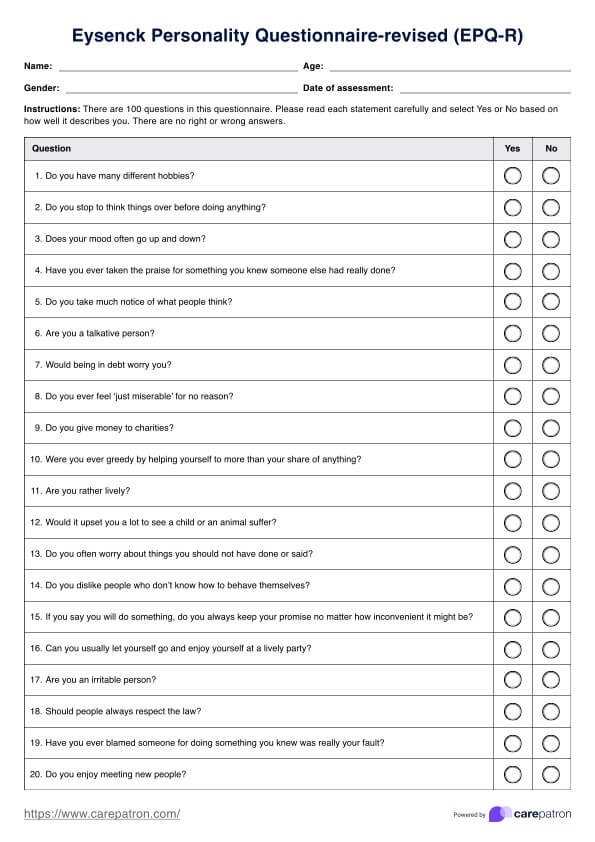
The EPQ has several versions, including the Eysenck Personality Questionnaire-revised (EPQ-R). This form contains 100 questions answered by yes or no with 48 items called EPQR-A or Eysenck Personality Questionnaire-revised abbreviated. The EPQR-A is an abbreviated version consisting of 24 items designed for quicker assessments.









