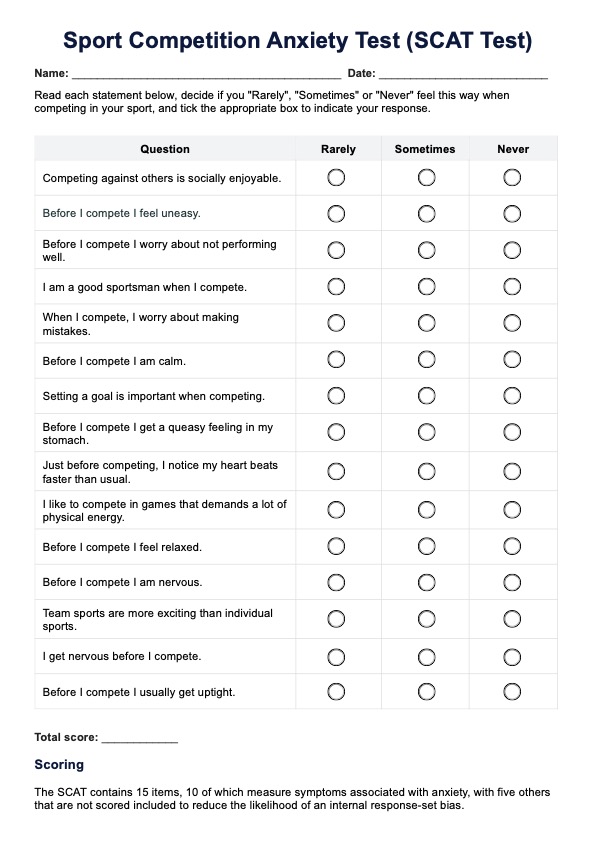
## **What is a Sports Competition Anxiety Test (SCAT Test)?**
The Sport Competition Anxiety Test (SCAT Test) is a psychological assessment designed to measure an athlete's competitive trait anxiety—how prone they are to experiencing anxiety in competitive situations. Developed by Rainer Martens (1977), the SCAT Test evaluates an athlete's tendency to feel nervous, queasy, or worried when faced with sports competition. This anxiety test is crucial for understanding how anxiety can impact sport performance, particularly in both team and individual sports.
The SCAT Test uses a questionnaire format where athletes respond to statements about their feelings in a competitive situation. These answers help determine anxiety levels, identifying whether an athlete has a high or low level predisposition to competitive anxiety. This is important for coaches and individual sports psychologists to understand, as high levels of anxiety can negatively affect physical energy, lead to an increased likelihood of making mistakes, and ultimately hinder performance, especially in team sports.
The SCAT Test scores can guide appropriate training interventions aimed at reducing anxiety and improving performance. Future research continues to explore the connection between SCAT scores and sport performance, making the test an essential tool for athletes, especially those who find team sports socially enjoyable but experience competition anxiety before competitions. The SCAT is also part of broader tools such as the sport anxiety scale and multidimensional sport performance anxiety assessments.
## **How to use our Sport Competition Anxiety Test template**
The Sport Competition Anxiety Test template by Carepatron is a valuable tool for medical professionals looking to assess and manage competitive anxiety in athletes. By following the steps outlined below, you can effectively use this template to understand your athletes' anxiety levels and provide support even during games, without making mistakes.
### **Step 1: Access the template**
To begin, you can easily access the Sport Competition Anxiety Test template within this guide by clicking "Use template." You may also save a PDF version by clicking "Download."
### **Step 2: Review the test template**
Before administering the sports competition anxiety test, take a moment to review the Sports Competition Anxiety Test template. Familiarize yourself with the questionnaire format and the specific questions that assess an athlete's anxiety levels. This will help you explain the process to your athletes and ensure accurate responses from them. Reviewing the structure also minimizes internal response set bias.
### **Step 3: Conduct the test**
With the template reviewed, you're ready to conduct the test. Administer the SCAT Test to your athletes in a calm setting, a non-pressuring environment. Encourage honest responses from athletes to each question. This will lead to a more accurate assessment of their competitive trait anxiety and help them feel relaxed rather than anxious while competing.
### **Step 4: Gather and interpret results**
After the test is completed, gather the results and interpret them using the provided scoring guidelines. Analyze the test scores to identify anxiety levels and notice any patterns in your athletes' responses. Use these insights to tailor appropriate training strategies that address their competitive anxiety, enhancing overall individual sports performance and minimizing somatic anxiety indicators such as heart beats faster, stomach issues, or the urge to withdraw.
## **Scoring**
The Sport Competition Anxiety Test is scored by summing the answers to 10 key items that measure symptoms associated with competitive anxiety. The test includes 15 items in total, five of which are not scored to minimize internal response-set bias.
The summed score provides an overall measure of competitive anxiety, with higher score indicating a greater tendency to experience state anxiety in competitive situations.
- A score below 17 suggests a low level of anxiety
- 17 to 24 reflects an average level
- Above 24 indicates high levels of competition anxiety
To ensure concurrent validity, use the table provided in the SCAT questionnaire to calculate the total score accurately. These ranges allow practitioners to gauge whether an athlete may benefit from sport-specific cognitive techniques or other psychological interventions.
## **Next steps after conducting this test**
After conducting the Sport Competition Anxiety Test, medical professionals should review and interpret the results to determine the athlete's anxiety level. Based on the score, the next step is to develop a tailored intervention plan. For athletes with high levels of anxiety, consider implementing relaxation techniques, practice routines, trait anxiety management, sport performance drills, or cognitive-behavioral strategies. These can help with understanding and managing competition anxiety effectively.
For those with average or low anxiety, monitor their progress and provide ongoing support as needed. Additionally, sharing the results with the athlete can help them understand their responses and motivate them to actively engage in anxiety-reducing practices. Tools like reward systems or simulation drills under time limit pressure can reinforce progress. This process is especially useful for adults participating in competitive sports who may need help performing under pressure.
## **Reference**
Martens, R. (1977). Sport Competition Anxiety Test (SCAT) [Database record]. APA PsycTests. https://doi.org/10.1037/t27556-000