









What is a flow state?
Flow activities refer to tasks that fully absorb an individual’s attention, allowing them to become deeply engaged and focused, often leading to a sense of enjoyment and accomplishment. The concept of flow theory was first introduced by psychologist Mihály Csíkszentmihályi in the 1970s. Flow represents a state of optimal experience, where individuals experience high levels of concentration, a sense of control, and a merging of action and awareness. Over time, flow research has gained popularity in fields like positive psychology, mental health, and self-improvement and is now commonly used in mental health practices to help individuals achieve a sense of fulfillment and reduce anxiety.
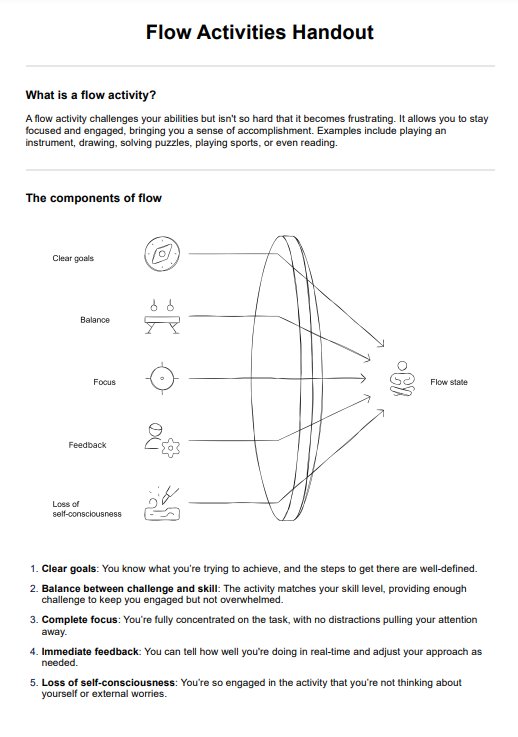
Flow occurs when certain conditions are met. To achieve flow, you need immediate feedback from the activity, a clear goal, and a balance between skill level and challenge. When an individual is in a state of flow, they are completely absorbed in the task, often losing self-consciousness and gaining a sense of personal control. People lose track of time and are fully immersed in the present moment, experiencing an intrinsic sense of joy and satisfaction. This flow experience is driven by intrinsic motivation, meaning the task is engaging in itself rather than being done for external rewards.
In everyday life, psychological flow happens more often than we may realize. Many people experience flow when they get so engrossed in an activity—whether it’s reading, gardening, or playing a sport—that they lose track of time. Simple tasks like solving puzzles or even preparing a meal can trigger flow, providing a rewarding focus. For children, intrinsically rewarding activities like drawing, building with blocks, or exploring imaginative play can lead to a flow experience. Encouraging these moments of flow can have numerous benefits, especially in mental health, where flow helps reduce stress and promote a sense of well-being.









