



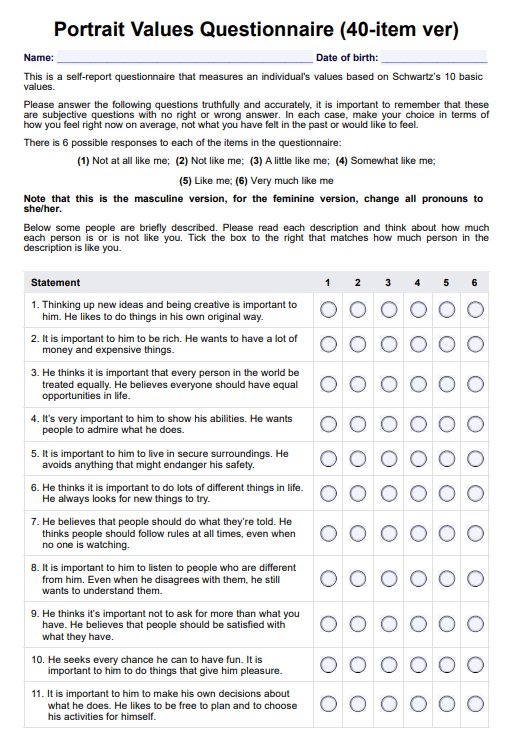



What is a Portrait Values Questionnaire?
The Portrait Values Questionnaire (PVQ) is a psychological assessment tool designed to measure individual values based on Shalom Schwartz's theory of universal human values. It evaluates how individuals prioritize ten core values(Schwartz, 2012):
- Universalism: Understanding and protecting the welfare of humanity and nature.
- Benevolence: Enhancing the welfare of those with whom one is in frequent contact.
- Tradition: Accepting beliefs and practices rooted in cultural or religious heritage.
- Conformity: Restricting actions or impulses that could harm others or violate social norms.
- Security: Promoting safety, harmony, and stability for oneself, others, and society.
- Power: Valuing status, prestige, and control over resources and others.
- Achievement: Demonstrating success and competence according to societal standards.
- Hedonism: Seeking pleasure and gratification of personal desires.
- Stimulation: Pursuing excitement, novelty, and a stimulating life.
- Self-Direction: Emphasizing independence and freedom to explore and define one’s path.
Schwartz initially created the Schwartz Value Survey (SVS) to measure these values. However, the SVS faced criticism due to its reliance on abstract concepts, which required respondents to interpret complex ideas. To address this limitation, Schwartz developed the Portrait Values Questionnaire, which focuses on cross-cultural applicability and implicit value measurement.
The PVQ consists of 40 items, each reflecting a specific value through relatable descriptions. Participants rate how similar they feel to the described person, using phrases like "lives an exciting life," "treats everyone equally," or "behaves properly." This approach minimizes the need for abstract reasoning and reduces response bias. There is also a 21-item modified version, developed to measure participants' values, which inferred from their self-reports of how similar they were to individuals described in portraits (Sandy et al., 2017).
The PVQ organizes these ten values into four higher-order value categories that guide individual decision-making:
- Self-transcendence: Universalism and Benevolence.
- Self-enhancement: Achievement and Power.
- Openness to change: Hedonism, Self-Direction, and Stimulation.
- Conservation: Conformity, Tradition, and Security.









