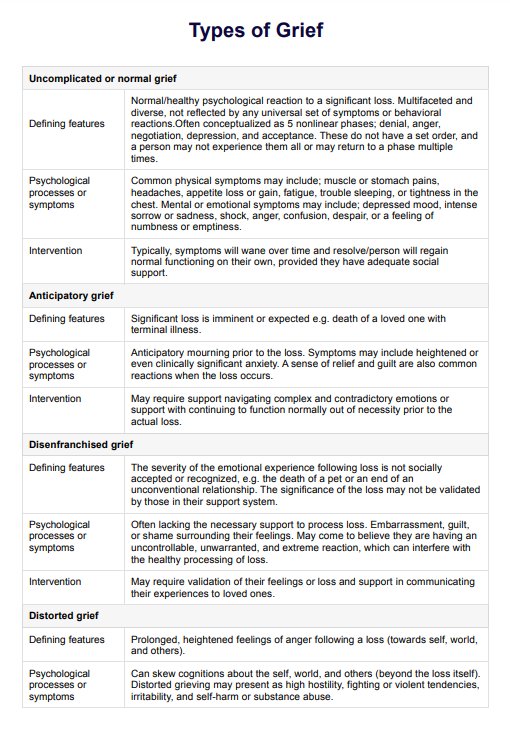
Types of grief
Grief counseling involves identifying the type of grief reaction the client is experiencing to help guide them through their complex emotions. Here are some of the common clinical contexts and presentations of grieving:
Normal grief
The normal (or uncomplicated) grief experience following significant loss is multifaceted and diverse and is not reflected by any universal set of symptoms or behavioral reactions. Often the normal grieving process is characterized as having multiple stages, including denial, anger, bargaining, depression and acceptance. In experiencing grief, one will likely pass some or all of these in a non-linear way.
Anticipatory grief
Anticipatory grief affects those for whom significant loss is imminent or expected. In these cases, (for example, anticipating the death of a family member with a terminal illness), the grieving individual begins anticipatory mourning before the loss has occurred.
Anticipatory grief symptoms may include heightened or even clinically significant anxiety. Feeling a sense of relief and guilt are also common reactions when the loss inevitably occurs.
Disenfranchised grief
Disenfranchised grief occurs in contexts where the severity of the emotional experience following loss is not socially accepted or recognized. This is common after the death of a pet or the end of an unconventional relationship, in which the significance of an individual's loss may not be recognized by those in their support system.
In these cases, the grieving individual often lacks the support necessary to process their loss. They may also feel embarrassment, guilt or shame surrounding their feelings. People whose grief is not validated often come to believe they are having an uncontrollable and extreme reaction, which can interfere with the healthy processing of loss.
Distorted grief
Distorted grief is associated with prolonged, heightened feelings of anger. These can skew cognitions about the self, world and others (beyond the loss itself). Distorted grieving may present as high hostility, fighting or violent tendencies, irritability, and self-harm or substance abuse.
Complicated grief
When intense feelings of grief over a prolonged period interfere with the grieving person's ability to function, this is known as complicated or prolonged grief. It is often accompanied by concerning maladaptive behaviors such as substance abuse, as well as rumination, self-blame, and difficulty accepting the loss or moving on.
Complicated grief is more common in individuals with a history of mental health struggles as they may lack the psychological buffer necessary to cope with difficult events. Prolonged grief disorder requires a clinical diagnosis.
Chronic grief
Chronic grief reactions are similar to complicated grief in that they are also associated with an extended period of mourning. When experiencing chronic grief, people will often present with continuous symptoms that do not reduce with time. In some cases, the individual may intentionally prevent themselves from feeling better as a way to uphold the memory or avoid letting go of the deceased. Complicated grief symptoms may overlap with those of chronic grief.
Abbreviated grief
Unlike chronic grief, abbreviated grief refers to contexts in which the grieving period seems abnormally short or appears to end abruptly in a way that is not proportionate to the significance of the loss. This may occur if the individual in mourning has found an alternative to processing their loss, e.g. remarrying soon after being widowed.
Often this indicates a reluctance to contend with psychological or emotional discomfort and can result in tension with others who were also impacted by the loss, such as family members. If a brief mourning period is the result of finding a distraction from the loss, it may progress into delayed grief later.
Absent grief
Absent grief occurs when the expected feelings associated with mourning are not experienced. This can be a form of complicated grief, and can present as emotional numbness, feeling disconnected, or relief after the loss.
Delayed grief
Delayed grieving processes may occur weeks, months or years after the event. Also called inhibited grief, this can occur when the mind defers processing loss until it has the resources or time, or if the loss results in initial shock that interrupts typical grief onset.
Traumatic grief
Traumatic grief occurs when loss is sudden, violent, or in an extremely distressing context, e.g. a natural disaster, witnessing a loved one pass violently, or the unexpected death of a child. Symptoms may overlap with post-traumatic stress disorder.
Ambiguous grief
Ambiguous grief is associated with contexts in which a loss is unresolved, such as when a loved one goes missing. Unexpected loss and uncertainty can simultaneously create feelings of hope and despair, which are difficult to navigate and often will not resolve. Building resiliency is the key therapeutic focus for those in ambiguous mourning.
Cumulative grief
When losses or distressing life events succeed one another before the individual can process them, this can result in compounded or cumulative grief. This can be associated with desensitization towards loss or normalization of sadness, skewing how the individual sees the world and preventing them from recovering.