









What is the Basic I.D. model?
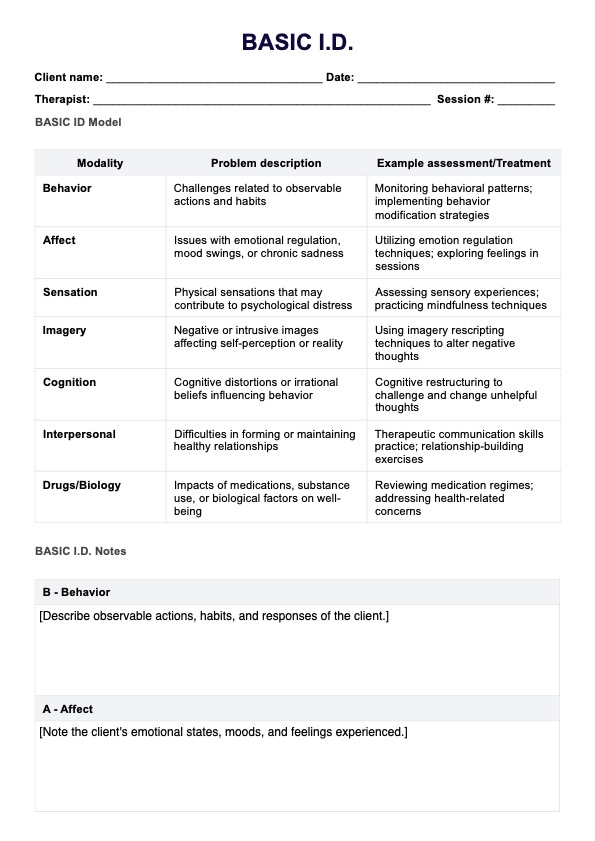
The Basic I.D. Model is a cornerstone of multimodal therapy developed by Arnold Lazarus as a comprehensive approach to psychotherapy and behavior therapy. This model posits that human functioning can be understood and addressed through seven interconnected modalities: Behavior, Affect, Sensation, Imagery, Cognition, Interpersonal relationships, and Drugs/Biology (Lazarus, 1989).
Multimodal therapists utilize this framework to conduct a thorough multimodal assessment, ensuring that all aspects of a client's experience are considered in treatment planning. The model emphasizes that individuals are complex beings whose problems often span multiple modalities and interpersonal behaviors, necessitating a comprehensive problem identification sequence.
Comprehensive therapy calls for addressing significant issues across all seven modalities of the Basic I.D. For instance, when treating chronic pain, a multimodal therapist might examine behavioral responses, emotional impact, sensory experiences, negative or intrusive images, cognitive patterns, effects on interpersonal relationships, and biological factors, including medication.
The model suggests that while all modalities are important, the biological modality forms the base of a conceptual pyramid, with the interpersonal modality at the apex (Rose et al., 2010). This highlights the significance of physiological and social factors in human functioning. By systematically assessing how a person responds across these dimensions, multimodal therapy aims to provide a more comprehensive and effective approach to psychotherapy.









