


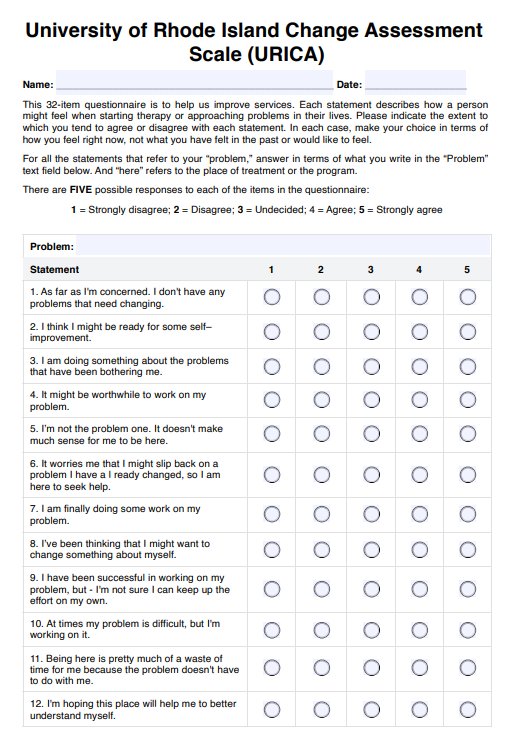




What is the URICA Assessment?
The University of Rhode Island Change Assessment (URICA) scale, or URICA Assessment, is a 32-item self-assessment tool designed to measure an individual's readiness to change specific behaviors. Rooted in the transtheoretical model (TTM) of behavior change, the URICA assesses an individual's current stage in the change process, which is helpful in therapeutic and counseling contexts. This model outlines a sequence of stages people typically experience when modifying behaviors.
Initially, the URICA aimed to assess five stages: Pre-contemplation, Contemplation, Determination, Action/Active Change, and Maintenance. However, after further study, it was found that the Determination stage did not reliably load as a factor, so it was removed from the final measure (McConnaughy, 1981). Currently, the URICA assesses four stages:
- Pre-contemplation (PC): The individual is not considering change and may not recognize a need for it.
- Contemplation (C): The person is aware of the need for change and may be thinking about it but is not yet ready to commit.
- Action/Active Change (A): Active steps are being taken to change the behavior.
- Maintenance (M): The individual is struggling to maintain the behavior change and may find it challenging to uphold their new behavior consistently.
Widely used as a research tool, the URICA scale asks individuals to respond to statements that reflect common attitudes or feelings they may experience when beginning therapy or addressing personal challenges. Responses indicate the degree to which each statement applies to the individual at this moment rather than in the past or as they would like to feel.
When completing the URICA, individuals answer in terms of a specific “problem” identified in a designated text field. Any references to “here” pertain to the current place of treatment or the program they are engaged with.









