




What is the Vancouver Index of Acculturation?
Understanding the interplay between mainstream American values and heritage culture traditions is crucial for assessing the acculturation process of migrants. Mainstream American culture often emphasizes individualism (Rosenbaum, 2018; Zakaras, 2022), equality, and liberty, fostering a sense of belonging to a broader national identity. In contrast, heritage culture traditions focus on community, familial ties, and the preservation of historical practices, offering a sense of continuity and identity for migrants.
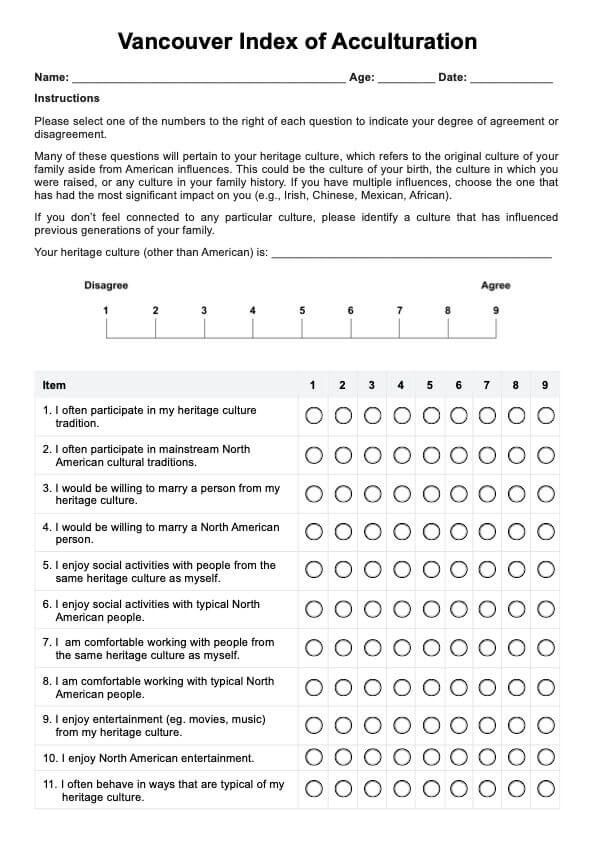
The Vancouver Index of Acculturation (VIA) is a self-report tool designed to evaluate acculturation, particularly among migrants. Developed by Ryder, Alden, and Paulhus in 2000, the VIA employs a bi-dimensional framework that distinguishes between adopting cultural practices from the host culture and preserving traditions related to one's heritage culture.
Comprising 20 items, the VIA evaluates two primary dimensions:
- Heritage acculturation: This dimension examines how deeply individuals engage with and uphold their original cultural practices and values.
- Mainstream acculturation: This dimension assesses the degree to which individuals integrate and adapt to the practices and values of the host culture.
Participants express their level of agreement with a series of statements regarding their cultural behaviors and preferences, enabling researchers to effectively measure their acculturation journey.
The psychometric properties of the VIA have been validated across various cultural contexts, demonstrating strong reliability, with Cronbach's alpha coefficients of 0.79 for Heritage and 0.75 for Mainstream (Ryder et al., 2000; Testa et al., 2019). Additionally, it exhibits measurement invariance across demographic groups, including gender and age.









