## **What is cognitive impairment?**
Cognitive impairment refers to a decline in mental abilities that affects memory, thinking, reasoning, attention, or language skills. Cognitive impairment ranges from mild to severe and can interfere with daily activities (Dhakal & Bobrin, 2023). Unlike normal age-related changes, cognitive impairment has a significant impact on a person's ability to function independently.
Cognitive impairment develops through various pathways. It may result from neurodegenerative diseases like Alzheimer's disease and Parkinson's disease dementia, vascular conditions such as stroke, traumatic brain injury, infections, medication side effects, or metabolic disorders. Mild cognitive impairment (MCI) represents an intermediate stage between normal cognitive function and dementia, where dementia patients experience noticeable cognitive decline but can still manage most daily activities independently.
Key characteristics of cognitive impairment or cognitive decline include difficulty remembering recent events, trouble concentrating or making decisions, confusion about time or place, problems with language or communication, and challenges with planning or problem-solving. Early detection, especially among elderly patients, through psychological assessment resources is critical, as timely intervention can help slow progression, improve quality of life, and allow patients and families to plan for future care needs.
## **What is the Mini-Mental State Examination?**
The Mini-Mental State Examination (MMSE), also known as the Folstein test, was developed by Marshal Folstein and colleagues in 1975 as a practical method for grading the cognitive state of patients. It is a brief test that assesses cognitive impairment, such as trouble understanding, thinking, concentrating, or remembering, that can affect an individual's daily life.
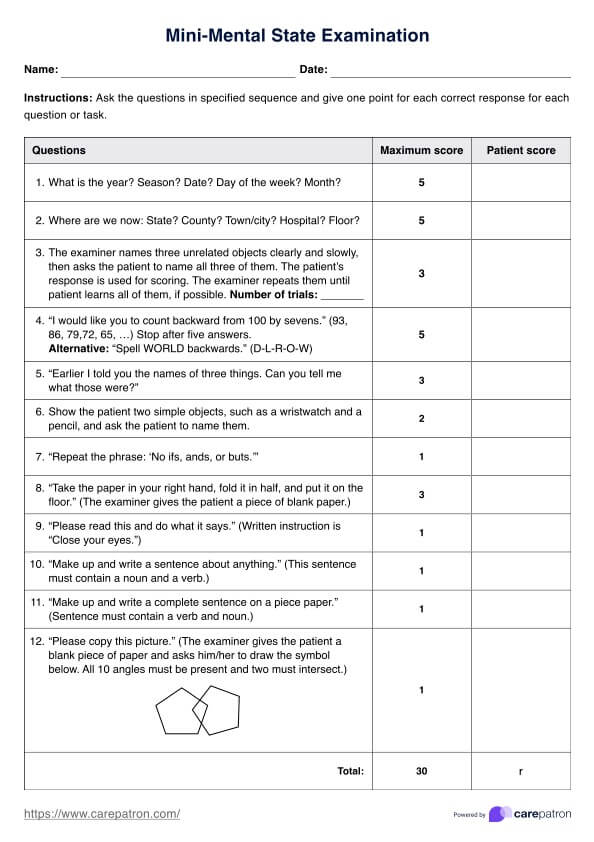
The test takes about 5 to 10 minutes to administer and contains 11 questions that assess the following areas:
- Memorizing and recalling a list of items
- Composing short sentences with proper grammar
- Replicating a specific drawing from the examination
- Recognizing the current day, date, month, year, and season accurately
- Identifying their current location
Health professionals, like practitioners of geriatric psychiatry, use the MMSE test as an initial assessment tool when dementia or cognitive decline is suspected. It serves multiple purposes in clinical practice, including routine cognitive status screening for older adults at risk, evaluation for suspected dementia, monitoring changes in patients with known severe impairments such as Alzheimer's disease, pre-operative and post-operative assessment, and distinguishing between delirium and dementia.
The mental state examination provides valuable baseline data that guides a healthcare professional in determining whether further evaluation or further tests are necessary. This is especially important for the cognitively impaired and those with possible psychiatric disorders.
### **Evidence supporting MMSE**
The Mini-Mental State Exam has been extensively validated through decades of research and remains one of the most widely studied cognitive assessment tools in clinical settings. A 2024 study published in Psychogeriatrics examined the validity of the MMSE and its individual domains. It confirmed strong psychometric properties, including diagnostic validity across orientation, memory, attention, and language components (Truong et al., 2024).
It has also been adapted and validated across diverse cultural contexts worldwide. A comprehensive review examined 45 years of MMSE use in Ibero-America, highlighting both its widespread adoption and the importance of cultural and educational considerations when interpreting scores (Gallegos et al., 2022).
However, the MMSE should never be the sole basis for diagnosing dementia and other disorders. It is recommended to use the MMSE in conjunction with comprehensive clinical evaluation, patient history, physical examination, laboratory tests, and neuroimaging when appropriate to detect dementia. Other tests, such as the [Montreal Cognitive Assessment (MoCA](https://www.carepatron.com/files/moca-test.pdf)), Clock Drawing Test, or other dementia tests, may provide complementary information on cognitive performance, especially for detecting early or mild cognitive impairment.
## **How to use our Mini-Mental State Examination PDF template**
The Mini-Mental Status Exam can seem overwhelming, so we've made it easier to understand by providing an example. Here's a step-by-step guide outlining how to use this printable assessment in your clinical practice.
### **Step 1: Download the PDF**
Download the Mini-Mental State Examination PDF to your device to get started. You can click on "Use template" to open and edit it within the Carepatron website, or "Download" to get a PDF copy.
### **Step 2: Brief your clients**
Explain the purpose of the examination to your clients so they know what to expect.
### **Step 3: Conduct the examination**
Practitioners can use this screening test during an online or in-person session. It is also editable online, so you can store your clients' records digitally.
### **Step 4: Analyze the results**
Determine the client's MMSE score. The MMSE has a maximum total score of 30, and a score less than 24 could indicate cognitive impairment.
## **How do you score a Mini-Mental State Examination?**
The Mini-Mental State Examination is a tool designed to evaluate a patient's cognitive state and function quickly. The test comprises a series of questions and tasks that target key cognitive domains, with each section contributing to a cumulative maximum score of 30 points.
### **Scoring the MMSE**
The scoring process is straightforward, with specified points allotted to each component of the test:
- **Orientation (10 points)**: This section assesses a patient's orientation to time (5 points) and place (5 points), with each correct piece of information earning a point.
- **Registration (3 points)**: The clinician states three unrelated objects clearly and slowly, after which the patient repeats them back correctly to earn points.
- **Attention and calculation (5 points)**: The patient is asked to subtract 7 from 100 continuously down to 65, with each correct subtraction earning a point. Alternatively, the patient can be asked to spell "world" backward.
- **Recall (3 points)**: This involves remembering and correctly repeating the three unrelated objects stated in the registration section.
- **Language and praxis (9 points)**: This section assesses multiple domains, including naming objects, following verbal and written instructions, writing a sentence spontaneously, and instructing them to copy and draw polygon shapes (1 point each).
### **Interpreting the score**
Scores range from 0 to 30, with a higher total score indicating better cognitive function. The most commonly used cut-off for normal cognitive functioning is a score of 24 out of 30, with lower scores indicating cognitive impairment or possible cognitive disorders. MMSE scores are commonly interpreted as follows:
- **24-30**: No cognitive impairment
- **18-23**: Mild cognitive impairment
- **0-17**: Severe cognitive impairment
It is essential to consider the individual's age, educational level, and other relevant factors when interpreting MMSE scores. This may also be interpreted in light of results from other common cognitive tests, such as the Montreal Cognitive Assessment, or in relation to their neuropsychological test performance.
### **References**
Dhakal, A., & Bobrin, B. D. (2023). Cognitive deficits. PubMed; StatPearls Publishing. https://www.ncbi.nlm.nih.gov/books/NBK559052/
Gallegos, M., Morgan, M. L., Cervigni, M., Martino, P., Murray, J., Calandra, M., Razumovskiy, A., Caycho-Rodríguez, T., & Gallegos, W. L. A. (2022). 45 years of the mini-mental state examination (MMSE): A perspective from Ibero-America. Dementia & Neuropsychologia, 16(4), 384–387. https://doi.org/10.1590/1980-5764-DN-2021-0097
Folstein, M. F., Folstein, S. E., & McHugh, P. R. (1975). Mini-mental state: A practical method for grading the cognitive state of patients for the clinician. Journal of Psychiatric Research, 12(3), 189-198. https://doi.org/10.1016/0022-3956(75)90026-6
Truong, Q. C., Cervin, M., Choo, C. C., Numbers, K., Bentvelzen, A. C., Kochan, N. A., Brodaty, H., Sachdev, P. S., & Medvedev, O. N. (2024). Examining the validity of the Mini-Mental State Examination (MMSE) and its domains using network analysis. Psychogeriatrics, 24(2), 259–271. https://doi.org/10.1111/psyg.13069
Commonly asked questions
The Mini-Mental State Examination (MMSE) is a brief, 30-point questionnaire used to screen for cognitive impairment, covering areas like orientation, registration (recalling three words), attention and calculation (like subtracting seven serially from 100), recall (remembering the three words), and language (naming objects, following commands, writing a sentence, and copying a design). The examiner must adhere strictly to standardized instructions for both asking the questions and scoring, which typically takes about 5 to 10 minutes.
The MMSE is designed for simplicity and can be administered by a wide range of individuals in the healthcare and research fields, including physicians, nurses, psychologists, social workers, and trained medical students or research workers, provided they are familiar with and strictly follow the standardized instructions and scoring procedures.
The MMSE is considered a reasonably good screening tool for moderate to severe cognitive impairment, but it is not a definitive diagnostic test for dementia or Alzheimer's disease on its own. Its accuracy varies depending on the setting and the population, generally showing better accuracy at ruling out dementia in primary care and community settings, and better case-finding ability in specialist settings.