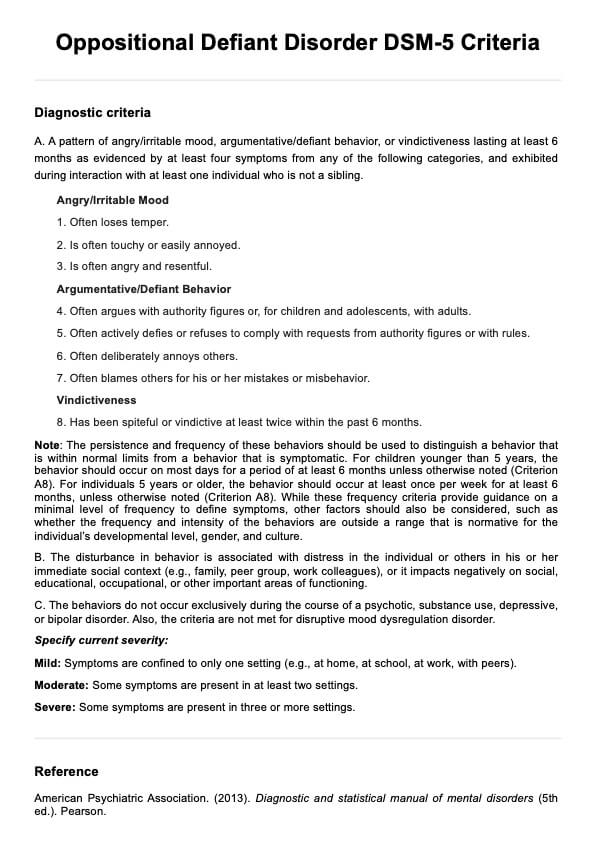
DSM-5 oppositional defiant disorder diagnostic criteria
The following criteria must be noted for an individual to be diagnosed with oppositional defiant disorder:
A. A pattern of angry/irritable mood, argumentative/defiant behavior, or vindictiveness lasting at least 6 months as evidenced by at least four symptoms from any of the following categories, and exhibited during interaction with at least one individual who is not a sibling.
- Often loses temper.
- Is often touchy or easily annoyed.
- Is often angry and resentful.
- Often argues with authority figures or, for children and adolescents, with adults.
- Often actively defies or refuses to comply with requests from authority figures or with rules.
- Often deliberately annoys others.
- Often blames others for his or her mistakes or misbehavior.
- Has been spiteful or vindictive at least twice within the past 6 months.
Note: The persistence and frequency of these behaviors should be used to distinguish a behavior that is within normal limits from a behavior that is symptomatic. For children younger than 5 years, the behavior should occur on most days for a period of at least 6 months unless otherwise noted (Criterion A8).
For individuals 5 years or older, the behavior should occur at least once per week for at least 6 months, unless otherwise noted (Criterion A8). While these frequency criteria provide guidance on a minimal level of frequency to define symptoms, other factors should also be considered, such as whether the frequency and intensity of the behaviors are outside a range that is normative for the individual’s developmental level, gender, and culture.
B. The disturbance in behavior is associated with distress in the individual or others in his or her immediate social context (e.g., family, peer group, work colleagues), or it impacts negatively on social, educational, occupational, or other important areas of functioning.
C. The behaviors do not occur exclusively during the course of a psychotic, substance use, depressive, or bipolar disorder. Also, the criteria are not met for disruptive mood dysregulation disorder.
Specify current severity:
- Mild: Symptoms are confined to only one setting (e.g., at home, at school, at work, with peers).
- Moderate: Some symptoms are present in at least two settings.
- Severe: Some symptoms are present in three or more settings.
Differences between the DSM-4 and DSM-5 criteria
The DSM-5 has introduced four key updates to the diagnostic criteria for ODD (American Psychiatric Association, 2013b):
- Symptom categorization: The symptoms are now organized into three distinct groups: angry/irritable mood, argumentative/defiant behavior, and vindictiveness. This restructuring emphasizes that ODD encompasses both emotional and behavioral components.
- Conduct disorder coexistence: The previous exclusion of conduct disorder has been eliminated, recognizing that these conditions can co-occur.
- Frequency guidance: The criteria now include guidelines on the frequency required for a behavior to be considered clinically significant, acknowledging that some ODD-like behaviors are common in typical development.
- Severity rating: A new severity scale has been incorporated based on research indicating that the extent to which symptoms manifest across different settings is a crucial indicator of the disorder's intensity.