


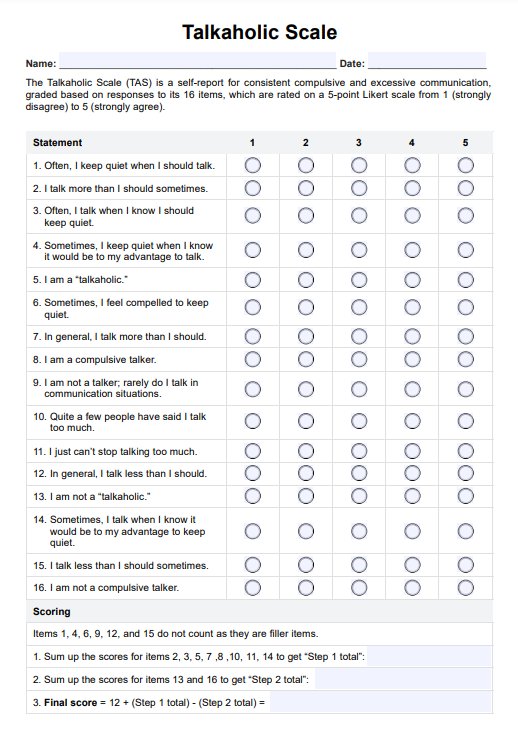




What is the Talkaholic Scale?
Talkaholism refers to compulsive and excessive talking, where an individual feels a constant urge to speak, often at the expense of listening or considering social cues. People with talkaholism may dominate conversations, interrupt others frequently, and struggle to stay quiet even when it would be appropriate to do so. This behavior can strain relationships, create social awkwardness, and lead to challenges in professional and personal environments.
For unaware talkaholics, it may feel normal to speak at length without pausing, making it difficult to recognize the issue. Often, it’s not until others point it out or the consequences become apparent that individuals realize the extent of their behavior. This is where the Talkaholic Scale comes in.
The Talkaholic Scale (TAS) was developed by communication research scholars James C. McCroskey and Virginia P. Richmond as a way to identify and quantify talkaholism. This self-report tool consists of 16 items, each rated on a 5-point Likert scale from "strongly disagree" to "strongly agree." The scale measures different aspects of compulsive talking, such as the inability to remain silent, the frequency of dominating conversations, and the awareness of others' reactions to excessive talking (McCroskey & Richmond, 1993; McCroskey & Richmond, 2009).
The results help clinicians and communication researchers assess the severity of talkaholism and guide interventions to manage this behavior. Identifying talkaholism early through the Talkaholic Scale can help prevent its long-term effects, such as social isolation, damaged relationships, and professional setbacks.









