Global Developmental Delay DSM-5 Criteria
The Diagnostic and Statistical Manual of Mental Disorders, Fifth Edition (DSM-5) indicates the following for the diagnosis of GDD:
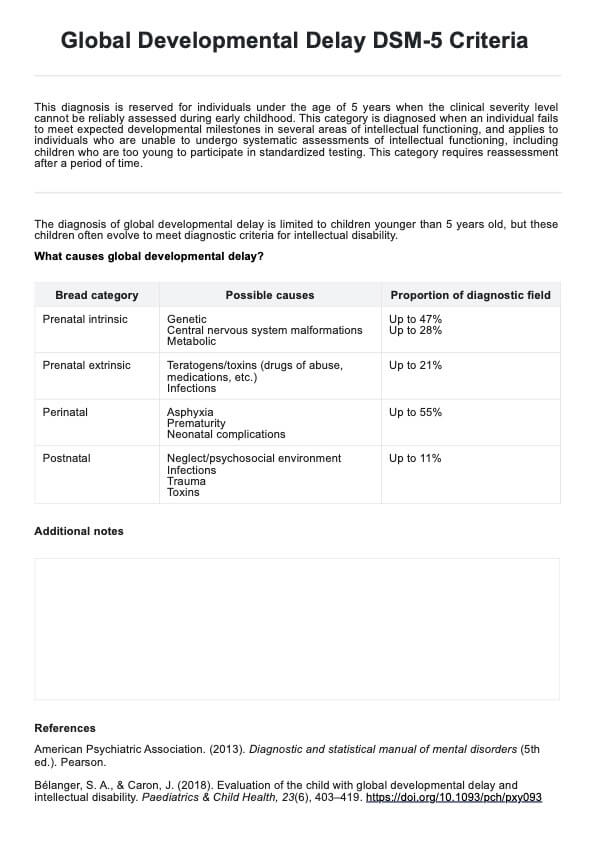
This diagnosis is reserved for individuals under the age of 5 years when the clinical severity level cannot be reliably assessed during early childhood. This category is diagnosed when an individual fails to meet expected developmental milestones in several areas of intellectual functioning, and applies to individuals who are unable to undergo systematic assessments of intellectual functioning, including children who are too young to participate in standardized testing. This category requires reassessment after a period of time.
While the DSM-5 doesn't provide specific criteria, GDD is considered under neurodevelopmental disorders. It's important to note that GDD is typically used as a temporary diagnosis for children under 5, pending further diagnostic evaluation as the child develops.
For children under 5 years of age, where standardized intelligence testing may not be reliable, clinicians use the term Global Developmental Delay when a child fails to meet expected developmental milestones in multiple areas. This diagnosis requires comprehensive clinical assessment and may serve as a provisional diagnosis until a more specific determination can be made.
Our Global Developmental Delay DSM-5 Criteria is designed as a reference tool that you can use as a handout when educating clients or patients.
Differences between the DSM-4 and DSM-5 criteria
The transition from the Diagnostic and Statistical Manual of Mental Disorders, Fourth Edition (DSM-IV) to the Fifth Edition brought significant changes in the conceptualization and diagnosis of developmental disorders. These changes are particularly relevant for understanding GDD and related conditions (American Psychiatric Association, 2013b):
- Terminology: The DSM-5 replaced the term "mental retardation" used in DSM-IV with "intellectual disability (intellectual developmental disorder)." This change reflects a more respectful and less stigmatizing approach to diagnosis.
- Diagnostic criteria: While the DSM-IV focused primarily on IQ scores for diagnosis, the DSM-5 emphasizes both intellectual and adaptive functioning. This shift allows for a more comprehensive assessment of an individual's abilities and challenges.
Disorders associated with global developmental delays
Global Developmental Delay is also often associated with various underlying conditions and developmental disorders. Understanding these associations is crucial for comprehensive care and management. Some of the commonly associated disorders include:
- Intellectual developmental disorder: GDD in early childhood may progress to intellectual disability as the child ages. The DSM-5 defines intellectual disabilities as deficits in both intellectual and adaptive functioning.
- Autism spectrum disorder: Children with GDD may also show features of autism spectrum disorder, including difficulties in social communication and restricted repetitive behaviors.
- Metabolic disorders: Inborn errors of metabolism can lead to GDD. Examples include phenylketonuria and hypothyroidism.
- Sensory impairments: Vision and hearing problems can contribute to developmental delays and may coexist with GDD.
- Communication disorders: Speech and language delays are often part of GDD but can also be separate diagnoses.