
Medial collateral ligament (MCL) injuries affect the band of tissue on the inner side of the knee that connects the femur to the tibia. MCL injuries occur when this ligament is partially or completely torn due to forceful external rotation of the knee joint or direct trauma to the lateral knee.
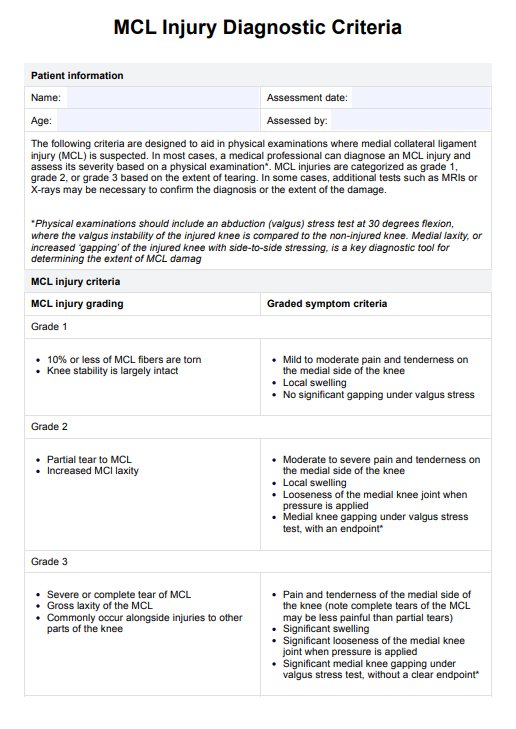



MCL Injury Diagnostic Criteria
Access a helpful MCL Injury Diagnostic Criteria template for evaluating MCL injuries.
Use Template
MCL Injury Diagnostic Criteria Template
Commonly asked questions
MCL injuries can typically be diagnosed during a physical examination, during which a doctor or physical therapist assesses a patient's pain, mobility, and medial laxity of the knee. When more severe MCL injuries are suspected, physicians typically conduct MRI or ultrasound scanning to assess the extent of the knee injury.
Grade 1 MCL injuries are less severe and will typically heal within a few weeks with adequate care as most of the connective fibers of the MCL are intact. Grade 2 indicates a partial tear of the MCL has occurred, while grade 3 indicates a severe or complete tear. These injuries take longer to heal, are associated with significant knee instability, and may require surgery.










EHR and practice management software
Get started for free
*No credit card required
Free
$0/usd
Unlimited clients
Telehealth
1GB of storage
Client portal text
Automated billing and online payments