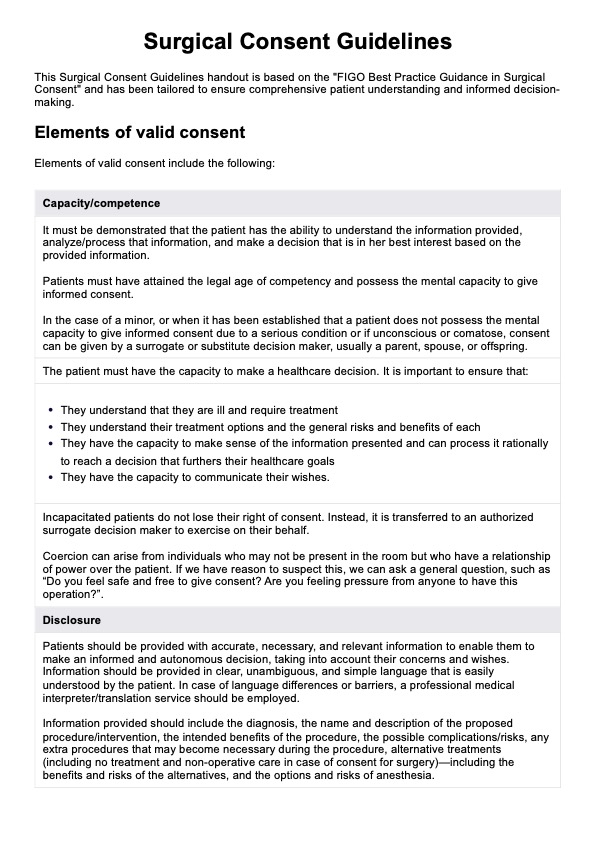
Surgical Consent Guidelines
There are various elements that need to be considered by the physician when obtaining surgical consent. These include (Topcu, et al., 2023):
Competence/capacity
It is important to assess the patient's ability to understand relevant medical information and the implications of treatment alternatives and to make an independent, voluntary decision. Patients must be both the legal age of competency and possess the mental capacity to do so. In the cases where patients are not able to provide consent, this is passed onto a surrogate or substitute decision make, typically a parent, spouse or offspring.
Disclosure
Patients should receive clear, relevant information to make informed, autonomous decisions that reflect their concerns and wishes. Communication should be simple and easy to understand, and if language barriers arise, a professional interpreter should be used.
Patients should be informed about their diagnosis, the specific medical intervention or procedure, its risks and benefits, possible additional procedures, alternative treatments (including no treatment), and anesthesia options with their associated risks.
While it's not practical to cover every possible risk, the most common and serious ones must be clearly explained. Patients need this information to make informed decisions, and physicians should focus on risks that are either frequent or significant.
Understanding
Ensure the patient understands by asking them to summarize the information and providing time for questions. Address any gaps in their understanding by clarifying and repeating key points as needed.
Voluntariness
Patients should be free to make voluntary decisions without pressure or coercion. Consent should be a process, not a one-time event, allowing time for discussion and reflection—unless it's an emergency. Patients can withdraw consent at any point before the medical treatment, and this must be respected.
Physicians may strongly recommend treatment, but coercion—using threats—is never acceptable. If a patient refuses a high-risk procedure, it’s important to document their decision.
Document informed consent
All discussions should be thoroughly documented in the patient’s records. Consent is finalized by the patient signing a standardized consent form, which should be supplemented with any relevant details. Any objections to specific instruments or additional procedures should also be clearly noted in the form.
In situations where a decision must be made urgently, such as an emergency, a patient typically cannot participate in decision-making (Topcu et al., 2023). If the surrogate is not available, physicians are able to initiate treatment prior to receiving informed consent, given that the treatment is needed, and waiting would put the patient's life at further risk.
In an emergency situation, it is crucial that the physician informs the patient/surrogate at the earliest moment and obtains consent for any ongoing treatment (Topcu et al., 2023).