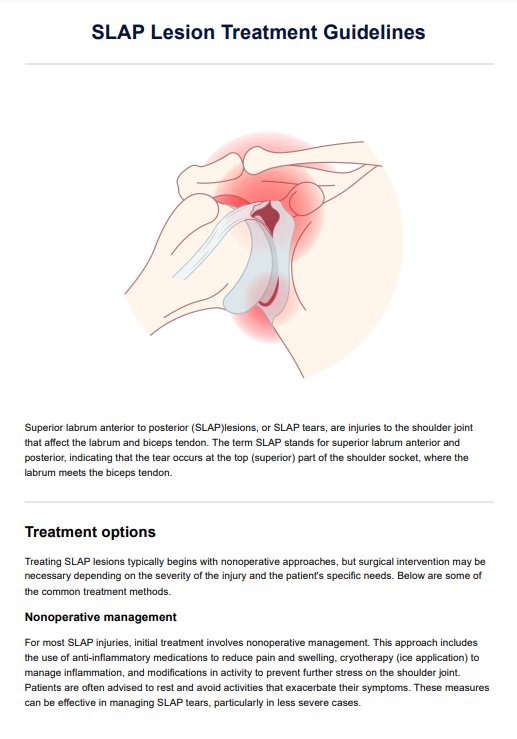
How do healthcare professionals treat SLAP lesions?
Treating SLAP lesions typically begins with nonoperative approaches, but surgical intervention may be necessary depending on the severity of the injury and the patient's specific needs. Below are some of the common treatment methods that are minimally invasive techniques.
Nonoperative management
For most SLAP injuries, initial treatment involves nonoperative management. This approach includes the use of anti-inflammatory medications to reduce pain and swelling, cryotherapy (ice application) to manage inflammation, and modifications in activity to prevent further stress on the shoulder joint. Patients are often advised to rest and avoid activities that exacerbate their symptoms. These measures can be effective in managing labrum tears, particularly in less severe cases.
Surgical treatment
When conservative management proves ineffective, surgical intervention becomes necessary. The choice of surgical technique varies based on the type of SLAP lesion:
- Type I lesions: Characterized by fraying of the labrum, these are typically treated through debridement, where damaged tissue is removed to create a stable edge.
- Type II lesions: The most prevalent type, these lesions frequently require arthroscopic repair. This procedure involves reattaching the labrum to the glenoid using sutures or suture anchors to restore stability.
- Type III lesions: These lesions present with a bucket-handle tear of the labrum, which is usually excised, and the remaining labrum is smoothed to ensure stability.
- Type IV lesions: Involving the biceps tendon, treatment may include tenotomy (cutting the tendon) or tenodesis (reattaching the tendon at a different site), in conjunction with labral repair, based on the severity of tendon damage.
Surgical procedures are generally performed arthroscopically, allowing for smaller incisions and a quicker recovery time. The selected technique is influenced by various factors, including the patient's age, activity level, and the presence of other shoulder injuries.
Physical therapy management
Physical therapy management is essential for patients recovering from SLAP lesions. For individuals with Type I SLAP lesions, conservative treatment may be sufficient. This typically begins with a cessation of throwing activities and a short course of anti-inflammatory medication to reduce pain and inflammation. Once pain subsides, physical therapy program focuses on restoring normal shoulder motion and strengthening the shoulder girdle musculature, which is critical for maintaining proper shoulder biomechanics.
Postoperative rehabilitation
For patients undergoing SLAP repair, postoperative rehabilitation varies based on the type of SLAP lesion and the specific surgical procedure performed. Initially, the patient's shoulder is immobilized in internal rotation using a sling. The following is a general guideline for postoperative rehabilitation:
- Week 0 to 3: The shoulder remains immobilized, with external rotation and abduction limited to 60°. Patients can perform pendulum exercises and elbow range-of-motion exercises.
- Week 4 to 8: Sling use is discontinued, and shoulder motion is gradually increased using active-assisted and passive techniques. External rotation is limited to 30° to minimize strain on the labrum, while internal and external rotation activities progress to 90° of shoulder abduction.
- Week 8: Resistance exercises focusing on scapular strengthening can be initiated, provided the patient has achieved approximately 115° to 120° of shoulder external rotation. Resisted biceps tendon activities are prohibited for two months to protect the healing of the biceps tendon anchor.
- Week 16: A sport-directed throwing program can commence for overhead athletes, focusing on exercises such as forward flexion in a side-lying position, prone extension, seated rowing, and serratus punch (protraction with the elbow extended).
- Week 24: Patients can generally return to contact sports, depending on their progress and recovery.