Exercises for bicep tendonitis
Exercises play a crucial role in managing biceps tendonitis by reducing pain, improving strength, and restoring flexibility to the affected shoulder. Gentle stretching exercises can help alleviate stiffness and improve the range of motion while strengthening exercises target the surrounding muscles to support the tendon and reduce strain during movement.
Healthcare professionals can use the following exercises to help patients recover from biceps tendonitis. These exercises aim to reduce pain, improve shoulder mobility, and strengthen the surrounding muscles to prevent future injuries:
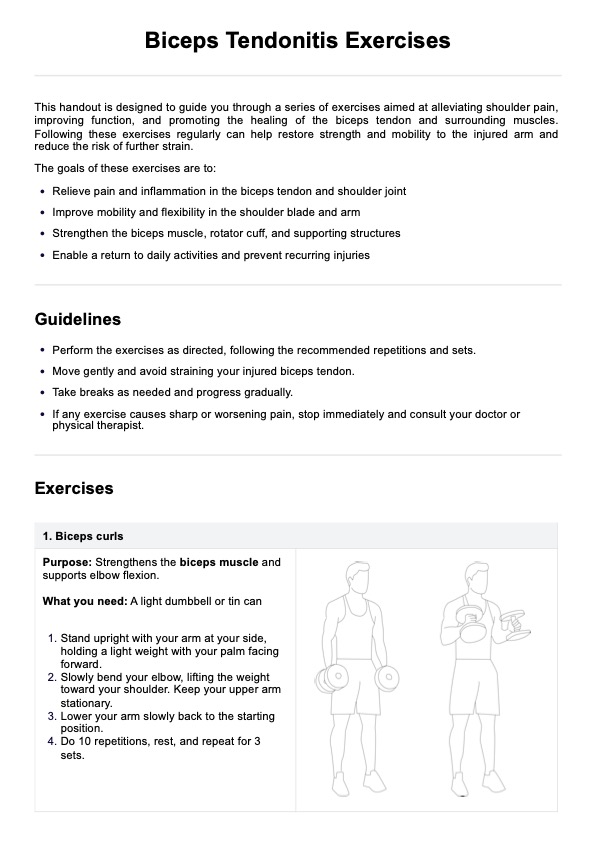
1. Biceps curls
Stand the patient upright with the affected arm resting by their side, holding a lightweight such as a dumbbell or tin can with their palm facing forward. Instruct the patient to keep their upper arm stationary and slowly bend their elbow, lifting the weight toward their shoulder. Once the weight reaches the top, have them lower it back to the starting position in a controlled manner. Repeat this 10 times, completing 3 sets with rest periods in between. Emphasize slow, controlled movements to avoid straining the tendon.
2. Biceps stretch
Have the patient stand facing a wall about 6 inches away, with their arm raised to the side at shoulder height. Instruct them to rotate their hand forward so their thumb touches the wall and their palm faces downward. Guide the patient to gently twist their body away from the raised arm until they feel a stretch in the biceps. Hold this position for 15 seconds, then return to the starting position. Repeat the stretch 3 times, ensuring they do not pull the shoulder backward to prevent overstretching.
3. Shoulder flexion
Position the patient standing upright with their arm resting by their side and palm facing their thigh. Instruct them to slowly lift the arm straight in front of their body until their fingers point toward the ceiling. Once the arm is raised, have them hold the position for 5 seconds before lowering it back down to the starting position. Encourage the patient to perform 10 repetitions per set, with 3 sets spread throughout the day. Advise them to avoid reaching overhead or backward, which may irritate the tendon.
4. Shoulder internal rotation
Provide the patient with a towel and instruct them to drape it over their non-injured shoulder, holding one end with their non-injured hand. Have them reach behind their back with the injured arm and grasp the other end of the towel. Instruct the patient to use their non-injured hand to gently pull the towel upward, stretching the injured shoulder. Hold the stretch for 30 seconds, then release and return to the starting position. Repeat this exercise twice daily, ensuring the stretch is gentle and pain-free.
5. Shoulder external rotation
Equip the patient with a resistance band and instruct them to hold it with both hands, elbows bent at 90 degrees and tucked into their sides. Guide them to slowly pull the band outward by rotating their shoulders, keeping the elbows stationary. Once they reach their limit, have them return to the starting position in a controlled motion. Instruct the patient to perform 10 repetitions per set, completing 3 sets daily. This exercise helps strengthen the rotator cuff and stabilize the shoulder joint.
6. Forearm supination and pronation
Position the patient with their arms at their sides, elbows bent at a 90-degree angle, and palms facing downward. Instruct them to rotate their forearm so their palm faces upward, holding the position for 5 seconds before returning to the starting position. Have them alternate between these positions for 10 repetitions per set and complete 3 sets throughout the day. This exercise enhances forearm flexibility and reduces strain on the biceps tendon.
7. Shoulder circle crossover
Have the patient stand with their arms extended to the sides and palms facing forward. Instruct them to squeeze their shoulder blades together and slowly move their arms back slightly. Guide them to lift their arms upward, turning their palms forward, until their hands cross horizontally in front of their body. Once in this position, have them reverse the motion until their palms face backward behind them. Repeat this exercise 3–6 times, completing 1–2 sets. Emphasize maintaining good posture and avoiding overextension of the shoulders.