How do healthcare professionals treat cavovarus feet?
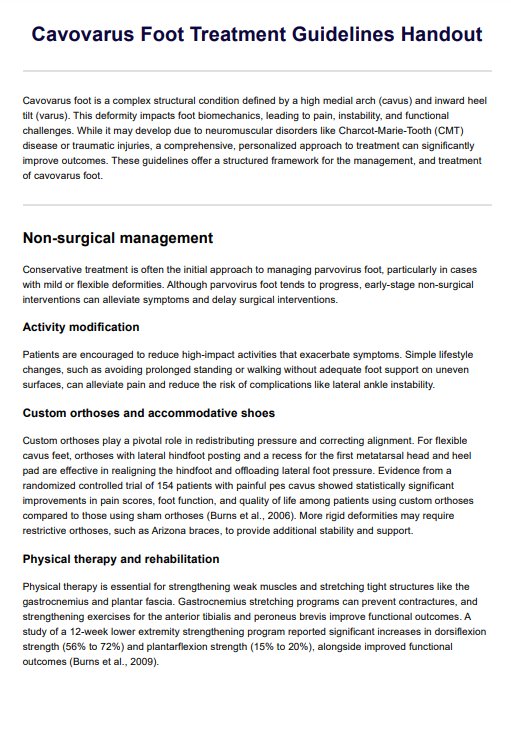
The management of cavovarus feet is tailored to relieve symptoms, enhance function, and correct structural abnormalities, with an individualized approach based on the deformity's severity and flexibility. Treatment typically progresses from conservative measures to surgical interventions as needed. This overview highlights five key treatment strategies discussed in clinical guidelines, providing a comprehensive framework for patient care.
Conservative treatments
The first line of management focuses on nonoperative measures designed to alleviate pain, maintain function, and delay the need for surgical intervention.
Orthotic devices, such as custom shoe inserts or arch supports, are critical in redistributing plantar pressure and improving foot alignment. Physical therapy complements orthotic use by targeting specific muscle groups: stretching tight structures like the plantar fascia and Achilles tendon while strengthening weaker muscles, such as the peroneus brevis, to enhance balance and mobility. Anti-inflammatory medications, including non-steroidal anti-inflammatory drugs (NSAIDs), are often prescribed to manage pain and swelling.
While conservative treatments cannot correct the underlying deformity, they provide significant symptom relief, particularly for mild or flexible cases, as supported by clinical studies.
Soft-tissue release
When conservative methods fail to provide adequate relief and the deformity remains flexible, soft-tissue release becomes a key intervention. Procedures such as plantar fasciotomy or Achilles tendon lengthening are employed to alleviate contractures and improve range of motion. These minimally invasive techniques focus on restoring flexibility and preparing the foot for further corrective measures. Soft-tissue release is frequently combined with other interventions, such as tendon transfers or bony reconstruction, to optimize outcomes and prevent recurrence.
Soft tissue balancing techniques
Tendon transfers are particularly effective in addressing muscle imbalances and dynamic deformities associated with cavovarus feet. These procedures involve redirecting tendons to new positions to restore functional balance:
- Posterior tibial tendon transfer: Relocates the tendon laterally to counteract hindfoot varus and reduce inward heel rolling.
- Peroneus longus to brevis transfer: Addresses forefoot imbalances by reducing plantarflexion forces on the first ray and enhancing lateral stability.
Tendon transfers are most successful when the deformity is flexible, and the affected muscles retain adequate strength to adapt to their new roles. They are often combined with soft tissue releases or bony reconstruction for comprehensive correction.
Bony reconstruction
In severe or rigid deformities, bony reconstruction is required to correct structural misalignments and restore a plantigrade, functional foot. Techniques include:
- Osteotomies: Procedures such as dorsiflexion wedge osteotomies for forefoot deformities and calcaneal osteotomies for hindfoot realignment reshape and reposition bones to correct angular deformities.
- Arthrodesis: Joint fusion procedures, including double or triple arthrodesis, are reserved for cases with significant joint damage or arthritis, stabilizing the foot while eliminating pain.
Bony reconstruction is highly individualized, with the surgical plan guided by imaging studies and the deformity's characteristics. For complex cases, a combination of osteotomies and arthrodesis may be required to achieve optimal outcomes.
Comprehensive, personalized care
Treatment of cavovarus feet is most effective when guided by a personalized approach that considers the patient’s functional needs, deformity severity, and underlying etiology. By combining these strategies—conservative management, soft-tissue release, tendon transfers, and bony reconstruction—healthcare professionals can achieve significant improvements in pain relief, alignment, and mobility, tailoring interventions to the unique challenges posed by each patient’s condition.