Body Dysmorphic Disorder DSM-5 diagnostic criteria
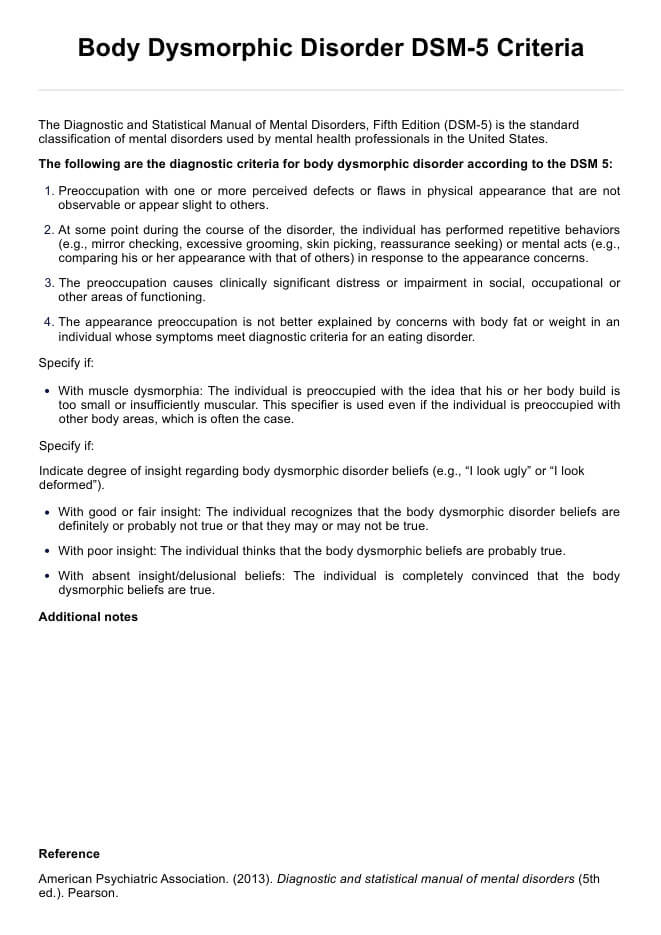
The Diagnostic and Statistical Manual of Mental Disorders, Fifth Edition (DSM-5) is the standard classification of mental disorders used by mental health professionals in the United States (American Psychiatric Association, 2013a). The following are the diagnostic criteria for body dysmorphic disorder according to the DSM-5:
A. Preoccupation with one or more perceived defects or flaws in physical appearance that are not observable or appear slight to others.
B. At some point during the course of the disorder, the individual has performed repetitive behaviors (e.g., mirror checking, excessive grooming, skin picking, reassurance seeking) or mental acts (e.g., comparing his or her appearance with that of others) in response to the appearance concerns.
C. The preoccupation causes clinically significant distress or impairment in social, occupational, or other areas of functioning.
D. The appearance preoccupation is not better explained by concerns with body fat or weight in an individual whose symptoms meet diagnostic criteria for an eating disorder.
Specify if:
- With muscle dysmorphia: The individual is preoccupied with the idea that his or her body build is too small or insufficiently muscular. This specifier is used even if the individual is preoccupied with other body areas, which is often the case.
Specify if:
Indicate degree of insight regarding body dysmorphic disorder beliefs (e.g., "I look ugly" or "I look deformed").
- With good or fair insight: The individual recognizes that the body dysmorphic disorder beliefs are definitely or probably not true or that they may or may not be true.
- With poor insight: The individual thinks that the body dysmorphic beliefs are probably true.
- With absent insight/delusional beliefs: The individual is completely convinced that the body dysmorphic beliefs are true.
Differences between the DSM-4 and DSM-5 criteria
DSM-4 only outlines three criteria, and BDD is classified under somatoform disorders. In DSM-5, body dysmorphic disorder includes new criteria for repetitive behaviors (criteria B) in response to appearance concerns, reflecting their significance in diagnosis.
Unlike in DSM-4, the new edition introduces a specifier for "muscle dysmorphia" to acknowledge its clinical relevance. The delusional variant now falls under a specific specifier for absent insight/delusional beliefs, distinct from somatic delusions (American Psychiatric Association, 2013b; Substance Abuse and Mental Health Services Administration, 2016).