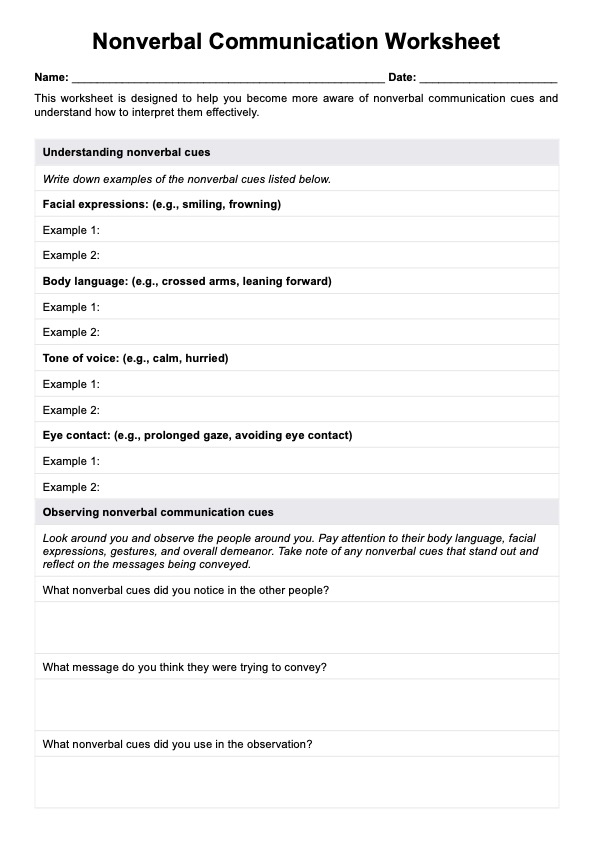
How to improve nonverbal communication skills
Nonverbal communication skills can be challenging for some people to enhance because they involve subtle behaviors and cues that may not always be easy to recognize or control. Here are some tips you can give your clients to help them improve their nonverbal communication skills:
Encourage awareness of body language
Help your clients become more mindful of their own body language, as it plays a crucial role in communication, often conveying messages even when spoken or written words are not used. Nonverbal cues like posture, gestures, and facial expressions can send powerful messages, whether intentional or not. For clients who find it challenging to control their body language, encourage them to first observe their default behaviors. Suggest that they focus on adopting an open posture—such as sitting with shoulders back and avoiding crossed arms—which can make them appear more approachable and engaged.
By incorporating these communication techniques, clients can begin to send positive nonverbal signals that enhance their overall interactions. Over time, this awareness will help them adjust their body language more consciously, improving their ability to communicate effectively without relying solely on spoken or written words.
Focus on eye contact
For many people, maintaining the right amount of eye contact can be tricky. Some clients may find it uncomfortable or intimidating, while others may struggle with making eye contact at all. Remind them that eye contact is a key way to show attentiveness and respect, but it’s important to strike a balance. Too little eye contact can make them seem disinterested or evasive, while too much can feel confrontational.
Guide them to practice maintaining eye contact for a few seconds at a time, gradually increasing as they become more comfortable. The goal is to find a natural rhythm that matches the conversation’s tone.
Modulate tone of voice
Your clients’ tone of voice plays a significant role in how their messages are received. Sometimes, they may not even be aware that their tone might be conveying something different from what they intend. Encourage them to practice varying their tone depending on the situation. For example, a calm and steady tone is suitable for sensitive conversations, while a more energetic tone works well in positive or casual exchanges.
You can suggest that they practice in front of a mirror or record themselves speaking to better understand how their tone comes across and how it can be adjusted to improve communication.
Observe others' nonverbal cues
Many clients may struggle with interpreting others’ nonverbal communication, which can sometimes lead to misunderstandings. Encourage your clients to actively observe others’ body language, facial expressions, and tone of voice during their interactions. They can look for signs of discomfort, interest, agreement, or disagreement in the way others express themselves.
This practice helps build empathy and can make your clients more responsive and in tune with others’ emotions, improving their communication skills in social and professional settings.
Practice active listening
Active listening is not just about hearing what someone is saying; it’s about understanding the message and responding appropriately. Clients who are focused on their own nonverbal communication may find it difficult to give their full attention to others. Suggest that they use their own body language to signal attentiveness, such as nodding occasionally, leaning forward, or maintaining eye contact. These nonverbal cues not only show they are listening but also encourage the speaker to open up and feel heard.