




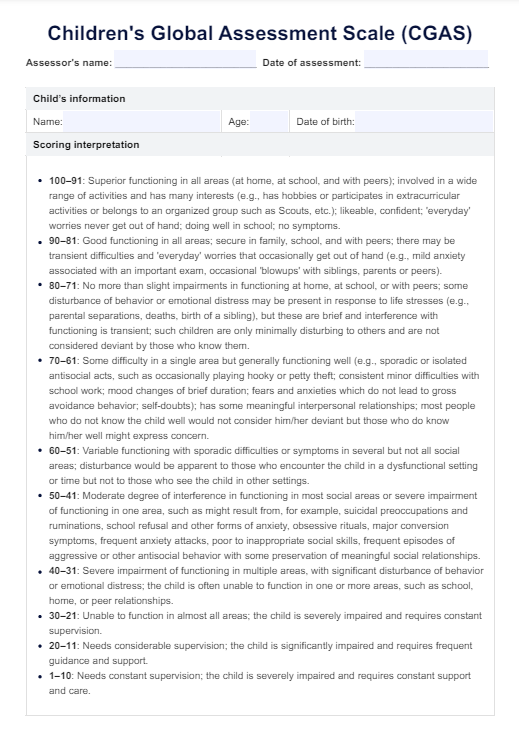




What is the Children's Global Assessment Scale (CGAS)?
The Children's Global Assessment Scale (CGAS) is a widely recognized tool adapted from the Global Assessment Scale for adults, specifically designed to assess the general functioning of children and adolescents aged 4-16 years. Developed by Shaffer and colleagues at Columbia University's Department of Psychiatry, the CGAS offers a practical method for clinicians to gauge young individuals' psychological and social functioning.
Functioning on a scale from 1 to 100, the CGAS classifies children into one of ten distinct categories. These range from "needs constant supervision" for scores between 1 and 10, indicative of extremely impaired functioning, to "superior functioning" for scores between 91 and 100, where the child exhibits exceptional adaptability across all areas of life, including home, school, and peer interactions.
The assessment considers several key facets of a child's life, ensuring a comprehensive evaluation. Clinicians utilize this scale to determine a child's lowest level of functioning during a specified time frame, typically the preceding month. This approach helps identify various levels of need—from "constant supervision" to "superior functioning"—enabling targeted interventions suited to the child's
Variants of the CGAS exist to address specific populations and needs. The Developmental Disability CGAS (DD-CGAS) is adapted for children with developmental disabilities, providing a more tailored assessment for this group. The Parent-Infant Relationship Global Assessment Scale (PIRGAS) focuses on evaluating the quality of the relationship between parents and their infants, highlighting relational dynamics that can impact early development.
How are the results interpreted?
Interpreting the CGAS involves a detailed analysis of the score assigned by the clinician, which reflects the child's overall ability to function across different environments. The score is determined based on the child's lowest level of functioning during the assessment period. Here is a simplified form:
- 1-10: Needs constant supervision due to severe challenges like self-destructive behaviour or major disruption in basic cognitive processes.
- 11-20: Needs considerable supervision to ensure safety and manage behaviors that may pose risks.
- 21-30: Severe impairment; it is nearly impossible for the child to engage in most daily activities without significant support.
- 31-40: Major impairment in several areas, requiring specific interventions to manage dysfunction.
- 41-50: Obvious problems manifest as noticeable disruptions in social interactions or personal care.
- 51-60: Noticeable problems where the child shows variable functioning with sporadic difficulties.
- 61-70: Some problems in one area but generally manages well with minor issues.
- 71-80: Doing alright, with only slight impairments noticed.
- 81-90: Good functioning in all areas with only transient difficulties.
- 91-100: Superior functioning with the child excelling in personal, social, and educational aspects.
Using the CGAS relies heavily on the examiner's clinical expertise to determine the appropriate score based on the descriptors for each 10-point interval. If you want the detailed descriptions for each category, please refer to our template.









