Everyone has a story to tell, and here we share and celebrate those who chose care as their life's work.
These are their words, their work and we're grateful to share them.
Elizabeth and Dennis handed their billing to Carepatron and grew My Therapeutic Concepts from five clients to seventy in two months, without losing their evenings.
Looking for exercises to teach patients who are recovering from meniscus tears? Read our guide to learn more about this common knee injury. Then, download our Meniscus Rehab Exercises Handout for you and your patient so you both have a reference to use during rehabilitation at work and at home.
## **What are meniscus tears?**
A meniscus tear is a common knee injury, affecting the C-shaped cartilage that acts as a shock absorber between the shinbone and thigh bone (Johns Hopkins Medicine, 2022).
The tear is typically caused by a forceful twisting or rotation of the knee, especially while bearing full weight on the leg, as seen in activities like aggressive pivoting in sports (Cleveland Clinic, 2016). However, tears can also be degenerative, resulting from the natural wear and tear that weakens the cartilage over time, making it susceptible to tearing from minor actions like an awkward twist when getting up from a chair (Wittstein, 2025).
The causes themselves (the injury event or the process of aging/degeneration) are not permanent, but the resulting tear in the cartilage is a structural injury that often has a limited ability to heal on its own, especially in the inner, less blood-supplied area (the "white zone") (University of Washington Medicine, 2025). This limited healing potential means the tear often requires medical intervention, like physical therapy or surgery, to resolve the symptoms and prevent long-term complications.
The problems caused by a torn meniscus stem from its disruption of the knee's normal function. Common symptoms include pain, swelling, and stiffness, particularly when twisting or rotating the knee. More mechanically disruptive issues involve the sensation of the knee catching, clicking, or locking, which occurs when a piece of the torn cartilage gets lodged in the joint (University of Washington Medicine, 2025).
If left untreated, a persistent tear can lead to knee instability and accelerate the wear and tear on the joint surfaces, significantly increasing the long-term risk of developing osteoarthritis (University of Washington Medicine, 2025). Timely diagnosis and appropriate treatment—which can range from rest and physical therapy to surgical repair or removal of the damaged tissue—are essential to restore knee function and mitigate these long-term issues.
## **What are Meniscus Rehab Exercises?**
Meniscus tear rehabilitation, whether post-surgical or for conservative management, is a phased protocol focused on progressively restoring the knee's function, stability, and strength. The goal is to strengthen the muscles to absorb shock and stabilize the knee, thereby reducing load on the damaged meniscus and mitigating the long-term risk of conditions like osteoarthritis.
Regularly performing meniscus rehab exercises offers numerous benefits for patients recovering from a meniscus tear:
- **Pain reduction**: Gentle exercises help reduce knee pain and swelling by promoting circulation and reducing stiffness.
- **Improved range of motion**: Exercises like heel slides and wall squats gradually improve knee flexibility and [range of motion](https://www.carepatron.com/templates/range-of-motion-assessment/).
- **Strengthened muscles**: Exercises targeting the quadriceps, hamstrings, and calf muscles help support the knee joint and improve stability.
- **Faster recovery**: A structured exercise program helps patients recover more quickly and safely, reducing re-injury risk.
- **Improved function**: As strength and flexibility improve, patients can more easily and confidently return to their daily activities and sports.
Meniscus tear rehabilitation exercises should begin as soon as safely possible, often starting with gentle, low-impact movements within the first few days, even immediately after surgery. The timeline is highly dependent on whether the injury is managed conservatively or surgically, but the initial focus is on minimizing swelling and performing basic exercises like ankle pumps and quadriceps activation holds.
Here are some exercises to guide your patients through, whether for a specific condition or rehabilitation:
### **Quad sets**
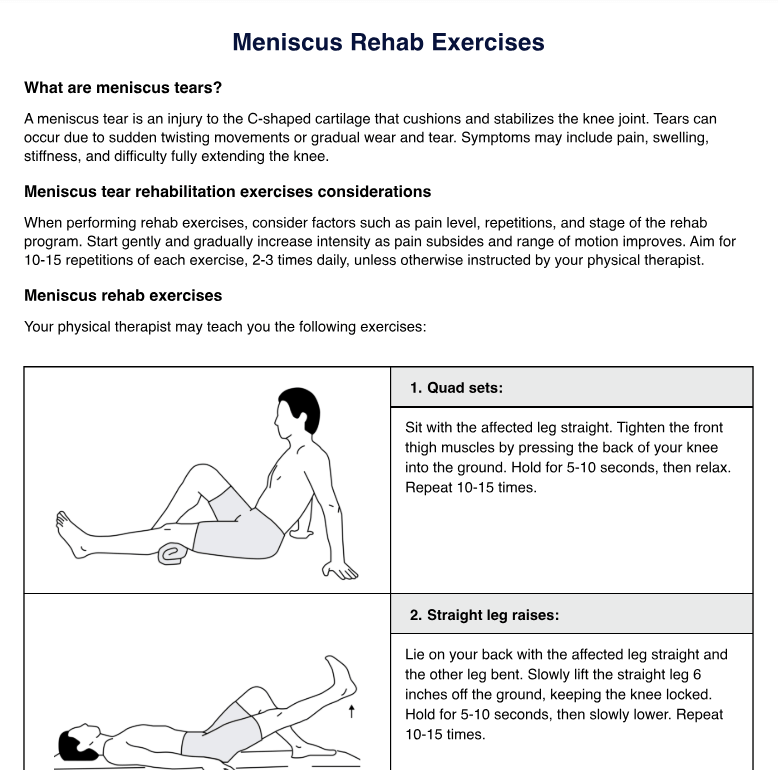
Instruct the patient to sit with their affected leg straight. They should tighten the muscles on the front of their thigh by pressing the back of their knee into the ground. Ask them to hold this position for 5-10 seconds before relaxing. Recommend repeating this movement 10-15 times to strengthen the quadriceps and improve knee stability.
### **Straight leg raises**
Have the patient lie on their back with the affected leg straight and the other leg bent. They should slowly lift the straight leg about 6 inches off the ground, keeping the knee locked. After holding this position for 5-10 seconds, they can slowly lower the leg back down. Suggest repeating this exercise 10-15 times to enhance the strength of the hip flexors and quadriceps.
### **Heel slides**
Ask the patient to lie on their back with both legs straight. They should slowly bend the affected knee, sliding the heel towards the buttocks. Once the knee is bent, they should hold this position for 5-10 seconds before gradually straightening the leg. Encourage them to perform this movement 10-15 times to improve knee flexion and range of motion.
### **Step-ups**
Have the patient stand in front of a low step. They should step onto the platform with the affected leg, maintain balance and control, and slowly step back to the starting position. Recommend repeating this exercise 10-15 times to build strength in the quadriceps, hamstrings, and glutes.
### **Wall squats**
Ask the patient to stand with their back against a wall, with their feet shoulder-width apart. They should slowly slide down the wall, bending their knees to about 45 degrees. After holding this position for 5-10 seconds, they can gradually slide back to the starting position. Suggest repeating this exercise 10-15 times to strengthen the quadriceps and improve knee stability.
### **Calf raises**
Instruct the patient to stand with their feet shoulder-width apart. They should rise onto their toes, lift their heels off the ground, and slowly lower back down. Recommend performing this movement 10-15 times to strengthen the calf muscles and improve ankle stability.
### **Hamstring curls**
Have the patient stand while holding a chair for balance. They should bend the affected knee, bringing the heel towards the buttocks. After holding this position for 5-10 seconds, they can slowly lower the leg back down. Suggest repeating this exercise 10-15 times to strengthen the hamstrings and enhance knee flexibility.
### **Meniscus tear rehabilitation exercises considerations**
When asking your patients to do meniscus tear exercises, you must consider several factors: pain level, the number of repetitions, and the current stage of the rehabilitation program. Begin with gentle exercises and gradually increase their intensity as your patient's pain decreases and their range of motion improves.
As you advance through the stages of rehab and meniscus tear recovery, progressively incorporate more challenging exercises to continue strengthening the knee and enhancing mobility.
## **What is a Meniscus Rehab Exercises Handout?**
Our Meniscus Rehab Exercises Handout is designed for physical therapists to provide patients with a comprehensive at-home exercise program. Print out the handout and review each exercise with your patient, demonstrating proper form and technique. Advise patients on the recommended repetitions, frequency, and progression of exercises based on their individual needs and stage of rehab. Encourage patients to track their progress and report any pain or difficulties.
## **How do we use our Meniscus Rehab Exercises Handout?**
Our Meniscus Rehab Exercises Handout is designed for physical therapists to provide patients with a comprehensive at-home exercise program. It has a visual of the exercise the patient can use as a reference, instructions on how to do the exercise, how long to maintain the position, and how many repetitions.
Physical therapists and other healthcare professionals can benefit from using our Meniscus Rehab Exercises Handout in several ways:
- **Saves time**: A pre-made, customizable handout template saves valuable time when creating exercise programs from scratch.
- **Ensures consistency**: Standardized handouts ensure that all patients receive consistent, high-quality care and instruction.
- **Enhances patient education**: A professional, easy-to-follow handout helps patients better understand and engage with their rehab program.
- **Improves outcomes**: By providing patients with a structured, evidence-based exercise program, professionals can help improve patient outcomes and satisfaction.
Follow these steps to utilize the handout effectively:
### **Step 1: Print the handout**
Ensure you have a printed copy of the handout ready for your patient.
### **Step 2: Review each exercise**
Go through each exercise on the handout with your patient. Demonstrate proper form and technique to ensure they understand how to perform the exercises correctly.
### **Step 3: Advise on repetitions and frequency**
Provide specific recommendations on the number of repetitions and frequency of each exercise. Tailor these instructions to the patient's individual needs and stage of rehab.
### **Step 4: Discuss progression**
Explain how and when to increase the intensity or difficulty of the exercises as the patient progresses through rehabilitation.
### **Step 5: Follow up**
Schedule regular check-ins to review the patient's progress, address any concerns, and update their exercise regimen as needed.
## **References**
Cleveland Clinic. (2016, December 22). Torn meniscus: Causes, symptoms, treatment & prevention. https://my.clevelandclinic.org/health/diseases/17219-torn-meniscus
Johns Hopkins Medicine (2022, February 11). Torn meniscus. https://www.hopkinsmedicine.org/health/conditions-and-diseases/torn-meniscus
University of Washington Medicine. (2025) Torn meniscus. https://orthop.washington.edu/patient-care/articles/sports/torn-meniscus.html#:~:text=A%20torn%20meniscus%20can%20prevent,a%20%22giving%20way%22%20sensation.
Wittstein, J. R. (2025). Meniscus tears. American Academy of Orthopaedic Surgeons. https://orthoinfo.aaos.org/en/diseases--conditions/meniscus-tears/#:~:text=These%20can%20occur%20through%20either,tear%20in%20an%20aging%20meniscus.
Commonly asked questions
A comprehensive meniscus rehab program typically incorporates a variety of exercises targeting muscle strengthening, flexibility, and functional movement. Examples include quad sets, leg raises, heel slides, step-ups, wall squats, calf raises, and hamstring curls.
Patients should perform meniscus rehab exercises regularly, typically 2-3 times daily, following specific repetitions and sets prescribed by their physical therapist. The frequency may vary based on individual patient needs and the rehabilitation stage.
Yes, many meniscus rehab exercises can be safely performed at home with proper instruction and guidance from a physical therapist. It's essential to ensure patients understand the correct technique and know any modifications necessary to prevent injury.