
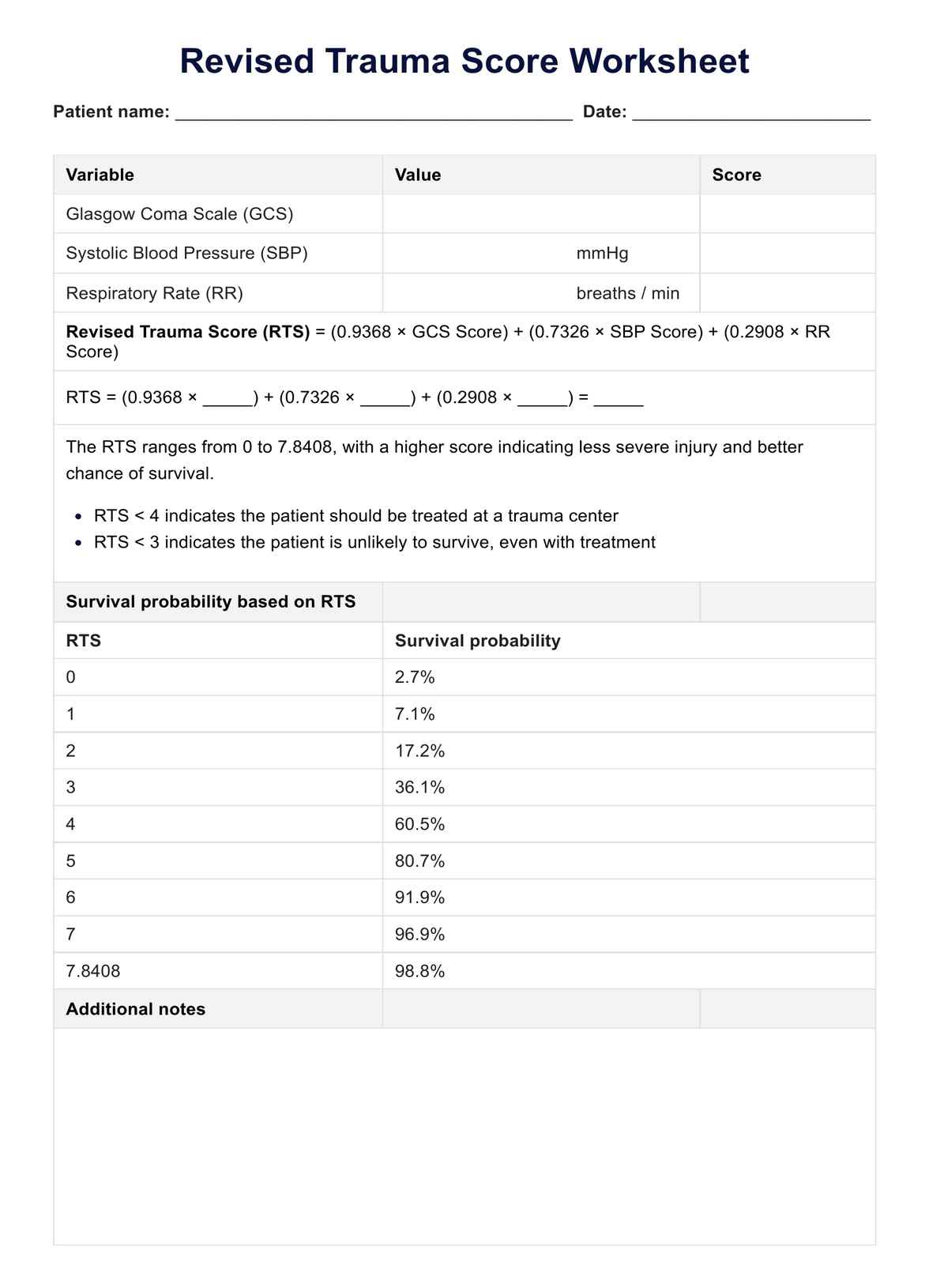




What is the Revised Trauma Score system?
The Revised Trauma Score (RTS) system is a medical scoring system used to assess the severity of a traumatic injury and predict the likelihood of a patient's survival. It combines physiological measurements to create a score that helps healthcare providers make quick, accurate decisions in trauma situations. The RTS is commonly used in emergency medical services (EMS) and trauma centers to triage patients and prioritize treatment based on the severity of their injuries.
The RTS system includes three main parameters:
- Glasgow Coma Scale (GCS): This measures a patient's level of consciousness, assessing eye, verbal, and motor responses. The GCS score ranges from 3 to 15, with lower scores indicating more severe impairment.
- Systolic Blood Pressure (SBP): This measures the pressure in the arteries when the heart beats. It indicates a patient's circulatory status and overall physiological stability.
- Respiratory Rate (RR): This measures the number of breaths a patient takes per minute, reflecting the patient's respiratory function and oxygenation status.
Each of these parameters is assigned a score, and the total RTS is calculated by summing the weighted values of these scores. The RTS ranges from 0 to 12, with higher scores indicating less severe trauma and a better prognosis. The system is valued for its simplicity, ease of use, and ability to convey critical information about a patient's condition quickly.
What are the scores used in trauma?
In trauma care, several scoring systems are used to evaluate the severity of injuries and predict patient outcomes. These scores help make informed decisions regarding patient management, resource allocation, and treatment priorities. The main scores used in trauma include:
- Glasgow Coma Scale: The GCS assesses a patient's level of consciousness based on eye, verbal, and motor responses. Scores range from 3 (deep unconsciousness) to 15 (fully awake). It is widely used to evaluate brain injuries.
- Revised Trauma Score: As described above, the RTS combines the GCS, systolic blood pressure, and respiratory rate to assess the overall severity of trauma. Scores range from 0 to 12, with higher scores indicating better physiological status.
- Injury Severity Score: The ISS quantifies overall injury severity based on the Abbreviated Injury Scale (AIS) for different body regions. It ranges from 0 to 75, with higher scores indicating more severe injuries. The ISS is particularly useful for assessing patients with multiple injuries.
- Trauma and Injury Severity Score: The TRISS combines the RTS, ISS, and patient age to predict survival probability. It compares trauma care quality across different institutions and researches trauma outcomes.
- Abbreviated Injury Scale (AIS): The AIS provides a standardized method for coding the severity of individual injuries for different body regions. It ranges from 1 (minor) to 6 (unsurvivable). The AIS is critical to the ISS and other composite trauma scores.
- Pediatric Trauma Score (PTS): The PTS is specifically designed to assess children's trauma severity. It includes parameters such as weight, airway status, systolic blood pressure, central nervous system status, open wounds, and skeletal injuries. Scores range from -6 to +12, with higher scores indicating less severe trauma.
- New Injury Severity Score (NISS): The NISS is a modification of the ISS that considers the three most severe injuries regardless of body region. It provides a more comprehensive assessment of overall injury severity.
These trauma scoring systems are essential tools in emergency and trauma care. They enable healthcare providers to quickly assess injury severity, predict outcomes, and optimize patient management.









