






What is the Emotion Reactivity Scale?
The Emotion Reactivity Scale (ERS) was developed by Matthew K. Nock‚ Michelle M. Wedig‚ Elizabeth B. Holmberg‚ and Jill M. Hooley back in 2008, published in their paper entitled “The Emotion Reactivity Scale: development‚ evaluation‚ and relation to self-injurious thoughts and behaviors.” It was developed to assess a person's emotional reactivity, which is how strongly they experience certain negative emotions and, by extension, how it puts them at risk of having self-injurious thoughts and enacting self-injurious behaviors.
During its development, the authors used exploratory factor analysis to determine the tool's factor structure, which revealed three factors of emotion reactivity: emotion sensitivity, emotional arousal/intensity, and emotion persistence. The scale has a strong internal consistency, with a Cronbach's alpha of 0.94 for the total ERS score. (Nock et al., 2008)
How is this scale answered?
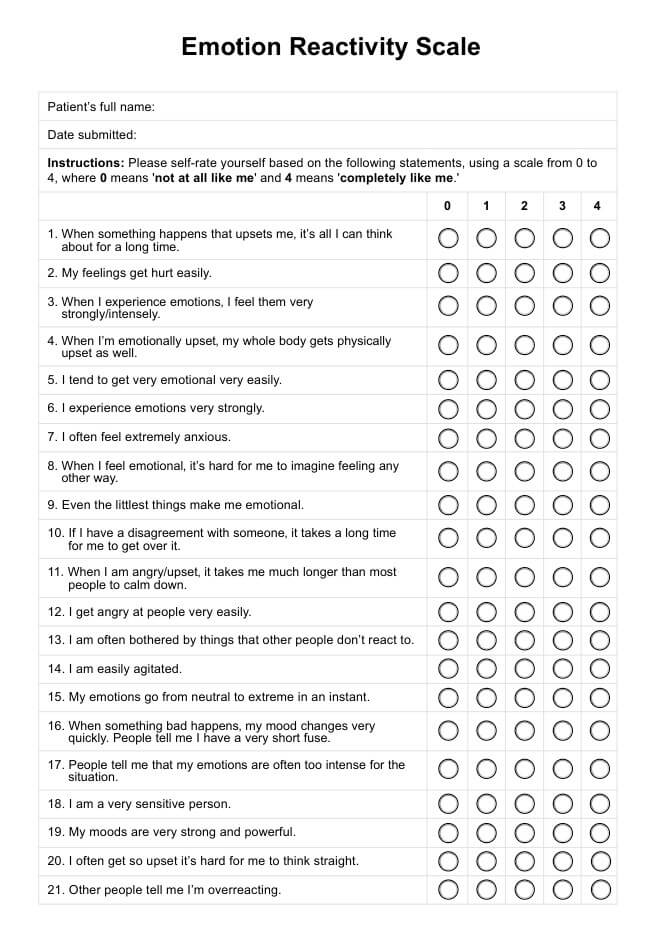
The Emotion Reactivity Scale is a 21-item list of statements all related to a person's emotional responses. Examples of such statements include the following:
- When something happens that upsets me‚ it’s all I can think about for a long time.
- When I’m emotionally upset‚ my whole body gets physically upset as well.
- Even the littlest things make me emotional.
- When I am angry/upset‚ it takes me much longer than most people to calm down.
- I am easily agitated.
- When something bad happens‚ my mood changes very quickly. People tell me I have a very short fuse.
To answer each item, the respondent only needs to pick a number from 0 to 4. 0 means "not at all like me." 4 means "completely like me."
How is it scored?
After the respondent returns a fully answered Emotion Reactivity Scale, all you need to do is to calculate the sum of all scores and write the totals for the following:
- Sensitivity subscale score (items 2‚ 5‚ 7‚ 9‚ 12‚ 13‚ 14‚ 15‚ 16‚ and 18)
- Arousal/intensity subscale score (items 3‚ 4‚ 6‚ 17‚ 19‚ 20‚ and 21)
- Persistence subscale score (items 1‚ 8‚ 10‚ and 11)
- Total score (all items)
There are no set score ranges for this, but the rule of thumb is the higher the total score, the higher a person's emotion reactivity.









