How is brief psychotic disorder diagnosed?
Diagnosing brief psychotic disorder requires a careful assessment of symptoms, their duration, and the exclusion of other potential causes. The process typically involves several key steps:
1. Clinical interview
A thorough clinical interview is the cornerstone of diagnosis. This involves gathering information about the nature and onset of psychotic symptoms, the duration of symptoms, the presence of any precipitating stressors, previous psychiatric history, family history of mental illness, and substance use history
Psychotic symptoms to assess include delusions, hallucinations, disorganized speech, and grossly disorganized or catatonic behavior.
2. Exclusion of other causes
To diagnose brief psychotic disorder, it's essential to rule out other potential causes of psychotic symptoms:
- Medical conditions: To exclude organic causes of brief reactive psychosis, a comprehensive physical examination and relevant laboratory tests (e.g., thyroid function tests, electrolyte panel) should be conducted.
- Substance-induced psychosis: A thorough substance use history and toxicology screening can help differentiate this condition from a brief psychotic disorder.
- Mood disorders with psychotic features: Careful assessment of mood symptoms is necessary to distinguish brief psychotic disorder from major depressive disorder or bipolar disorder with psychotic features.
- Other psychotic disorders: The duration and pattern of symptoms help differentiate brief psychotic disorders from conditions like schizophrenia, schizoaffective disorder, or another possible personality disorder.
3. Diagnostic criteria
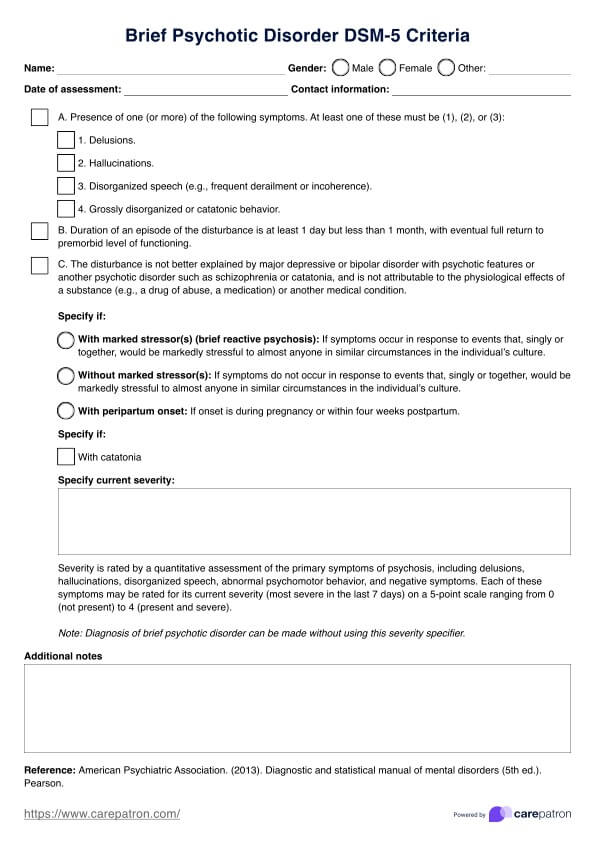
According to the DSM-5, the diagnosis of brief psychotic disorder requires the presence of one or more of the following positive or negative symptoms:
- Delusions
- Hallucinations
- Disorganized speech
- Grossly disorganized or catatonic behavior
These symptoms should not be better explained by another mood disorder, the effects of a substance, or a medical condition.
4. Specifiers
The diagnosis can be further specified as:
- With marked stressor(s): If symptoms occur in response to events that would be markedly stressful to almost anyone in similar circumstances
- Without marked stressor(s): If there's no apparent stressor
- With postpartum onset: If onset is within 4 weeks postpartum
5. Other diagnostic tools
While the clinical interview is primary, structured diagnostic interviews, such as the Structured Clinical Interview for DSM-5 (SCID-5), or tests such as a Mental State Examination and a risk assessment for possible homicidal or suicidal ideation can help ensure a comprehensive assessment.
6. Cultural considerations
It's important to consider cultural factors when assessing brief psychotic episodes. The content of delusions and hallucinations, as well as the interpretation of experiences, can vary across cultures.