What is the Gaze Stabilization Test?
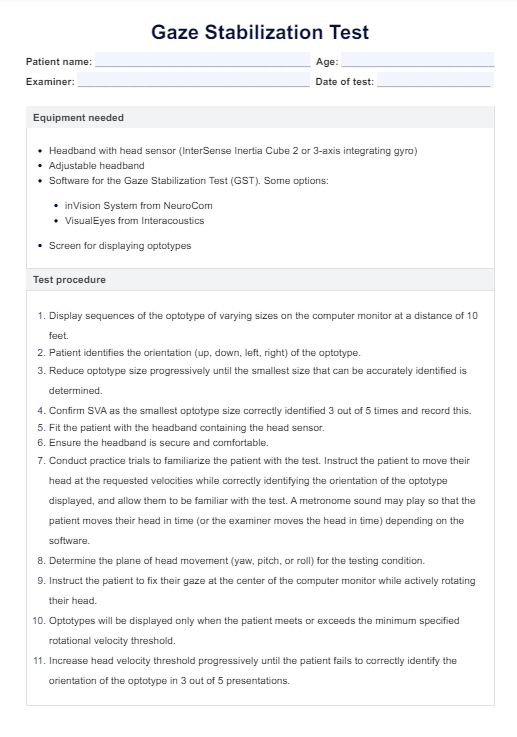
The Gaze Stabilization Test (GST) is a clinical test to assess the vestibulo-ocular reflex (VOR)'s ability to stabilize the eyes during head movements. Alongside the dynamic gait index, the GST is important for assessing individuals with unilateral vestibular dysfunction and certain balance disorders.
The GST involves tracking a visual target (the optotype) with different types of active head movement at different velocities. The head velocity increases until the patient can no longer track the target; the fastest speed at which the patient can still track the optotype is then measured as the peak head velocity. The test includes head rotation, yaw, and roll. A head sensor is used to measure speed.
What does the GST measure?
Static visual acuity
Static visual acuity (SVA) refers to the sharpness or clarity of vision when the head and eyes are stationary, without any movement. Simply put, this is the patient's ability to focus on a stationary object. SVA is tested asking the patient to identify the smallest optotype they can without moving their head, using a Snellen or LogMAR chart. Some GST software may test for this by making the patient identify changes to a stationary optotype while the patient is in a static position.
Static visual acuity helps establish a baseline of the patient's normal vision without head movements, which is crucial for calculating dynamic visual acuity and can serve as a comparison to other visual test results.
Dynamic visual acuity
Dynamic visual acuity (DVA) is the patient's ability to see clearly while their heads move. This ability is vital as it simulates everyday activities, such as looking at a street sign while walking or driving. Impaired dynamic visual acuity may manifest as dizziness, vertigo, or nausea during movement. These symptoms may make it difficult to read, navigate environments, play sports, or operate vehicles.
The dynamic visual acuity test usually involves head rotations at various speeds while the patient tracks the optotype. The DVA equates to the smallest optotype the patient can correctly identify during head movement. GST software often calculates the DVA value automatically.
These tests help identify impairments in the vestibulo-ocular reflex and provide valuable data for diagnosing and managing vestibular disorders.