Everyone has a story to tell, and here we share and celebrate those who chose care as their life's work.
These are their words, their work and we're grateful to share them.
Elizabeth and Dennis handed their billing to Carepatron and grew My Therapeutic Concepts from five clients to seventy in two months, without losing their evenings.
Looking for a way to help your clients/patients understand what the concept of the cognitive triangle is? Read our guide to learn more about this concept and how it can be applied to help people reconfigure the way they think about things, their behaviors, and what they feel. Download and use the Cognitive Triangle Worksheet to help them do just that.
## **What is a cognitive triangle/CBT triangle?**
Cognitive behavioral therapy (CBT) is one of the most popular forms of therapy that has ever been developed because it has been proven to be able to help patients/clients taking it to work through their mental health issues, emotional distress, and maladaptive behaviors by teaching them methods of reconfiguring negative thought patterns and practical strategies to combat cognitive distortions, which will lead them to attaining better emotional well-being (Early & Grady, 2016).
One of the core models of CBT is the cognitive triangle, which posits that our thoughts determine how we feel (physically and emotionally), and what we feel influences what we do and may shape our behaviors (Wilding & Milne, 2007). Based on this model, having negative thoughts will lead to negative emotions, and negative emotions can lead to negative behaviors (e.g., engaging in negative self-talk; self-harming acts), which can significantly impact one's mental well-being.
Cognitive behavioral therapists will use a visual representation of this model when addressing anxiety, depression, and other mental health problems. They will teach this model to their patients/clients to help them learn how thoughts, emotions, and behaviors interact. They will also work with them to identify unhelpful/negative thought patterns and, through critical thinking, replace them with more realistic ones that help them adapt to their current situations (Beck, 2011).
By being cognizant of how these interactions are connected and learning how to reconfigure the negative ones, CBT therapists and their clients can create healthy coping strategies that they can use whenever negative thoughts (especially if they're recurring patterns of thought) emerge, develop healthier habits, and overcome challenges usually posed by such thoughts.
## **What is a Cognitive Triangle Worksheet?**
One way for cognitive behavioral therapists to teach concepts to their patients/clients is to introduce worksheets to them. These are fundamental tools to help them apply what they've learned from their therapists. It's also a way for therapists to see how much their clients understand what was taught to them.
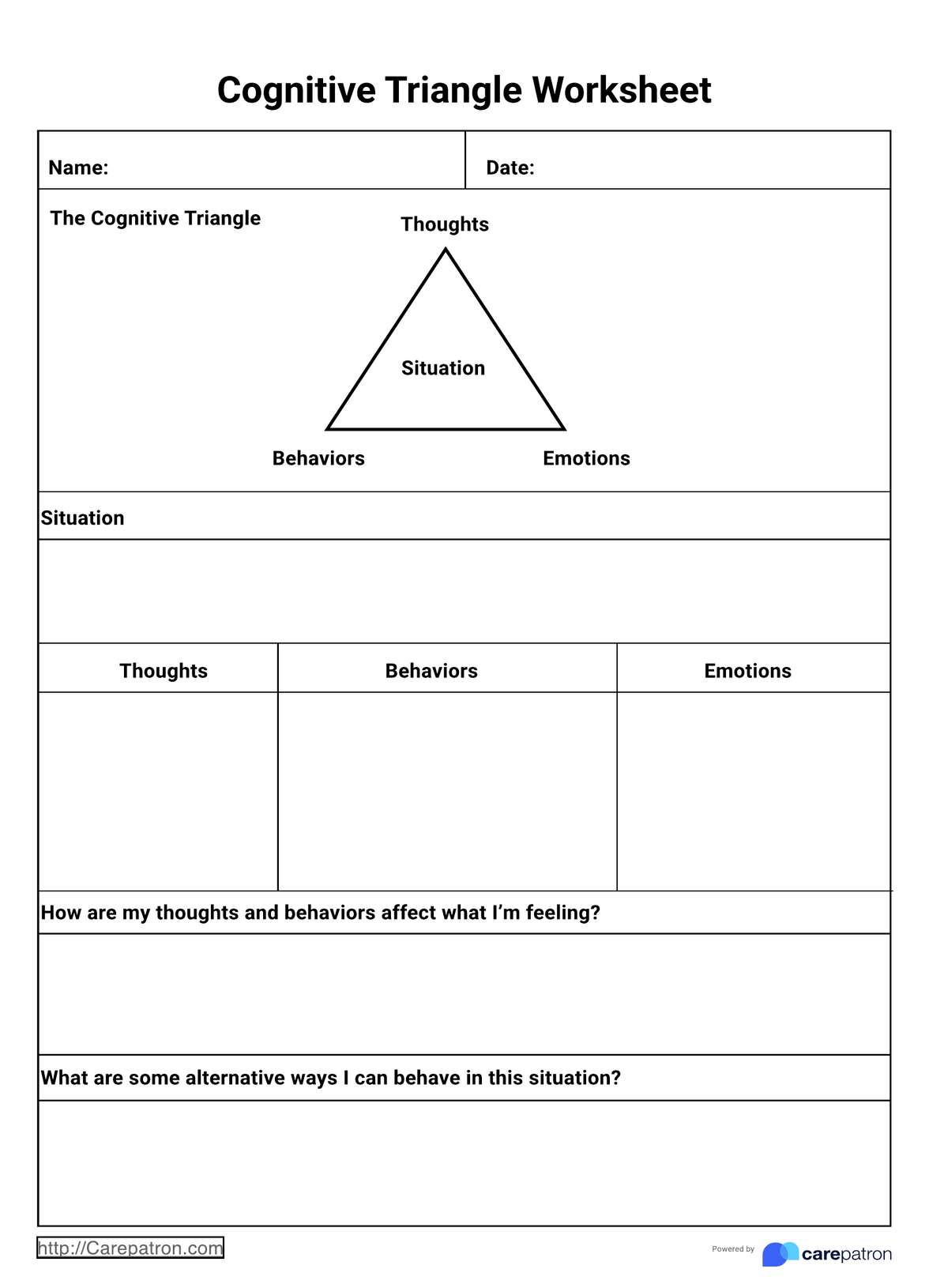
An example of such a worksheet is a cognitive/CBT triangle worksheet. This type of worksheet often presents a visual representation of the cognitive triangle. Using this triangle, they will discuss a particular situation that has distressed them and led them to develop negative thoughts, emotions, and behaviors. They will do this through text, specifically by following prompts or guide questions. It's a great way for clients to practice coping strategies.
Worksheets such as this allow your patients/clients to gain greater insight into their thoughts and behaviors and make choices that can lead to positive changes. It also helps create a safe and comfortable environment for patients to express themselves without fear. It allows them to open up and share their thoughts and feelings in a way that makes them feel heard, understood, and respected. This can be invaluable for helping your patient to make positive changes.
It'll also allow more effective communication between you and your patient/client, enabling you to understand their thoughts and feelings more easily. You can provide more targeted advice and treatments for the best possible care.
## **How to use our Cognitive Triangle Worksheet**
We, at Carepatron, developed our own cognitive triangle worksheet that you can use for free!
### **Step 1: Download our template**
Access our free worksheet by clicking "Use template" or "Download."
### **Step 2: Give a copy to your patient**
Give your patient a copy of the worksheet and explain how it works. Make sure that you've already talked to them about the cognitive triangle model.
### **Step 3: Discuss the components of the cognitive triangle**
Like any other Cognitive Triangle Worksheet, they will see the visual representation of it at the beginning of the worksheet. Immediately after that is a section where they can discuss a situation that has caused them distress. This is their opportunity to describe this situation with as much detail as possible. In fact, encourage them to be as detailed as they can so you can have a better picture of it as well.
After that, there are boxes for thoughts, feelings, and behaviors. For these boxes, have them list the negative thinking patterns that emerged from the situation, the feelings they experienced as a result of these thoughts, and any negative behaviors they developed or expressed due to these negative thoughts and feelings.
For the last part, they just need to answer the following questions:
- How are my thoughts and behaviors affecting what I’m feeling?
- What are some alternative ways I can behave in this situation?
### **Step 4: Let the patient work on the worksheet**
Let your patient think about a situation they have experienced and how it relates to the cognitive triangle. You can use these prompts below to get them going:
- To complete the worksheet, think of a situation in which you experienced distress. For example, if you're feeling stressed about an upcoming deadline at work, write down the details of this particular situation in the "Situation" box.
- Next, think about your thoughts or beliefs before, during, and after the event. This can include things such as “I'm not good enough” or “I can't do this”. Write down whatever comes up in the "Thoughts" box.
- In the "Behaviors" box, write down any behaviors that you exhibited in response to the situation, such as “I'm avoiding people” or “I'm staying up late to work on this project”.
- In the "Emotions" box, write down any emotions you felt before, during, or after the event. This can be anything from fear to anger to sadness.
- Then, think about how your thoughts and behaviors affected how you feel. Also, write down some alternate thoughts or approaches you could have had during the situations. For example, if you felt “I can't do this,” an alternate thought might be “I can take it one step at a time.”
### **Step 5: Discuss what they wrote**
Once your patient has completed the worksheet, discuss any insights or changes they have identified. Or if no insights and changes have been identified yet, discuss what they've written and structure your discussion in a way where you can nudge them to develop insights and exact changes.
### **Step 6: Secure the worksheet**
Because the worksheet contains confidential information, store it securely after your session.
## **Other CBT worksheets you can use**
Besides the Cognitive Triangle Worksheet, we have a bunch of other similar worksheets you can use:
- **[Thoughts and Behaviors Journal CBT Worksheet](https://www.carepatron.com/templates/thoughts-and-behaviors-journal-cbt-worksheet)**: This worksheet is just meant for your patients/clients to log their negative thoughts, feelings, behaviors, and actions that emerged or have been exhibited because of a stressful situation. This worksheet doesn't necessarily make them reconfigure these, but it can help therapists identify patterns in their patients'/clients' lives that contribute to these negative thoughts, feelings, behaviors, and actions.
- **[Decatastrophizing Worksheet](https://www.carepatron.com/templates/decatastrophizing-worksheet)**: This worksheet focuses on excessive worrying, so excessive that your client's day is disrupted whenever they worry. This worksheet will try to get to the root of a client's excessive worrying and have them reconfigure the way they think about it by examining the cause of the worry, any evidence that supports that an event could happen, and counter-evidence to support that the event they're worrying about won't happen.
- **[Cognitive Distortions Worksheet](https://www.carepatron.com/files/cognitive-distortions-worksheet.pdf)**: This worksheet is a great way for you to teach patients/clients about various cognitive distortions, such as all-or-nothing thinking, overgeneralization, mind reading, fortune telling, personalization, and more. By having them discuss certain distressing situations, your clients can become self-reflexive and identify the kinds of cognitive distortions that emerged or emerge whenever they undergo certain situations. Being cognizant of these is a huge step when it comes to reconfiguring these distortions.
## **References**
Beck, J. S. (2011). Cognitive Behavior Therapy, second edition: Basics and Beyond. Guilford Press.
Early, B. P., & Grady, M. D. (2016). Embracing the contribution of both behavioral and cognitive theories to cognitive behavioral therapy: Maximizing the richness. Clinical Social Work Journal, 45(1), 39–48. https://doi.org/10.1007/s10615-016-0590-5
Wilding, C., & Milne, A. (2007). Cognitive Behavioural Therapy.
Commonly asked questions
Before anything, please note that worksheets are not diagnostic tools. However, they can be used on people who are suspected of having certain mental health issues. Worksheets such as this can help you identify certain traits/symptoms that are characteristic of suspected mental health issues your patient/client has, so they can at least help you gather evidence. But again, worksheets are not diagnostic tools.
Practitioners should use a cognitive triangle worksheet to gain insight into a patient's thinking patterns and behavioral responses. It can also be used as an educational tool.
Cognitive behavioral therapists are usually the mental healthcare professionals who use this, but it can also be used by adjacent professionals like counselors, social workers, and psychiatrists, so long as they are familiar with CBT concepts.