Everyone has a story to tell, and here we share and celebrate those who chose care as their life's work.
These are their words, their work and we're grateful to share them.
Elizabeth and Dennis handed their billing to Carepatron and grew My Therapeutic Concepts from five clients to seventy in two months, without losing their evenings.
## **What are executive function skills?**
Executive function skills encompass a set of cognitive abilities crucial to completing tasks and handling emotions and behaviors effectively. These skills facilitate goal-directed behavior, enabling individuals to plan, organize, prioritize, and execute tasks efficiently. Children begin developing executive functions from a very young age, which include working memory, cognitive flexibility, and attentional control.
Working memory, a core component of executive functioning skill, involves holding and manipulating information temporarily in mind. This skill is vital for tasks such as following instructions, problem-solving, and academic success. As children progress through elementary school and into middle school, their executive functioning skills continue to develop, allowing them to refine time management, organization, and emotional control.
Practicing executive functioning skills is essential for children to navigate daily challenges successfully. By learning to regulate impulses, manage time effectively, and organize tasks, children can improve their ability to complete assignments, achieve academic accomplishments, and foster positive social interactions. Strengthening executive function skills early on lays a foundation for lifelong cognitive and emotional well-being. Therefore, nurturing and supporting a child's executive functioning skills is fundamental for their overall development and success.
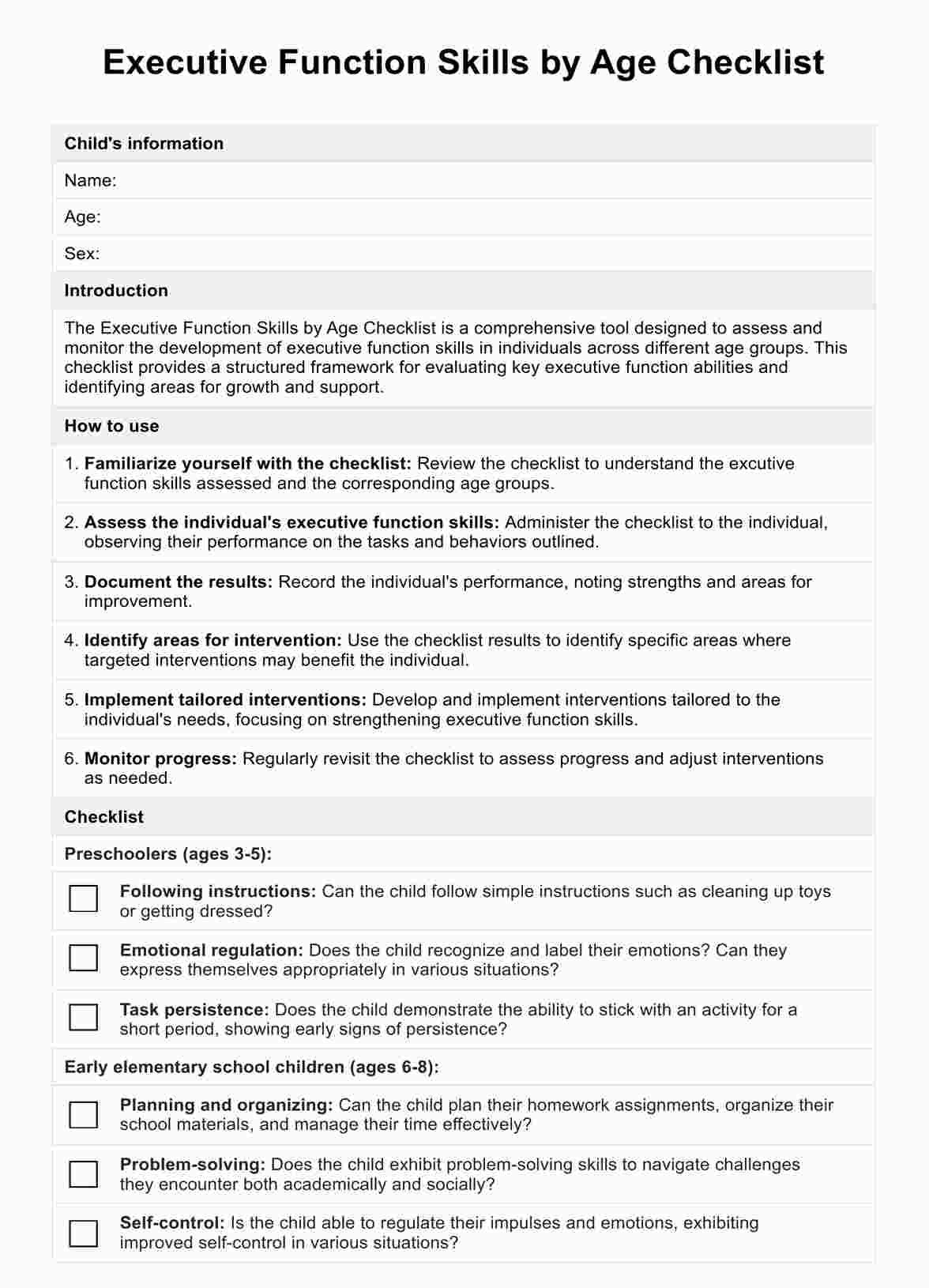
Executive Function Skills by Age Checklist Template
## **Examples of Executive Function Skills by Age Group**
Executive function skills vary across different age groups, with each stage of development presenting unique challenges and milestones. Here are some examples of such essential skills observed in children at different age ranges:
### **Preschoolers (ages 3-5)**
Preschoolers begin to develop foundational cognitive skills that lay the groundwork for future cognitive abilities. At this age, children learn to follow basic instructions, such as cleaning up their toys or getting dressed. They may demonstrate the ability to stick with an activity for a short period, showing early signs of persistence.
Additionally, it is at this age that preschoolers begin to recognize and label their emotions and learn to express themselves appropriately in various situations.
### **Early elementary (ages 6-8)**
As children progress into early elementary school, their executive function skills become more refined. They start showing organizational skills by planning homework assignments, develop problem-solving abilities to navigate challenges academically and socially, and exhibit improved self-control in various situations.
### **Late elementary (ages 9-11)**
Late elementary school children further develop their executive function skills, displaying advanced organization skills by managing time effectively and creating schedules. They apply logical reasoning and critical thinking skills to solve problems, and they continue to refine their ability to regulate emotions and impulses.
### **Middle school (ages 12-14)**
In middle school, executive function skills become more complex as children juggle multiple responsibilities. They develop time management skills to balance academic demands and extracurricular activities, self-regulation skills, engage in long-term planning by setting goals, and demonstrate adaptability by adjusting strategies based on changing circumstances.
Understanding these developmental milestones in executive function skills is crucial for educators, caregivers, and healthcare professionals to provide appropriate support and interventions tailored to each age group's needs.
## **Why are these skills important for a person's development?**
Executive function skills are pivotal in a person's overall development, influencing various aspects of their life from childhood through adulthood. Here's why these skills are crucial:
- **Academic success**: Effective executive functioning skills, such as working memory and time management, are closely linked to academic achievement. Children who can regulate attention, organize tasks, and manage their time are better equipped to excel in school.
- **Social and emotional well-being**: Executive functions contribute to social and emotional control. They enable individuals to regulate their emotions, control impulses, and navigate social interactions effectively, fostering positive relationships and reducing the likelihood of behavioral problems.
- **Life skills**: As individuals progress into adulthood, executive function skills become essential for managing daily responsibilities, pursuing career goals, and maintaining overall well-being. Strong executive functioning skills enable individuals to plan, prioritize, and problem-solve effectively in various contexts.
- **Adaptability**: Adapting to new situations and navigating challenges is critical for success in a rapidly changing world. An executive function skill, such as cognitive flexibility and decision-making, empower individuals to adjust their strategies and responses as needed, promoting resilience and adaptability.
## **What is an Executive Function Skills by Age Checklist?**
An Executive Function Skills by Age Checklist is a tool designed to track and practice executive functioning skills across different age groups. This checklist outlines specific tasks and behaviors associated with a child's executive function skills, allowing caregivers, educators, and healthcare practitioners to assess a child's progress and identify areas for improvement.
This executive functioning checklist provides a comprehensive framework for understanding and supporting a child's cognitive development by breaking down executive function issues into age-appropriate categories, such as developing working memory, time management, and task completion.
Regular use of the checklist enables individuals to monitor how executive functioning skills develop over time and implement strategies to practice and improve these skills effectively.
### **Which healthcare professionals can use this?**
An Executive Function Skills by Age Group Checklist is a valuable tool utilized by various healthcare professionals to assess and support the child's development of executive function skills in individuals. Here are some healthcare professionals who may benefit from using this checklist:
- **Neuropsychiatrists**: These specialists focus on the relationship between brain function and behavior, making them well-equipped to assess and address executive function deficits.
- **Neuropsychologists**: With expertise in both psychology and neuroscience, neuropsychologists can conduct comprehensive evaluations of executive function skills and provide targeted interventions.
- **Occupational therapists**: Occupational therapists help individuals develop the skills needed to perform daily activities, including executive function skills such as organization, time management, and planning.
- **Speech-language therapists**: These professionals work with individuals to improve communication and language skills, which are closely linked to executive function abilities such as verbal fluency and comprehension.
## **How to use our Executive Function Skills by Age Checklist template**
Using our Executive Function Skills by Age Checklist template is simple and effective. Follow these steps to make the most of this valuable tool:
### **Step 1: Familiarize yourself with the checklist**
Review the checklist to understand the different executive function skills assessed and the corresponding age groups. Take note of the specific tasks and behaviors listed for each age range.
### **Step 2: Assess the individual's executive function skills**
Administer the checklist to the individual you are evaluating, whether it's a child, adolescent, or adult. Observe their performance on the tasks and behaviors outlined in the checklist, noting any strengths or areas for improvement.
### **Step 3: Document the results**
Record the individual's performance on the checklist, indicating which skills they have mastered and which ones may require further typical development. This documentation serves as a baseline assessment and helps track progress over time.
### **Step 4: Identify areas for intervention**
Use the checklist results to identify specific areas where the individual may benefit from targeted interventions or support. Focus on developing strategies to strengthen executive function skills that are lacking or underdeveloped.
### **Step 5: Implement tailored interventions**
Based on the identified areas for improvement, develop and implement interventions tailored to the individual's needs and preferences. These interventions may include cognitive training exercises, organizational strategies, or behavioral interventions.
### **Step 6: Monitor progress**
Regularly revisit the checklist to assess progress and adjust interventions as needed. Continuously monitor the individual's executive function skills development to ensure ongoing support and success.
## **How do professionals help people develop these skills?**
Professionals play a crucial role in supporting individuals in developing executive function skills across different age groups. This helps children grow into successful adults. Here's how they help:
### **Preschoolers (ages 3-5)**
Professionals engage preschoolers in structured activities that promote following instructions, emotional regulation, and task persistence. Using play-based interventions, professionals create opportunities for children to practice executive function skills in a fun and engaging manner.
Professionals help preschoolers learn and internalize executive function skills by modeling appropriate behaviors and providing positive reinforcement.
### **Elementary school children (ages 6-11)**
Professionals provide targeted training sessions on planning, organizing, problem-solving, and self-control. CBT techniques teach children strategies for managing their thoughts, emotions, and behaviors, improving executive function skills.
Professionals utilize visual supports such as schedules, checklists, and timers to help children manage time, organization, and task completion.
### **Middle schoolers (ages 12-14)**
Professionals conduct workshops to teach middle schoolers practical strategies for time management, organization, and critical thinking. Professionals provide personalized support and guidance through one-on-one coaching sessions to help middle schoolers develop and strengthen executive function skills.
Professionals create opportunities for middle schoolers to apply executive function skills in real-life scenarios, such as planning a project or managing a schedule.
Commonly asked questions
Executive function skills typically continue to develop throughout early childhood and adolescence, with significant strides seen during the preschool and elementary school years. However, full maturity of these skills may not be reached until early adulthood, around the mid-20s.
Age can impact executive function skills, with younger individuals generally exhibiting executive dysfunction than older individuals. As the human brain matures, executive function abilities such as planning, organization, and impulse control tend to improve.
Signs of poor executive functioning encompass a range of challenges that may manifest in daily life. Individuals with poor executive functioning may struggle with planning and organizing everyday tasks, leading to difficulties in managing time effectively and maintaining focus and attention. This may also be a sign of executive functioning disorder, so it's best to have the child checked for this if they have poor executive functioning skills.