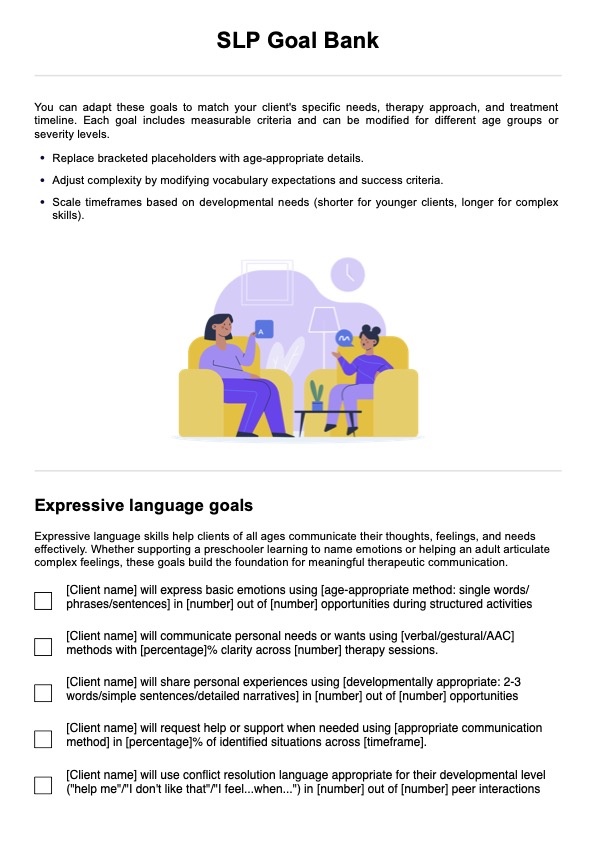
## **What is an SLP Goal Bank?**
Speech-language pathologists face the ongoing challenge of creating individualized, measurable goals that address each client's unique communication needs. Whether you're working with a child who demonstrates initial consonant deletion or an adult recovering their conversational speech abilities, having access to a well-organized goal bank streamlines the treatment planning process.
This is where an SLP Goal Bank comes in. It serves as a comprehensive collection of evidence-based, measurable objectives designed to address various communication disorders across the lifespan. This resource provides speech language pathologists with ready-to-use templates that can be customized for individual clients, covering areas from early language development to complex executive function skills.
The goal bank includes objectives targeting receptive language, expressive language goals, articulation patterns like final consonant deletion and cluster reduction, fluency disorders, voice concerns, and pragmatic language skills. Each goal incorporates specific criteria, such as accuracy percentages and measurable outcomes that align with evidence-based practice standards.
Modern speech therapy goal banks recognize that communication disorders present differently across developmental stages. Goals addressing weak syllable deletion in preschoolers require different complexity levels than objectives focusing on figurative language comprehension in adolescents or breath support techniques for adults with voice disorders.
## **How does this SLP Goal Bank work?**
This systematic approach to goal development ensures that therapeutic objectives remain both clinically sound and practically applicable. The template structure allows for efficient customization while maintaining the rigor necessary for effective intervention planning.
### **Step 1: Access and download the template**
Begin by accessing the SLP Goal Bank template through the Carepatron platform. You can click "Use template" to open a customizable file within the platform before printing or sending to clients, or select "Download" to obtain a PDF copy for offline use.
### **Step 2: Select appropriate goal categories**
Review the various goal categories to identify areas that align with your client's assessment results. The goal bank covers receptive language goals for clients who struggle with following directions or understanding multiple meaning words or context clues, expressive language goals for those working on grammatically correct sentences or descriptive language, and specialized areas like fluency goals incorporating stuttering modification techniques.
### **Step 3: Choose developmental complexity**
Adapt each goal template to match your client's current functioning level. For instance, articulation goals can target single words at the word level for beginning speakers or connected speech at the sentence level for more advanced clients. Goals addressing age-appropriate phonemes should reflect realistic expectations based on typical development patterns.
### **Step 4: Customize measurement criteria**
Modify the bracketed placeholders with specific details relevant to your client's needs. Replace general terms with precise measurements, such as requiring correct subject-verb agreement in 80% accuracy across structured activities, or demonstrating appropriate voicing for target phonemes in word positions, including initial position, medial position, and final position.
### **Step 5: Establish contextual parameters**
Define the therapeutic contexts where goals will be measured. Some clients may need to demonstrate skills during structured language activities with picture cues and verbal prompt support, while others should generalize abilities to conversational speech with a familiar listener. Consider whether the client requires assistance from a speech generating device or can produce single words independently.
## **When would you use this template?**
This SLP Goal Bank template proves valuable across diverse clinical scenarios where systematic goal development enhances therapeutic outcomes.
### **Initial assessment and treatment planning**
Following comprehensive evaluations, clinicians can quickly identify relevant goal areas and customize objectives to address specific deficit patterns. For clients presenting with phonological processes like final consonant devoicing or initial consonant deletion, the template provides structured frameworks that incorporate appropriate developmental expectations and measurable criteria.
### **IEP and treatment plan development**
Educational and clinical settings requiring formal documentation benefit from the template's alignment with regulatory standards. Goals addressing answering WH questions skills, demonstrating knowledge of spatial concepts, or producing sentences with correct grammar can be efficiently adapted for individual education programs or insurance-required treatment plans.
### **Progress monitoring and goal modification**
Regular review cycles become more systematic when using standardized goal templates. Clinicians can track whether clients accurately produce target behaviors, identify when verbal prompt levels should be reduced, or determine if complexity should increase from simple sentences to compound sentences.
### **Transition planning across service delivery models**
When clients move between service providers or settings, standardized goal formats ensure continuity of care.
## **Benefits of SLP Goal Banks**
Implementing a systematic approach to goal development through comprehensive goal banks enhances both clinical efficiency and therapeutic outcomes. These resources support evidence-based practice while reducing the administrative burden associated with individualized goal creation.
### **Enhanced clinical efficiency**
Goal banks significantly reduce planning time by providing pre-structured templates that address common communication challenges. Rather than creating objectives from scratch, clinicians can focus their expertise on customizing existing frameworks to meet individual client needs.
### **Improved goal quality and consistency**
Standardized templates ensure that objectives incorporate essential elements like specific measurement criteria, functional contexts, and developmentally appropriate expectations. Goals addressing answering simple wh questions or sequencing words in a short story, maintain consistent quality regardless of clinician experience level or time constraints.
### **Comprehensive coverage of communication domains**
Well-designed goal banks address the full spectrum of communication disorders, from fluency shaping techniques for stuttering to critical thinking skills for complex language disorders. This comprehensive approach ensures that clinicians consider all relevant areas during the assessment and treatment planning phases.
### **Reduced documentation burden**
Standardized goal formats streamline documentation processes required by educational institutions, healthcare systems, and insurance providers. Clear measurement criteria and functional outcomes facilitate progress reporting and justify continued intervention services.