Everyone has a story to tell, and here we share and celebrate those who chose care as their life's work.
These are their words, their work and we're grateful to share them.
Elizabeth and Dennis handed their billing to Carepatron and grew My Therapeutic Concepts from five clients to seventy in two months, without losing their evenings.
Behind one person's anger lies underlying feelings (or hidden emotions) that have likely compounded and are the reasons behind their anger. Sometimes, the angry person doesn't recognize this.
Suppose you want your anger management clients to recognize the underlying causes of their anger better. In that case, you'll need to help them understand the concept of the anger iceberg so they can be cognizant of all the factors contributing to their rage. Continue reading our guide to refresh on what the anger iceberg is, then download our Anger Iceberg Worksheet to help your clients better articulate to themselves why they are angry.
## **What is the concept of the anger iceberg?**
The anger iceberg metaphor is a concept developed by The Gottman Institute. The concept was made to help people visualize anger (Kyle Benson, 2016). Using this concept, we can recognize that the primary emotion, in the context of anger management, is anger. This is best represented as the tip of the iceberg. The tip represents us expressing anger.
However, the tip is just the tip, and underneath it is a massive layer that people need to be aware of. The middle layer of the iceberg represents deeper feelings behind our anger. You can call these secondary emotions, if you want. These are the deeper emotions that we need to examine to explain better what fuels anger.
The last layer is where we can place our values and thoughts, which might have been, for the lack of a better word, violated, hence all the feelings that fuel one's anger and why that person feels vulnerable.
By introducing this concept to your [anger management](https://www.carepatron.com/guides/anger-management/) clients, they will have the opportunity to develop a deeper understanding of themselves, their own emotions, and the underlying causes of their anger. When they are cognizant of these, they have a better shot at taking a step back, reconfiguring how they think, or at the very least developing ways to calm down and whittle their anger.
Of course, knowing the concept is not enough. It's always best to put things into practice to help them combat this powerful emotion, and what better way than through an anger management worksheet like the Anger Iceberg Worksheet!
## **What is an Anger Iceberg Worksheet?**
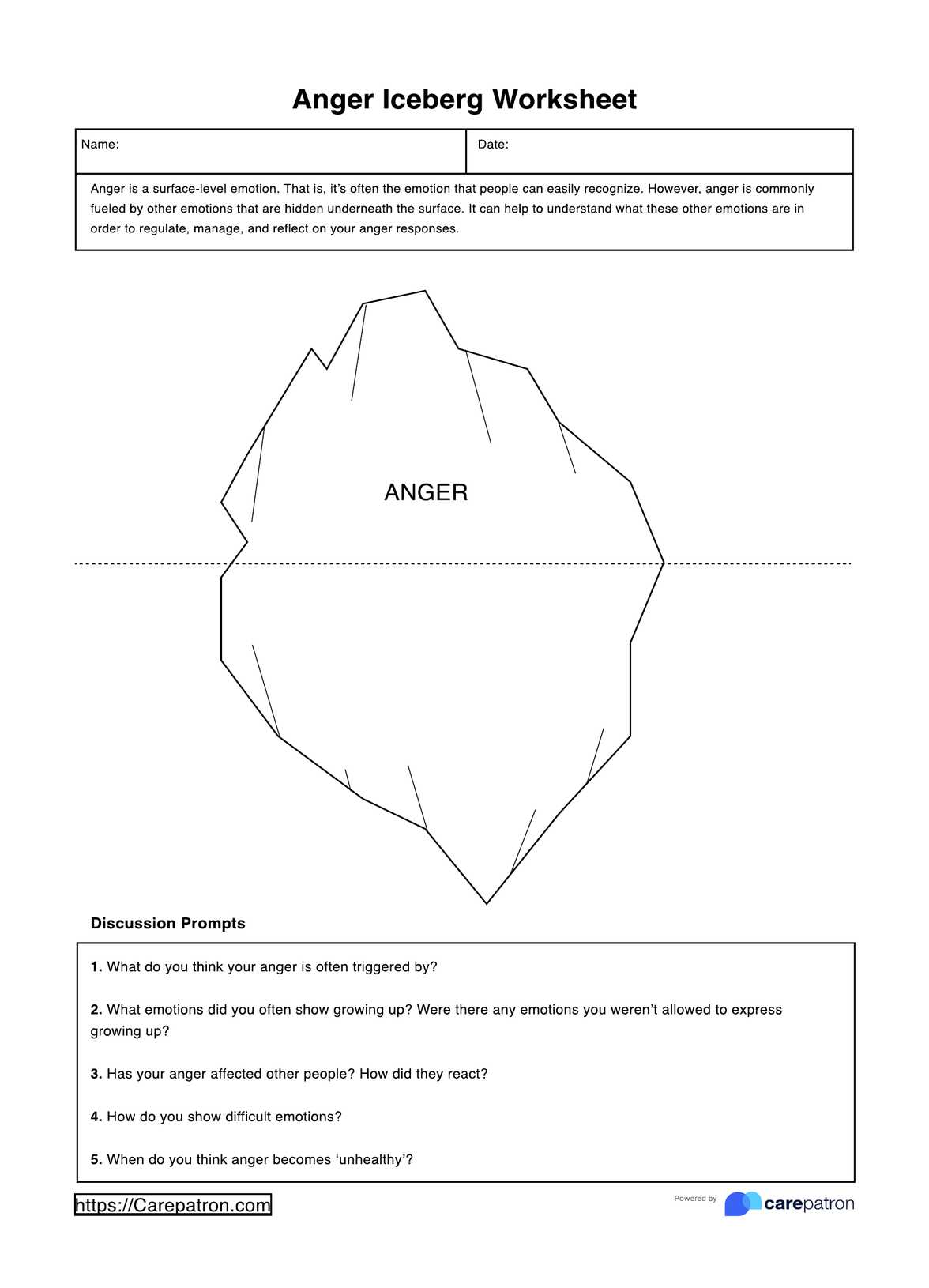
An Anger Iceberg Worksheet is a resource designed to help clients more comprehensively understand their emotions. Essentially, this worksheet provides a visual depiction of an iceberg, and the client is prompted to write in the majority of the iceberg the other emotions they are feeling (in addition to anger).
This model is based on the idea that when anger is outwardly present, there are likely other emotions “hidden” beneath an individual's surface, such as fear, sadness, disappointment, shame, guilt, and jealousy. For people to understand the nature of their emotions more deeply, it's important that they can recognize and identify what these simmering (and likely contributing) emotions are.
The primary goal of this worksheet is to help clients understand the interconnection of their emotions. The Anger Iceberg Worksheet enables individuals to reflect on the various emotions associated with their feelings of anger, helping them better understand their emotional responses. In turn, this information will allow them to regulate responses and, in some instances, focus on implementing more positive behaviors.
This worksheet will give you a deeper insight into your clients' emotional and behavioral processes. The responses a client includes will help you determine how effectively they can manage and regulate their emotions, as well as identify areas that may require improvement. Not only that, but you can also determine what communication skills they need to learn down the line to better, clearly, and healthily express anger.
## **How to use our Anger Iceberg Worksheet**
We, at Carepatron, have designed an Anger Iceberg Worksheet PDF that enables clients to explore and better understand their emotions. Accessing and using our worksheet is extremely easy. This guide provides a step-by-step demonstration of how to achieve this, followed by an outline of some relevant benefits. Let's get started!
There are a few steps involved in using this worksheet, but luckily, they are pretty easy to follow. If you're already confident in knowing how you can access and implement these resources, then feel free to skip to the next section (where we provide a sample completed template!).
### **Step 1: Access the worksheet**
Naturally, the first thing you need to do is access the worksheet. This can be completed either by following the link on this page or via the Carepatron platform. The worksheet will open in PDF format, allowing you to download, save, and print it from here.
### **Step 2: Clients complete the worksheet**
The next step involves clients completing the worksheet. We've included some prompts on the template to guide your clients on the types of responses they should include, but you might find it more helpful to walk them through each step. The process of completing the worksheet is as follows:
1. The top of the iceberg has the word “Anger” pre-written in it, so the client can just leave this section as is.
2. In the remaining area of the iceberg, the client should write their responses to the discussion questions included on the worksheet. These prompts encourage the client to reflect on the triggers of their anger, allowing them to consider the underlying emotions that often coexist with anger.
Here's an example. The prompt is "What do you think your anger is often triggered by?" The answer could be as detailed as this: My anger has been stewing for quite some time now to the point that whenever my mother and father tell me to do things, my frustration and anger become evident on my face."
The prompt after that is: "Has your anger affected other people? How did they react?" Here's a sample answer in relation to the first example: "My mother and father have noticed that I've been frustrated and angry through my facial expressions. Seeing my face contort the way it does has made them upset, and mostly sad. I haven't communicated why I've been angry with them."
The PDF is interactive, allowing your client to write in the fillable fields if you've gone paperless.
Although the second step can be completed independently by the client, you may prefer to fill it in together. If this is the case, you can ask your client each of the questions and encourage them to write down their responses. We recommend this approach because it will establish better rapport and trust between you and your clients.
This is a good way to also learn about their specific anger triggers. Knowing their triggers will help you understand what lies beneath the surface of their anger and help you develop healthy coping strategies during therapy sessions.
### **Step 3: Use the completed worksheet in your discussion**
After the client has filled in the anger iceberg, it is a good idea to follow up with each of their responses. You can use the discussion questions as prompts to encourage your client to elaborate on their answers, helping you determine the root causes of their anger and any harmful protective mechanisms they may have. This process can also reconfigure their thought patterns and, if needed, work with them to develop coping strategies.
### **Step 4: Store the worksheet securely**
Completed Anger Iceberg Worksheets contain confidential client information and, as such, they need to be stored in a HIPAA-compliant manner. If you're storing things digitally, you can't take advantage of our storage system.
## **Healthy coping strategies for anger**
Besides teaching them communication skills to handle their anger better and help them have healthier relationships, it's also beneficial to help create coping strategies that your clients can follow when they feel angry or experience other negative emotions. Providing helpful tips to them will make them trust you more as their therapist/counselor.
Here are some examples:
- **Deep breathing exercises**: Many experts have promoted [deep breathing](https://www.carepatron.com/guides/deep-breathing-exercises/) exercises as a way to combat anger because they help people calm down via simple breathing exercises.
- **Changing one's environment**: If they have the means to, suggest to them that they should try to change their environment, even if only for a while. Being away from where the anger triggers are might be great for them because they have a better shot at relaxing elsewhere than in the same place as their triggers.
- **Working out**: Working out in the gym, jogging, hiking, or any physical activity can help counter anger. Working out can be therapeutic for some people, so if your client hasn't tried doing so to calm down, you can recommend it to them.
- **Use humor or watch something funny**: One way of calming down is to downplay their anger with humor. This can be self-deprecating or anything that makes them laugh (but hopefully not to the detriment of others). However, be sure to advise them not to always resort to humor, as there will come a point where they can't consider their anger a laughing matter, especially if it has escalated into something potentially dangerous.
Commonly asked questions
The anger iceberg theory suggests that anger is often just the visible part of a deeper emotional experience. Beneath the “tip of the iceberg,” people may feel sadness, fear, shame, guilt, or disappointment. Recognizing these underlying emotions helps clients understand what’s truly driving their anger and respond more constructively.
Therapists can use the anger iceberg as a visual or reflective tool to help clients explore the feelings hidden beneath their anger. During sessions, clients can identify what lies “below the surface,” linking anger to unmet needs or painful experiences. This approach promotes emotional awareness and helps clients regulate anger with empathy and understanding rather than suppression or avoidance.
The four roots of anger are frustration, hurt, fear, and injustice. Frustration stems from unmet goals or blocked desires, while hurt arises when someone feels rejected or disrespected. Fear and injustice often trigger anger as protective responses—fear signals threat or vulnerability, and injustice activates a sense of moral violation or unfairness.