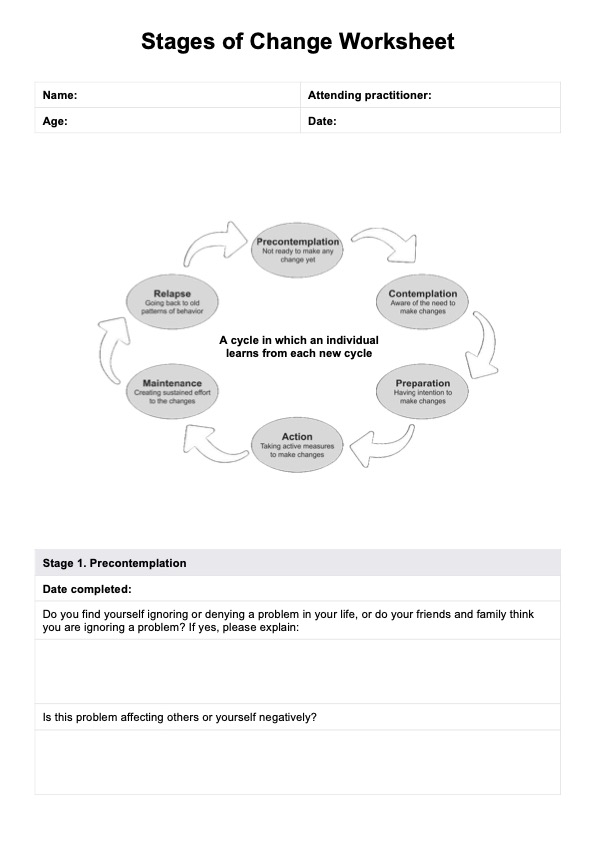
Looking for a tool that can help you support clients who are navigating significant life transitions? Read our guide to learn about the transtheoretical model and use our Stages of Change Worksheet to help clients reframe their relationship with change, develop healthy coping mechanisms, and build confidence as they work toward lasting behavioral change.
## **Understanding the stages of change model**
The transtheoretical model of change—also known as the stages of change model—is a widely used framework for understanding how people modify their behavior over time. This model identifies six distinct stages that individuals typically move through when working toward behavioral change: precontemplation, contemplation, preparation, action, maintenance, and termination (Prochaska & Velicer, 1997).
- **Precontemplation stage**: Here, individuals are often unaware of their behavior as a problem or may be in denial about its impact. They have no intention of changing in the next six months and may feel defensive if others raise concerns.
- **Contemplation stage**: During contemplation, awareness increases. The person begins to recognize that change may be necessary, but conflicting emotions and ambivalence are common. They may weigh the pros and cons of changing without committing to action, sometimes remaining in this stage for months or even years.
- **Preparation stage**: The preparation stage marks a turning point. Here, individuals begin to take small steps toward change—gathering information, setting a start date, or making minor adjustments—preparing themselves for more significant action within the next month.
- **Action stage**: Observable behavioral change occurs. The person actively implements strategies to address the problem, whether that involves stopping smoking, adopting new coping strategies, or restructuring daily routines. This stage typically lasts up to six months.
- **Maintenance stage**: Maintenance is where the real work of sustaining change happens. Having maintained new behaviors for more than six months, individuals focus on preventing relapse and integrating changes into their identity and lifestyle. Temptation is no longer present at the same intensity, but vigilance remains essential.
- **Termination stage**: Termination represents the final stage, where the individual has zero temptation to return to old behaviors. The new behavior has become fully integrated, and the risk of relapse is minimal or no longer present. However, not everyone reaches this stage—some individuals may remain in maintenance for a longtime (for example, five years or longer), while others may cycle back through earlier stages if they experience setbacks.
While termination is the ideal outcome, it's important to acknowledge that relapse is a common reality in the change process. When individuals return to old behaviors, feelings of disappointment, frustration, or failure may arise. However, relapse offers valuable insights and can lead to renewed motivation and progress in later stages.
## **What prevents people from accepting change?**
Even when change could improve well-being, many factors can create resistance. Fear of failure, lack of motivation, lack of motivation to engage with the change process, or simply feeling overwhelmed by the challenges ahead can all stall progress. Social and environmental barriers, such as limited support systems, financial constraints, or ingrained habits, also play a significant role.
Additionally, individuals may lack insight into the consequences of their current behavior or may not yet recognize the risk to their health, relationships, or future. This is especially common in the precontemplation stage, where the person may be unaware or in denial.
Being resistant to change can have serious implications for overall well-being. In the context of addiction or substance abuse, resistance can delay recovery and increase the risk of harm (Chadda & Chatterjee, 2018).
Supporting clients to move through the stages of change, rather than forcing immediate action, can reduce resistance, honor their autonomy, and increase the likelihood of lasting success.
## **What is the Stages of Change Worksheet?**
A Stages of Change Worksheet is a valuable tool designed to help clients reflect on their readiness for change (particularly health behavior change), identify barriers, and develop strategies for moving forward. These worksheets typically guide users through each stage, prompting them to consider their current stage, motivations, challenges, and action plan.
These worksheets are used by a wide range of professionals, including psychologists, counselors, psychotherapists, social workers, life coaches, and addiction specialists. They're especially helpful in counseling and therapy settings where clients are working on behavioral change related to mental health, substance abuse, eating behaviors, sleep hygiene, relationships, or lifestyle modification.
## **How to use the Stages of Change Worksheet template**
To use the Stages of Change Worksheet, we recommend that you follow these simple steps:
### **Step 1: Download the form**
Access the worksheet by clicking "Use template" for a copy you can customize via the Carepatron app. For a PDF copy, click "Download."
### **Step 2: Distribute the worksheet**
Give the worksheet to your client and explain the objectives. It can be completed during your session or at home for quiet reflection. It is recommended that you work with the patient through their answers during sessions, as your expertise can contribute to deeper insights.
### **Step 3: Work through each section together**
Start with the precontemplation stage, even if you believe your client has moved beyond it. This helps establish a baseline and validate their progress. Encourage honest, nonjudgmental reflection.
For each stage, use open-ended questions to deepen the conversation. If a client struggles to answer a question, explore it together. For example, if they're unsure about coping strategies in the preparation stage, brainstorm possibilities based on their strengths and resources.
Not every section needs to be completed in one session. Use your clinical judgment to recognize when a client may benefit from pausing and returning to the worksheet in a future session.
### **Step 4: Store the document**
Store the document safely once completed. Stages of Change Worksheets contain highly sensitive information, so it is recommended that you store the worksheet within a HIPAA-compliant platform to protect and safeguard patient information at all times. This way, you can easily return to it to complete the relapse section if the client returns to old behaviors.
## **Common strategies to help clients cope with significant life changes**
Supporting clients through behavioral change requires more than worksheets. In reality, it also demands practical strategies that build resilience, reduce resistance, and foster long-term success. Here are some approaches that can complement the use of Stages of Change Worksheets:
### **Motivational interviewing**
Motivational interviewing (MI) is a client-centered counseling approach that helps individuals explore and resolve ambivalence about change (Substance Abuse and Mental Health Services Administration, 2019). By asking open-ended questions, reflecting back what clients say, and affirming their ability to change, practitioners can help clients move from contemplation to preparation and action.
### **Build a strong support system**
Encourage clients to identify people in their lives who can offer encouragement, accountability, and practical support. Whether it's a friend, family member, counseling group, or online community, having others to lead the way or walk alongside them can make a significant difference in sustaining motivation and preventing relapse.
### **Set realistic, incremental goals**
Breaking down larger goals into smaller, achievable steps helps clients build confidence and progress steadily. Celebrate small wins along the way to reinforce positive change and maintain momentum.
### **Normalize relapse and reframe failure**
Relapse is not failure—it's feedback. Help clients see setbacks as opportunities to learn, adjust, and try again. Research shows that individuals who experience relapse and re-engage with the change process may have a greater opportunity to develop key learning insights (DiClemente & Crisafulli, 2022).
## **References**
Chadda, R. K., & Chatterjee, B. (2018). Need for psychosocial interventions: From resistance to therapeutic alliance. Indian Journal of Psychiatry, 60(Suppl 4), S440–S443. https://doi.org/10.4103/psychiatry.IndianJPsychiatry_11_18
DiClemente, C. C., & Crisafulli, M. A. (2022). Relapse on the road to recovery: Learning the lessons of failure on the way to successful behavior change. Journal of Health Service Psychology, 48(2), 59–68. https://doi.org/10.1007/s42843-022-00058-5
Prochaska, J. O., & Velicer, W. F. (1997). The transtheoretical model of health behavior change. American Journal of Health Promotion, 12(1), 38–48. https://doi.org/10.4278/0890-1171-12.1.38
Substance Abuse and Mental Health Services Administration. (2019). Enhancing motivation for change in substance use disorder treatment. https://www.ncbi.nlm.nih.gov/books/NBK571068/