Everyone has a story to tell, and here we share and celebrate those who chose care as their life's work.
These are their words, their work and we're grateful to share them.
Elizabeth and Dennis handed their billing to Carepatron and grew My Therapeutic Concepts from five clients to seventy in two months, without losing their evenings.
## **What is the DEARMAN framework?**
The DEARMAN framework, sometimes referred to as the Dear Man DBT skills, is a set of skills developed by dialectical behavior therapy (DBT) professionals that serve as interpersonal effectiveness DBT skills. These, along with emotional regulation and distress tolerance skills, are meant to help clients develop the appropriate mindsets and communication skills that can help them build better relationships, maintain them, set boundaries, and navigate tricky ones with maturity (Linehan, 2023).
The "DEAR MAN" acronym stands for Describe, Express, Assert, Reinforce, Mindful, Appear Confident, and Negotiate, delivering a structured framework that guides the clients through specific aspects of the communication process, from describing the issue at hand to negotiating a compromise that meets both parties' needs in a relationship (Linehan, 2023).
### **The different DEAR MAN skill components**
Here are the seven sets of skills that make up the DEAR MAN technique/framework (Sunrise Residential Treatment Center, 2018):
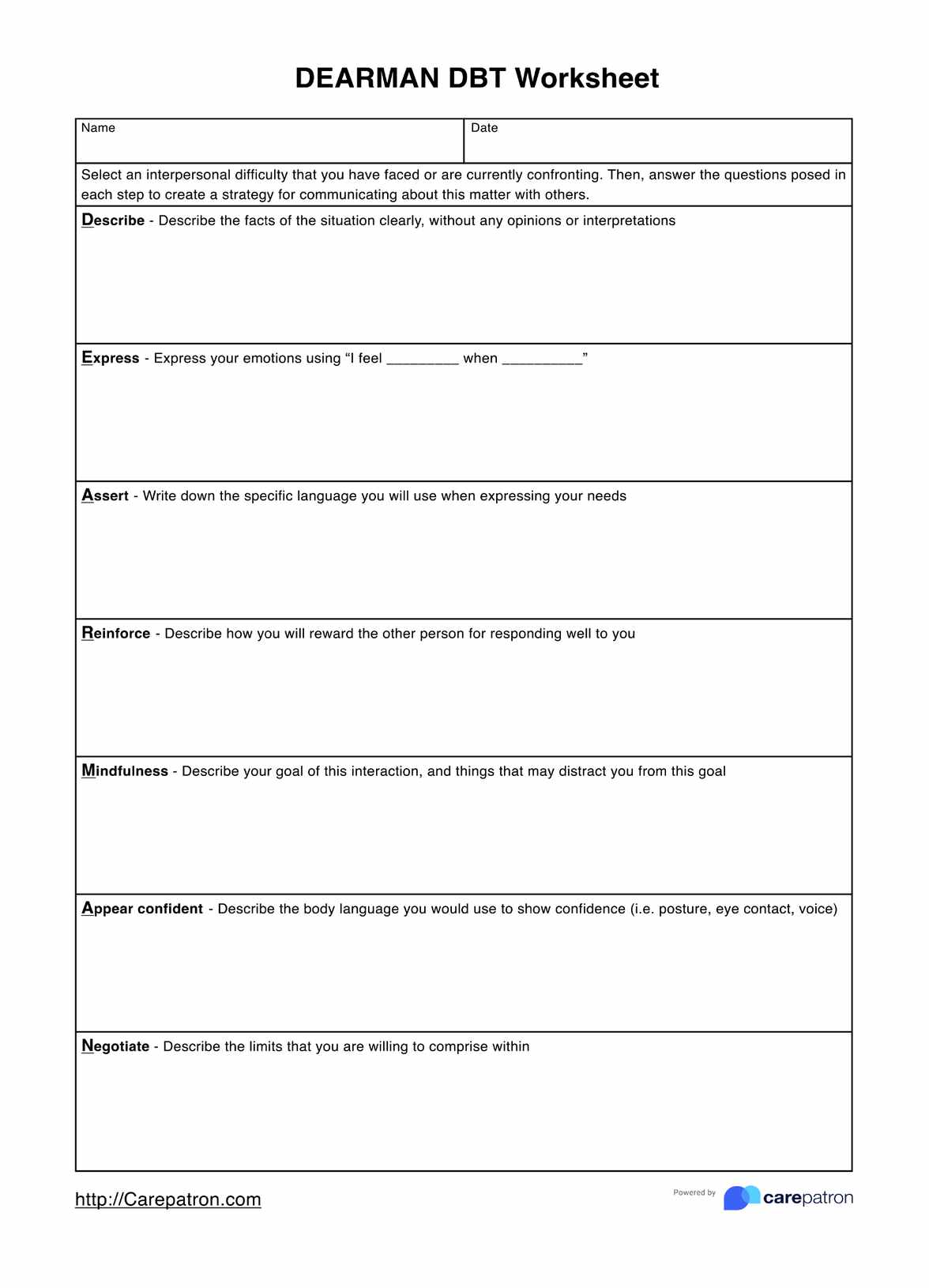
- **D (Describe)**: Describe the facts of the situation clearly, without any opinions or interpretations
- **E (Express)**: Express your emotions using "I feel _________ when __________."
- **A (Assert)**: Write down the specific language you will use when expressing your needs
- **R (Reinforce)**: Describe how you will reward the other person for responding well to you
- **M (Mindfulness)**: Describe your goal for this interaction, and things that may distract you from this goal
- **A (Appear confident)**: Describe the body language you would use to show confidence (i.e., posture, eye contact, voice)
- **N (Negotiate)**: Describe the limits that you are willing to compromise within
## **What is a DEARMAN DBT Worksheet?**
A DEARMAN DBT Worksheet is a simple but effective tool that assists individuals in effectively conveying their needs, desires, and boundaries in a relationship with clarity and assertiveness.
With the assistance of the Dearman DBT Worksheet, individuals can acquire the vital ability to communicate in a way that is not only respectful but is also clear, efficient, and above all, effective while simultaneously promoting negotiation and compromise.
Overall, the Dearman DBT Worksheet is a valuable tool for anyone seeking to improve their communication skills and establish more substantial and positive relationships. Whether you are trying to assert your needs in a personal or professional setting or simply striving to improve your communication skills in general, the Dearman DBT Worksheet can help your client step closer to their goals and lay the foundation for enhanced relationships with others.
Through exercises such as this, you can ensure that your clients can develop effective interpersonal communication, self-respect, a better ability to manage emotions, and improved mental health over time, especially when it comes to professional and personal relationships.
### **Why should I include this in my roster of tools?**
Such worksheets provide a clear and structured approach to communication that is especially beneficial for individuals struggling with interpersonal effectiveness. It offers a systematic way to communicate effectively, set boundaries, and negotiate a compromise. This structured approach allows DBT counselors to teach clients valuable communication skills that can be applied in their daily lives.
It also encourages clients to express their feelings and thoughts in a non-judgmental manner, which can help them develop self-awareness and validation. By using the worksheet, clients can learn to communicate their needs effectively and assertively while also learning to recognize and validate their own emotions.
The worksheet can be used as part of a larger treatment plan to help individuals with communication difficulties and relationship issues. By utilizing the worksheet, counselors can help clients develop better communication skills, establish healthy boundaries, and negotiate more effectively, which can lead to better treatment outcomes and stronger relationships.
## **How to use this DEARMAN DBT Worksheet**
To make the most of this resource in your practice, follow these steps:
### **Step 1: Download the PDF**
The first step to using the Dearman DBT Worksheet is to click "Use template" or "Download" from this page. Alternatively, you can access this worksheet from the Carepatron template library, which allows you more flexibility in the structure of the template.
### **Step 2: Identify the issue**
The next step is to identify the specific issue that your client wants to address with another person. This could be a request, concern, or boundary they need to set. Tell them to make sure to be clear and specific when describing the issue, as this will help them communicate your needs more effectively.
### **Step 3: Use the DEARMAN acronym**
Once both of you have identified the issue, use the DEARMAN acronym to guide them through the communication process. Here's a more detailed breakdown of each step of the acronym:
- **Describe**: Have them begin by describing the issue in detail. Tell them to be specific and avoid making assumptions or judgments about the other person's thoughts or feelings. Tell them to stick to the facts and use "I" statements to describe their own experiences.
- **Express**: Tell them to express how they feel about the issue. This can include your emotions, thoughts, and reactions to the situation. Use "I" statements to avoid blaming or accusing the other person.
- **Assert**: Have them assert their needs and expectations. Let them know to be clear about what they want and need from the other person, and why it's important to them. Have them use "I" statements to clarify that this is about their needs, not the other person's.
- **Reinforce**: Have them reinforce the benefits of meeting their request, and explain how meeting their needs can benefit the other person or the relationship. This can include positive outcomes for both parties or the relationship as a whole.
- **Mindful**: Tell them to be mindful and calm during the conversation. Suggest that they should use mindfulness skills to stay focused and present during the conversation, and to take deep breaths and try to stay centered.
- **Appear confident**: Remind them to appear confident in their communication. Remind them to use good posture, make eye contact, and speak clearly and confidently. This can help them convey their message more effectively.
- **Negotiate**: Finally, have them negotiate a compromise that meets both their needs and the needs of the other person. This might involve brainstorming alternative solutions, setting clear boundaries, or establishing a plan of action.
### **Step 4: Practice and refine**
Using the Dearman DBT Worksheet takes practice, so it's essential for your client to be patient with themself and allow room for growth and improvement. Have them take time to reflect on each conversation and identify areas where they can improve their communication skills. With consistent practice, they can become more confident and effective in their communication, leading to stronger and healthier relationships with others.
### **Limitations**
Please note that this is a written exercise. This is different from actually conversing with the other person, though; despite this, this worksheet can help them organize their thoughts and goals when it comes to communication with others. It's a matter of applying what they wrote down in real life.
## **Other DBT-related tools**
**Making a Simple Request DBT Worksheet**: Making a simple request is important when it comes to communicating with others. If your client is still having trouble with this, you can use this worksheet alongside the DEARMAN worksheet. This simple worksheet will ask the client to write about a scenario where they have to make a request, and they will describe how they feel about it, what they plan on doing, etc.
**Improving Your Listening Skills DBT Worksheet**: Being able to actively listen to the person you're conversing with is important when communicating. For this worksheet, they will rate themselves per item based on how much the statement applies to them, and then they will reflect on what kinds of listening barriers they face.
**Identifying Trustworthy and Supportive People DBT Worksheet**: Besides learning how to communicate with others well, it's also important for people to learn how to identify trustworthy and supportive people. For this exercise, they will think about a specific person, then tick the checkboxes of statements that apply to this person. They will also write about the people they find trustworthy and supportive, and reflect on what it takes for them to place their trust in someone.
## **References**
Linehan, M. (2023). DEAR MAN Skill. Dialectical Behavior Therapy (DBT) Tools. https://dbt.tools/interpersonal_effectiveness/dear-man.php
Sunrise Residential Treatment Center. (2018, March 26). The DEAR MAN DBT Skill: The Most Effective Way to Make a Request. https://sunrisertc.com/dear-man/
Commonly asked questions
DBT stands for Dialectical Behavior Therapy, which is a type of therapy that was initially developed to treat individuals with borderline personality disorder. However, it has since been adapted for use in treating a wide range of mental health conditions, including depression, anxiety, and substance use disorders.
While the Dearman DBT Worksheet can be used by individuals seeking self-development, it is recommended to use it under the guidance of a trained mental health professional. This is because the worksheet is intended to be used as part of a larger treatment plan, and a mental health professional can provide the support and guidance needed to use the worksheet effectively and safely.
The effectiveness of the Dearman DBT Worksheet will depend on the individual and their specific communication goals and challenges. However, the worksheet has been shown to be effective for many individuals, particularly those who struggle with interpersonal effectiveness and boundary-setting in their relationships.