Everyone has a story to tell, and here we share and celebrate those who chose care as their life's work.
These are their words, their work and we're grateful to share them.
Elizabeth and Dennis handed their billing to Carepatron and grew My Therapeutic Concepts from five clients to seventy in two months, without losing their evenings.
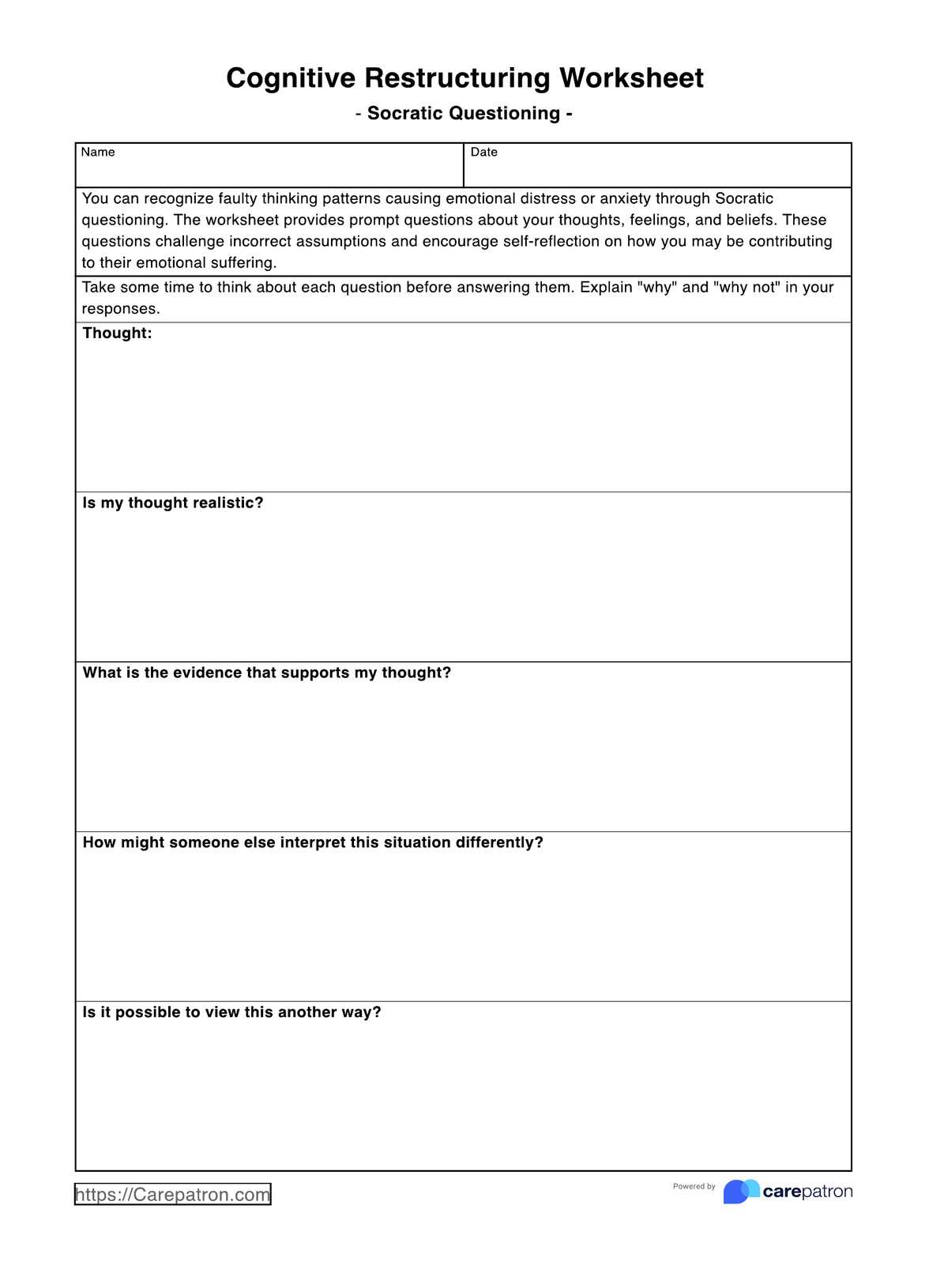
Looking for a tool that can help your patients recognize and reconfigure their negative thought patterns? Read our guide to learn more about how cognitive restructuring transforms unhelpful beliefs and how to practice cognitive restructuring techniques effectively. Download our free Cognitive Restructuring Worksheet to help your clients identify and address the distorted thinking that contributes to anxiety, depression, and other emotional difficulties.
## **Understanding cognitive restructuring**
Cognitive restructuring is a core technique within cognitive behavioural therapy (CBT) that helps individuals recognize, challenge, and modify unhelpful thought patterns. First developed by Aaron Beck and later refined by practitioners worldwide, this approach operates on the principle that our thoughts, emotions, and behaviors are interconnected. Specifically, when we change our perspective on a situation, we can shift how we feel and respond to it (Chand et al., 2023).
The process begins with awareness—learning to notice automatic thoughts as they occur. These are the rapid, often unconscious interpretations our minds generate in response to everyday situations. Sometimes these thoughts reflect reality accurately, but other times they're shaped by cognitive distortions—systematic errors in thinking like all-or-nothing reasoning, catastrophizing, or overgeneralization. When left unchallenged, distorted thoughts can reinforce negative emotions, low self-esteem, and maladaptive behaviors.
Cognitive therapy techniques like Socratic questioning help clients step back and examine their thoughts with curiosity rather than judgment. By asking questions such as "What evidence supports this thought?" or "How might someone else view this situation?", clinicians guide patients toward more balanced, realistic perspectives. This method doesn't force positive thinking—it encourages accurate thinking grounded in facts rather than assumptions.
Cognitive restructuring is widely employed in treating depression, anxiety disorders, stress-related conditions, and challenges with relationships or confidence. It's also integrated into approaches like behavioral activation for mood improvement and problem-solving therapy. Similar to CBT in principle, the goal isn't to eliminate difficult emotions but to help clients respond to their experiences more flexibly, reducing emotional suffering while building insight and resilience (American Psychological Association, 2017).
## **What is a Cognitive Restructuring Worksheet?**
A Cognitive Restructuring Worksheet is designed to help individuals identify [cognitive distortions](https://www.carepatron.com/templates/cognitive-distortions-pdf) and change negative thinking patterns. It is an effective way to practice cognitive restructuring along with other types of CBT worksheets.
Most cognitive restructuring tools walk users through several key components:
- **Situation identification**: Recording the specific event or context that triggers distress
- **Thought documentation**: Writing down the immediate, automatic thoughts that appeared
- **Emotional response**: Noting the feelings and intensity of emotions experienced
- **Evidence examination**: Listing facts that support or contradict the original thought
- **Alternative perspectives**: Generating more balanced or helpful interpretations
- **Outcome reflection**: Assessing how the new perspective affects mood and future actions
You can use these worksheets in various settings, including individual therapy sessions, group psychotherapy, homework assignments, or self-guided practice. Therapists working with cognitive-behavioral approaches often introduce these approaches early in treatment to help clients develop skills in recognizing and modifying distorted thinking. They're particularly valuable for addressing irrational thoughts, challenging deeply held underlying beliefs, and developing awareness of recurring mental patterns.
Mental health practitioners such as psychologists, counselors, and social workers effectively use these tools to help clients with conditions like anxiety, depression, and trauma-related symptoms. The worksheets provide structure when patients feel stuck, offering a clear pathway from identifying a problem to taking action toward change.
However, cognitive restructuring has its limitations. It requires a degree of insight and abstract reasoning that may not be suitable for everyone, especially those in acute crisis or with specific cognitive impairments. Some clients find the process intellectually demanding or struggle to access alternative perspectives when overwhelmed by emotion.
Cognitive restructuring is also not about promoting toxic positivity or forcing clients to "just think differently." Rushing the process or dismissing someone's emotions can backfire, making them feel invalidated. It works best when paired with empathy, validation, and attention to the real challenges someone faces in their life. For some, behavioral activation or acceptance-based strategies may be more helpful starting points before diving into cognitive work.
## **How to use this Cognitive Restructuring Worksheet**
Using a Cognitive Restructuring Worksheet can help you begin reframing negative thoughts through cognitive exercises. Here are some steps to get started with the worksheets:
### **Step 1: Download the worksheet**
The link on this page allows you to access our free Cognitive Restructuring Worksheet. You can click "Use template" to open and edit it within the Carepatron app or click "Download" to quickly get a PDF copy.
### **Step 2: Introduce the worksheet**
Introduce the worksheet during a session when you've identified a specific automatic thought or recurring pattern causing distress. Explain that the goal isn't to force positivity but to examine whether their interpretation reflects reality.
### **Step 3: Ask your patient to fill out the worksheet**
Have your patient complete the worksheet either in session (allowing you to guide them through difficult spots) or as homework between appointments. Encourage them to take time with each question and write out full responses rather than quick answers.
### **Step 4: Review the worksheet together**
Review the completed worksheet together. Focus on the evidence they gathered, alternative perspectives they generated, and any shifts in emotional intensity. Ask what they notice about their thinking after working through the exercises.
Help them apply their insights to future situations. Discuss how they might use these questions when similar thoughts arise, building their capacity to respond more flexibly without always needing the worksheet in front of them.
## **Related tools and resources**
Cognitive restructuring works best when paired with other evidence-based techniques. Here are complementary tools available through Carepatron that can support your clients' progress:
- **[Cognitive Distortions Worksheet](https://www.carepatron.com/files/cognitive-distortions-worksheets.pdf)**: This resource helps clients identify specific types of distorted thinking, such as catastrophizing, mind-reading, and all-or-nothing reasoning. Use it before introducing cognitive restructuring to build awareness of common mental traps, or alongside restructuring worksheets to deepen understanding of recurring patterns.
- **[Thought Record Template](https://www.carepatron.com/templates/thought-record-template/)**: This is a more comprehensive CBT tool that tracks the full sequence from situation to thought to emotion to behavior. It's valuable for clients ready to analyze multiple triggers and responses systematically, effectively putting their insights into practice across various contexts in their lives.
- **[Behavioral Activation Worksheet](https://www.carepatron.com/files/behavioral-activation-worksheets.pdf)**: When depression or avoidance keeps someone stuck, changing behavior can precede changing thoughts. This worksheet helps clients schedule meaningful activities that improve mood and energy, creating a foundation that makes cognitive work feel more manageable.
- **[Socratic Questioning Worksheet](https://www.carepatron.com/templates/socratic-questioning-worksheet/)**: The Socratic Questioning Worksheet is a standalone version that focuses specifically on the Socratic method. Useful for clients who gain the most benefit from this particular approach and want additional practice challenging their assumptions through structured dialogue.
These tools aren't meant to replace clinical judgment or the therapeutic relationship. Instead, they help structure the work you're already doing. Choose the resources that match where your client is in their process, their learning style, and the specific challenges they're working to address.
## **References**
American Psychological Association. (2017). What is cognitive behavioral therapy? Clinical Practice Guideline for the Treatment of Depression. https://www.apa.org/ptsd-guideline/patients-and-families/cognitive-behavioral
Chand, S. P., Kuckel, D. P., & Huecker, M. R. (2023, May 23). Cognitive behavior therapy (CBT). National Library of Medicine; StatPearls Publishing. https://www.ncbi.nlm.nih.gov/books/NBK470241/
Commonly asked questions
A cognitive restructuring worksheet helps individuals identify, examine, and modify unhelpful thought patterns that contribute to emotional distress. It's used in cognitive behavioral therapy to guide clients through the process of challenging automatic thoughts, evaluating evidence, and developing more balanced perspectives that reduce anxiety, depression, and other difficult emotions.
Cognitive restructuring works well for clients who can engage in self-reflection and are willing to examine their thinking patterns. It's particularly helpful for those struggling with negative thinking, catastrophizing, or irrational thoughts that fuel anxiety and mood issues. However, it may not be the best starting point for clients in acute crisis, those with severe cognitive impairments, or individuals who need behavioral activation or stabilization before cognitive work.
Frequency depends on treatment goals and the patient's needs. Some clients benefit from completing a worksheet whenever they notice distressing automatic thoughts, while others use them as weekly homework between sessions. The key is regular practice.