






Attention Span TestsAI Template IconToolbar IconShare Icon

Attention Span Tests

Measure your focus with our Attention Span Test—a quick and accurate assessment for your cognitive abilities.

Bernard Ramirez avatar

By Bernard Ramirez on Aug 2, 2025.

Fact Checked by Ericka Pingol.

Use Template

What is an Attention Span Test?

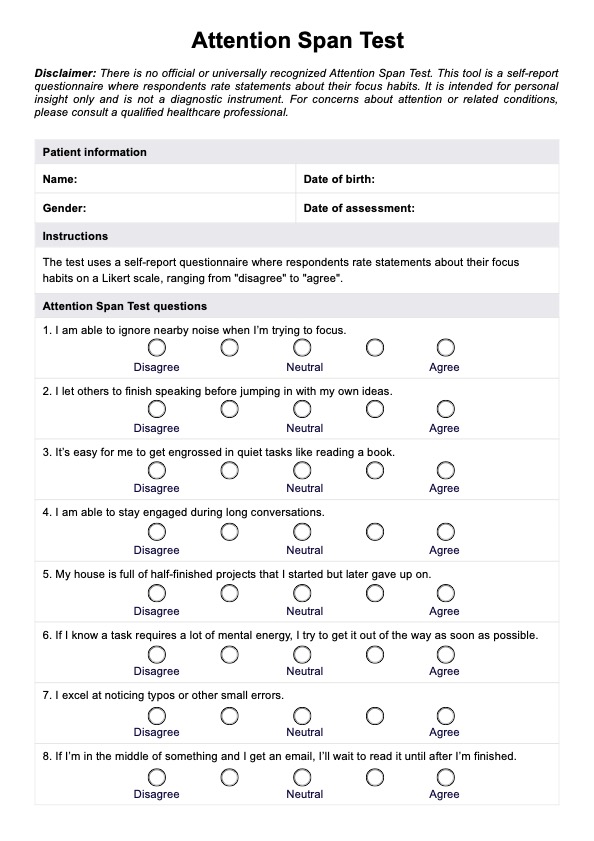
An Attention Span Test is a self-report questionnaire designed to help individuals better understand their ability to focus and maintain attention on tasks. Rather than serving as a clinical diagnostic tool, this type of test offers personal insight into everyday focus habits, with the goal of raising awareness about patterns that may impact productivity, learning, and relationships.

The test invites respondents to reflect on their typical attention-related behaviors—for example, whether they tend to finish tasks they start, get distracted easily, or can stay engaged during long conversations. Responses are rated on a Likert scale, with higher scores generally indicating stronger sustained attention.

It’s important to note that this type of Attention Span Test is not intended to diagnose attention disorders such as ADHD or other cognitive conditions. Instead, it serves as a helpful starting point for self-reflection. If concerns about attention difficulties arise, individuals should seek guidance from a qualified healthcare professional for further evaluation.

Attention span itself refers to the length of time a person can focus on a task without becoming distracted. It is a key factor in how efficiently one learns and completes daily activities. Becoming more aware of one’s attention patterns can empower individuals to adopt strategies that improve focus and enhance overall cognitive well-being.

Attention Span Tests Template

Download PDF Template

How does it work?

The Attention Span Test is a comprehensive cognitive assessment tool designed to evaluate an individual's ability to sustain attention and focus over various tasks. It assists healthcare practitioners in identifying attention-related challenges and cognitive functioning. The test comprises several attention span tasks that gauge different aspects of attention and cognitive processes.

Steps involved in using this template:

Step 1: Patient information

Begin by entering the patient's name, age, gender, and assessment date to establish a record.

Step 2: Instructions

Inform the patient to carefully read and complete each task as accurately as possible. Tasks should be performed in the specified order to correctly measure different aspects of attention.

Step 3: Task execution

Respondents rate statements about their focus habits—such as their ability to stay on task, manage distractions, and complete activities—using a Likert scale. The test does not require the execution of specific cognitive tasks or scoring by a clinician. Instead, total scores are calculated by summing responses, with higher scores reflecting stronger sustained attention. The results are intended to provide personal insight, not a clinical assessment.

Step 4: Notes and recommendations

Record observations and insights based on the patient's performance. Tailor recommendations, interventions, and strategies to improve attention span as necessary. Provide feedback on factors such as focus, accuracy, and performance.

Step 5: Review and discussion

Sit down with the patient to review the results. Discuss strengths, weaknesses, and potential areas of concern. Collaborate on strategies for addressing any attention-related challenges and improving cognitive function in daily life.

When would to use this form?

The Attention Span Test Form is a versatile and valuable tool for healthcare practitioners seeking to assess and enhance patients' cognitive focus and attention spans. Here are vital scenarios when this form can be effectively employed:

Diagnostic assessment

Clinicians, neuropsychologists, and psychiatrists can administer the Attention Span Test to evaluate attention-related challenges and identify potential cognitive disorders, such as attention-deficit hyperactivity disorder (ADHD) or mild cognitive impairment. It is useful in diagnosing ADHD or ruling out related conditions.

Treatment planning

Psychologists and occupational therapists can use the form to gather insights into patients' attention abilities, enabling them to tailor treatment plans and interventions to specific cognitive needs. For example, insights can lead to interventions that help adults sustain attention across an extended period.

Monitoring progress

Educational professionals and special educators can utilize the form to track students' attention spans over time, ensuring the effectiveness of interventions and educational strategies within various educational settings.

Rehabilitation programs

Physical and cognitive rehabilitation specialists can integrate the form into rehabilitation programs, helping patients recover focus and attention following neurological injuries or conditions. Different studies have demonstrated the importance of addressing attention in rehabilitation.

Workplace assessments

Occupational health practitioners can apply the form to assess employees' attention spans in demanding work environments, informing workplace adjustments or accommodations.

Geriatric care

Geriatric specialists can employ the form to evaluate attention changes in older adults, aiding in the early detection of cognitive decline and guiding appropriate care plans.

Research studies

Researchers investigating attention-related phenomena can utilize the form to gather standardized data, contributing to the advancement of cognitive science and healthcare knowledge. The use of cognitive tests such as these has proven useful in recognizing subtle deficits across different populations.

Telehealth sessions

Remote healthcare providers can incorporate the form into virtual assessments, offering a comprehensive evaluation of patients' attention spans regardless of location.

Parental guidance

Pediatricians and child psychologists can share the form with parents, enabling them to assess their children's attention spans and seek professional guidance if necessary.

Wellness programs

Health coaches and wellness practitioners can use the form to measure attention spans as part of comprehensive wellness assessments, fostering cognitive health awareness.

Benefits

Employing the Attention Span Test Form offers a range of advantages, empowering healthcare practitioners to enhance patient care, foster cognitive well-being, and contribute to advancing the field of cognitive science.

Comprehensive assessment

The Attention Span Test Form offers a structured approach to evaluating various facets of attention, including selective attention and sustained attention, providing a holistic view of an individual's cognitive capabilities.

Early detection

Free Attention Span Tests enable early identification of attention-related challenges, allowing for timely intervention and management of cognitive disorders such as ADHD and mild cognitive impairment.

Tailored interventions

The form's quantitative insights facilitate personalized treatment planning, enabling healthcare professionals to design targeted interventions to enhance attention spans and improve cognitive well-being in daily life.

Progress monitoring

Regular use of the form allows for ongoing tracking of attention improvements over time, enabling practitioners to measure the effectiveness of interventions and recognize differences in response across individuals.

Evidence-based care

Healthcare practitioners can make informed decisions based on standardized assessment data, ensuring evidence-based care for patients' cognitive health.

Patient empowerment

By engaging patients in attention-span assessments, the form empowers individuals to take an active role in their cognitive well-being and pursue strategies for improvement.

Enhanced communication

The form's results provide a common language for healthcare practitioners, educators, and caregivers to discuss attention-related concerns and collaborate on care plans, using data to guide discussions.

Versatile application

The form accommodates diverse healthcare and assessment scenarios and is suitable for various settings, including clinics, schools, workplaces, and remote telehealth sessions.

Resource efficiency

The availability of free Attention Span Tests in a downloadable format eliminates the need for creating assessment tools from scratch, saving valuable time and resources.

Research insights

Aggregated data from form usage can contribute to research studies, enriching the understanding of attention spans and cognitive health in different populations.

Research & evidence

While there is no single official or universally recognized Attention Span Test, tools like the one offered by Psychology Today (2019) are grounded in well-established concepts from cognitive psychology and attention research.

Attention span is known to play a crucial role in academic performance, workplace success, and interpersonal relationships. Self-report questionnaires, like the Psychology Today Attention Span Test, provide an accessible way for individuals to explore their own focus habits in a structured manner.

However, it is important to emphasize that self-assessments of attention are not a substitute for professional evaluation. They offer a helpful snapshot of one’s perceived attention patterns but do not provide a clinical diagnosis or validated measure of cognitive functioning. For individuals concerned about possible attention-related challenges, consultation with a qualified healthcare provider remains the gold standard.

As tools like the Psychology Today Attention Span Test evolve, they continue to encourage greater self-awareness around focus, distraction, and attention management in everyday life.

References

Psychology Today. (2019). Attention span test. Psychology Today. https://www.psychologytoday.com/us/tests/personality/attention-span-test

Commonly asked questions

Assessing attention span is crucial because attention is a fundamental cognitive function that impacts daily life, including learning, work performance, and overall cognitive well-being. Identifying attention deficits early can lead to timely interventions and improved cognitive health.

Individuals of all ages, from students to adults, can benefit from taking an Attention Span Test. It benefits those experiencing attention-related challenges, cognitive disorders (e.g., ADHD), or seeking to enhance their cognitive abilities.

Attention Span Tests typically involve a series of tasks that require the individual's active participation. These tasks can be presented visually, auditorily, or through a combination. The individual's performance is then evaluated based on accuracy and ability to sustain attention during the tasks.

EHR and practice management software

Get started for free

*No credit card required

Free

$0/usd

Unlimited clients

Telehealth

1GB of storage

Client portal text

Automated billing and online payments






