




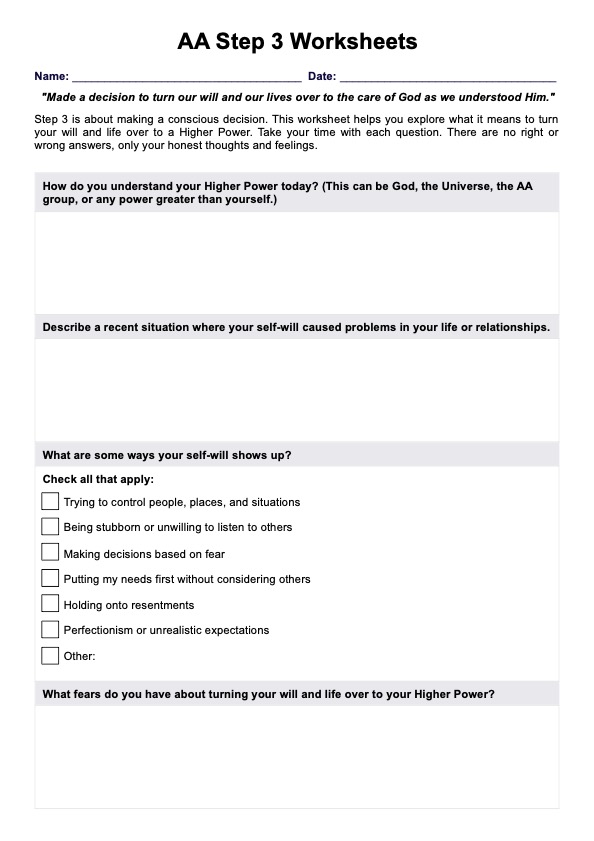



AA Step 3 Worksheets

## **What is an AA Step 3 Worksheet?**
The third step of Alcoholics Anonymous is one of the most transformative moments in recovery. Here, individuals make the profound decision to turn their will and their own lives over to the care of God as they understood Him (Alcoholics Anonymous, n.d.). A Step 3 worksheet shelps clients navigate this action step in their spiritual path toward achieving sobriety and spiritual growth.
This essential tool breaks down the complex process of surrendering complete control and embracing a power greater than themselves. The worksheet addresses the challenges many face when moving from the first two steps—admitting powerlessness in the first step and coming to believe that a higher power can restore sanity—to actually making the decision to turn their lives over to that higher power.
An AA Step 3 Worksheet typically includes sections for exploring one's current concept of a higher power, examining how self will affect their everyday life, and identifying specific areas where they're ready to practice surrender.
Many worksheets incorporate elements of the Serenity Prayer, helping clients distinguish between things they can and cannot change. The process encourages honest reflection on personal experience while respecting diverse religious beliefs and spiritual understanding.
AA Step 3 Worksheets Template
## **How to use the AA Step 3 Worksheet**
The AA Step 3 Worksheet works best when clients approach it with openness and honesty. This process and its steps bear witness to the shift from trying to control their recovery through willpower alone to accepting support from a higher power working in their lives.
### **Step 1: Access and download the template**
Healthcare practitioners can easily obtain the AA Step 3 Worksheet by clicking "Use template" to open a customizable file within the Carepatron platform before printing or sending to clients, or selecting "Download" to get a PDF copy for immediate use.
### **Step 2: Create a supportive environment**
Begin by establishing a safe space where clients feel comfortable exploring their relationship with a power greater than themselves. Explain that this worksheet connects to both the previous steps and prepares them for the fearless moral inventory that follows in Step 4. Emphasize that their personal experience and current understanding of spirituality are valid starting points.
### **Step 3: Guide clients through self-reflection**
Encourage clients to work through each section thoughtfully. Allow them to explore how their attempts to maintain complete control have impacted their everyday life and relationships.
The worksheet should prompt examination of their willingness to accept a new way of living and their readiness to let thy power guide their decisions rather than relying solely on their own way of thinking.
### **Step 4: Process responses together**
Review completed worksheets during sessions to explore emerging themes around surrender, fear, and spiritual growth. The process often reveals both their struggles with letting go and their growing sense that recovery requires more than individual effort.
### **Step 5: Develop practical applications**
Work with clients to identify specific ways they can practice Step 3 principles in their daily lives. This might include morning prayers acknowledging thy love and thy way, or evening reflections on how they witnessed their higher power working throughout the day.
The goal is to translate the abstract idea of surrender into concrete actions that support their sober life.
## **When should you use these Step 3 AA worksheets?**
The timing of introducing an AA Step 3 Worksheet requires careful consideration of where clients are in their recovery journey and their readiness to explore spiritual concepts.
This tool becomes most effective when clients have gained some stability and are genuinely ready to examine their relationship with control and spirituality for a better life.
- **Early recovery stabilization**: Clients typically benefit from Step 3 work after completing their first two steps and achieving some initial sobriety milestones.
- **Resistance to powerlessness concepts**: When clients struggle with the idea that they cannot achieve sobriety through willpower alone, the AA Step 3 Worksheet helps bridge the gap between intellectual understanding and emotional acceptance.
- **Spiritual exploration readiness**: This tool respects diverse religious beliefs while encouraging exploration of what "god as we understood" means personally. It works equally well for those with traditional faith backgrounds and those exploring spirituality for the first time in recovery.
- **Transition between treatment phases**: During the movement from intensive early treatment to longer-term recovery maintenance, the Step 3 worksheet helps clients develop internal resources for ongoing sobriety.
- **Crisis or relapse prevention**: When clients face significant challenges or report feeling overwhelmed by life circumstances, returning to Step 3 principles through worksheet exercises can restore their sense of connection to their spiritual path.
## **Benefits of using Step 3 AA worksheet**
These benefits impact both immediate therapeutic progress and long-term recovery outcomes through a new path of structured spiritual exploration and practical application of surrender principles.
### **Enhanced spiritual development**
The worksheet facilitates meaningful spiritual growth by providing a framework for clients to explore their relationship with a power greater than themselves.
The structured format helps clients move beyond abstract spiritual concepts to develop a practical understanding of how their higher power can support their ultimate goal of sustained recovery.
### **Reduced anxiety and fear**
The worksheet helps clients discover that letting go actually reduces rather than increases their anxiety. The process of writing about their struggles with control often leads to the realization of how their self-will affected their inner landscape and created more problems than solutions. This leads to clients' improved well-being.
### **Improved therapeutic alliance**
Working through Step 3 materials together strengthens the therapeutic relationship by creating opportunities for deep, meaningful conversations about a hundred forms that power and spirituality can take.
### **Foundation for continued growth**
Completing Step 3 work establishes the spiritual foundation necessary for successfully navigating subsequent steps in the AA program. The commitment to turn one's life over to a higher power provides the courage needed for the fearless moral inventory of Step 4 and the willingness to make amends that comes later.
## **Reference**
Alcoholic Anonymous. (n.d.). Practicing step three is like the opening of a door. https://www.aa.org/sites/default/files/2022-01/en_step3.pdf
Commonly asked questions
Individuals in addiction recovery, specifically those following the 12-step program in Alcoholics Anonymous, use AA Step 3 Worksheets.
AA Step 3 Worksheets are used when individuals work on the third step of the AA program, which involves surrendering their will and life to a higher power.
They are used as structured tools to guide self-reflection, explore spirituality, and solidify one's commitment to recovery. Individuals answer questions and prompts to facilitate this process.










EHR and practice management software
Get started for free
*No credit card required
Free
$0/usd
Unlimited clients
Telehealth
1GB of storage
Client portal text
Automated billing and online payments