Everyone has a story to tell, and here we share and celebrate those who chose care as their life's work.
These are their words, their work and we're grateful to share them.
Elizabeth and Dennis handed their billing to Carepatron and grew My Therapeutic Concepts from five clients to seventy in two months, without losing their evenings.
## **What is an AA Step 5 Worksheet?**
An AA Step 5 Worksheet is a vital tool within the context of Alcoholics Anonymous (AA), a well-known and highly regarded mutual support program designed to help individuals overcome alcohol addiction. Step 5 is one of the 12 steps of the AA program, and it involves admitting to a higher power, oneself, and another human being the exact nature of one's wrongs and past mistakes. This reflects the importance of alcohol addiction recovery.
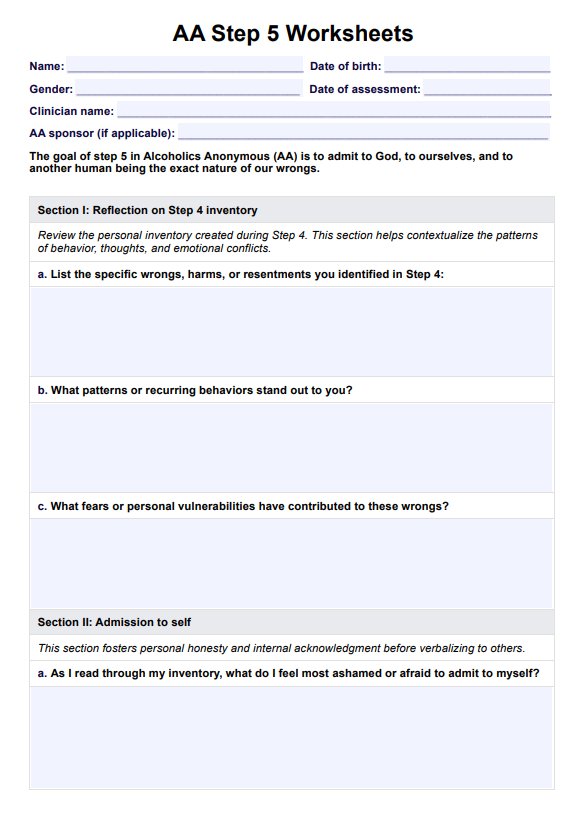
The AA Step 5 Worksheet serves as a structured guide to assist individuals in completing this crucial step. It encourages members to reflect deeply on their past actions, behaviors, and the harm they may have caused themselves and others due to alcoholism. This encourages individuals to look back on behaviors that reflect underlying character defects.
Typically, an AA Step 5 Worksheet consists of a series of questions and prompts that prompt individuals to:
- Make a comprehensive moral inventory of themselves, acknowledging character defects, resentments, fears, and harmful actions.
- Consider the underlying causes and motivations behind their harmful behaviors and patterns.
- Identify specific instances where they have harmed others emotionally, physically, or otherwise.
- Explore how alcohol addiction has played a role in their actions and decisions.
- Reflect on their readiness to share this inventory with others and their higher power.
Completing this worksheet is an essential part of the continued recovery process in AA, as it helps individuals gain clarity and self-awareness about their past behavior, paving the way for personal growth and healing. Sharing this inventory with another human being, often a sponsor or trusted person, provides accountability and support. This reflects the importance of addiction recovery.
## **How does it work?**
Carepatron’s AA Step 5 Worksheet is designed to seamlessly integrate into your clinical workflow. This structured tool helps guide patients through a safe, therapeutic admission of their wrongs in alignment with Alcoholics Anonymous practices, while also allowing you to provide clinical insight, emotional support, and accountability. This reflects the importance of underlying character defects.
### **Step 1: Access the template**
Click “Use template” on this page to instantly access the worksheet through the Carepatron app. This will allow you to customize the worksheet before printing or giving it to clients. You can also click "Download" to get a PDF copy.
### **Step 2: Use the template during patient assessment**
Explain how the worksheet encourages self-awareness, spiritual openness, and trust-building through confession. During your session, open the template and begin filling it out collaboratively with your patient. The guided prompts help facilitate self-reflection, honesty, and spiritual connection, all while offering a clinically supportive environment for emotional disclosure.
### **Step 3: Go through the inventory process with the patient**
Support your patient as they revisit their Step 4 inventory, helping them identify key patterns, fears, and wrongs. Use clinical judgment to guide conversations gently while allowing the patient to express vulnerability, gain insight, and prepare for spiritual and interpersonal admissions.
### **Step 4: Provide patient support and next steps**
Offer trauma-informed guidance, assess emotional readiness, and identify safe, trusted individuals the patient might share their Step 5 with. Provide follow-up planning, including therapy, group support, or spiritual counseling.
## **Who can use this form?**
The AA fifth step worksheet is a valuable resource that various practitioners and individuals can utilize within Alcoholics Anonymous (AA) and addiction recovery. The following are people or entities who can use this worksheet:
### **Addiction counselors and therapists**
Addiction professionals can introduce the AA Step 5 Worksheet as a part of their therapy sessions for clients in recovery. It serves as a structured tool to guide clients through acknowledging past wrongs and exploring the underlying causes of their addiction.
### **AA sponsors**
Sponsors play a crucial role in guiding newcomers through the 12-step program. They can use the AA Step 5 Worksheet to facilitate the completion of Step 5, helping sponsees inventory their resentments, fears, and character defects and providing a supportive environment for sharing.
### **Group therapy practitioners**
In group therapy settings focused on addiction recovery, therapists can incorporate the AA Step 5 Worksheet as an individual or group activity. This encourages participants to delve into their experiences, fostering peer support and insight.
### **Rehabilitation centers**
Rehab centers often integrate AA principles into their treatment programs. The AA Step 5 Worksheet can be a structured exercise in these settings, aiding residents in addressing their past actions and contributing to their overall recovery plan.
### **Self-help and support groups**
Beyond AA meetings, various self-help and support groups for addiction recovery can introduce the AA Step 5 Worksheet to members. This provides a structured means for individuals to work on their inventory in a group context.
### **For individuals practicing self-reflection**
Anyone on the path to recovery, whether actively involved in AA or not, can use the AA Step 5 Worksheet for personal reflection and growth. It's a valuable resource for anyone seeking to address past wrongs and character defects as part of their recovery journey.
## **Benefits**
Using this worksheet in your clinical practice offers the following benefits:
### **Structured self-examination**
These worksheets offer a structured approach to self-examination, helping individuals systematically identify and acknowledge resentments, fears, and character defects, which is vital for personal growth.
### **Personal accountability**
By listing past wrongs and taking responsibility for one's actions, AA Step 5 Worksheet users gain a sense of personal accountability, a cornerstone of addiction recovery.
### **Emotional healing**
Sharing one's inventory with a trusted confidant provides a cathartic release, promoting emotional healing and reducing the burden of guilt and shame.
### **Guidance in recovery**
For newcomers to AA or those unfamiliar with the 12-step process, these free worksheets serve as an accessible guide, ensuring they navigate Step 5 effectively and remain on the path to recovery.
### **Enhanced support**
AA Step 5 Worksheets foster community and support, as individuals often share their inventories with sponsors or peers, receiving valuable feedback and encouragement.
## **Research & evidence**
The AA Step 5 Worksheet is a fundamental tool within the context of Alcoholics Anonymous (AA), a mutual support program established in the 1930s to assist individuals in recovering from alcohol addiction (Kelly, 2017). While the AA program has a long history of anecdotal success and widespread adoption, the specific history of the AA Step 5 Worksheet is not extensively documented.
Research and evidence regarding the effectiveness of AA and its various steps, including Step 5, primarily rely on qualitative and observational studies, personal testimonials, and clinical observations rather than traditional scientific research with control groups and randomized trials (Kaskutas, 2009). AA's anonymity and privacy principles make conducting formal research on its methods challenging (Kang & Hwang, 2023).
However, several studies published have explored the effectiveness of 12-step programs like AA (Donovan et. al., 2015). One such study found that participation in 12-step programs was associated with reduced alcohol use and increased abstinence rates among individuals with alcohol use disorders (Kelly et. al., 2020).
Another study suggested that AA involvement might lead to reduced impulsivity, a common contributing factor to addiction (Blonigen et. al., 2013).
It's important to note that while the AA Step 5 Worksheet is a crucial component of the AA program, the specific research and evidence supporting its effectiveness as an isolated tool may be limited. Instead, the overall success of AA and its steps is attributed to the program's comprehensive and holistic approach to addressing addiction and its peer support and accountability.
### **References**
Blonigen, D. M., Timko, C., & Moos, R. H. (2013). Alcoholics Anonymous and reduced impulsivity: A novel mechanism of change. Substance Abuse, 34(1), 4–12. https://doi.org/10.1080/08897077.2012.691448
Donovan, D. M., Ingalsbe, M. H., Benbow, J., & Daley, D. C. (2015). 12-step interventions and mutual support programs for substance use disorders: An overview. Social Work in Public Health, 28(3–4), 313–332. https://doi.org/10.1080/19371918.2013.774663
Kang, E., & Hwang, H.-J. (2023, March). The importance of anonymity and confidentiality for conducting survey research. ResearchGate. https://www.researchgate.net/publication/370048267_The_Importance_of_Anonymity_and_Confidentiality_for_Conducting_Survey_Research
Kaskutas, L. A. (2009). Alcoholics Anonymous effectiveness: Faith meets science. Journal of Addictive Diseases, 28(2), 145–157. https://doi.org/10.1080/10550880902772464
Kelly, J. F. (2017). Is Alcoholics Anonymous religious, spiritual, neither? Findings from 25 years of mechanisms of behavior change research. Addiction, 112(6), 929–936. https://doi.org/10.1111/add.13590
Kelly, J. F., Humphreys, K., & Ferri, M. (2020). Alcoholics Anonymous and other 12-step programs for alcohol use disorder. Cochrane Database of Systematic Reviews, 2020(3), Article CD012880. https://doi.org/10.1002/14651858.cd012880.pub2
Commonly asked questions
Yes, digital tools and apps, like Carepatron, are designed to assist individuals in completing and managing their Step 5 inventory. These tools provide a secure and convenient way to engage in the recovery process.
The frequency of revisiting Step 5 varies from person to person. Some individuals may review it periodically as part of their ongoing self-improvement, while others may focus on it once during their initial recovery. It ultimately depends on individual needs and goals.
While Step 5 is a part of the AA program designed explicitly for alcohol addiction recovery, the concept of self-inventory and sharing can be adapted for addressing other personal issues and emotional healing process outside of addiction recovery. However, consulting with a qualified therapist or counselor for guidance is essential.