Everyone has a story to tell, and here we share and celebrate those who chose care as their life's work.
These are their words, their work and we're grateful to share them.
Elizabeth and Dennis handed their billing to Carepatron and grew My Therapeutic Concepts from five clients to seventy in two months, without losing their evenings.
Looking for AA step worksheets to provide to your patients undergoing rehabilitation for alcohol use disorder/addiction? Read our guide to learn about the AA Step 2, then use our AA Step 2 Worksheet to have them reflect on their addiction and sobriety.
## **What is Alcoholics Anonymous (AA)?**
Alcoholics Anonymous (AA) is a globally recognized, community-based program designed to support individuals grappling with alcohol-related issues. This self-help group follows a structured 12-step approach, empowering members to acknowledge their lack of control over alcohol and take steps toward lasting recovery and personal redemption. It welcomes anyone who wants to put a stop to their alcohol addiction, abuse, and dependence with open arms (Alcoholics Anonymous, 2024).
### **What are the twelve steps of Alcoholics Anonymous?**
The Twelve Steps are the premier program of Alcoholics Anonymous. Think of it as their version of the Twelve Commandments. Speaking of Twelve Commandments, please note that Alcoholic Anonymous incorporates aspects of the Christian/Catholic faith in their program (Alcoholics Anonymous, 2025), so, unless your patient/client is open to taking such a program, please direct them to an alternative. If they're willing to undergo such a program, then by all means, please promote Alcoholics Anonymous and their Twelve Steps to them.
The Twelve Steps are the following:
1. We admitted we were powerless over alcohol — that our lives had become unmanageable.
2. Came to believe that a Power greater than ourselves could restore us to sanity.
3. Made a decision to turn our will and our lives over to the care of God as we understood Him.
4. Made a searching and fearless moral inventory of ourselves.
5. Admitted to God, to ourselves, and to another human being the exact nature of our wrongs.
6. Were entirely ready to have God remove all these defects of character.
7. Humbly asked Him to remove our shortcomings.
8. Made a list of all persons we had harmed, and became willing to make amends to them all.
9. Made direct amends to such people wherever possible, except when to do so would injure them or others.
10. Continued to take personal inventory and when we were wrong promptly admitted it.
11. Sought through prayer and meditation to improve our conscious contact with God as we understood Him, praying only for knowledge of His will for us and the power to carry that out.
12. Having had a spiritual awakening as the result of these Steps, we tried to carry this message to alcoholics, and to practice these principles in all our affairs.
### **What is AA Step 2?**
The second step in AA states: “We came to believe that a Power greater than ourselves could restore us to sanity.” Step 2 is a pivotal stage in the 12-step journey, representing a shift from self-will to the belief that a greater power can guide individuals toward sobriety and mental clarity.
At this point in their recovery, individuals begin to accept the possibility that they cannot stay sober through willpower alone. Instead, they start to explore the idea that a higher power, however they choose to define it, can provide strength, stability, and guidance in their journey. Step 2 is founded on hope, humility, and the willingness to seek help beyond oneself (What Is Step 2 of Alcoholics Anonymous?, n.d.).
## **What is an AA Step 2 Worksheet?**
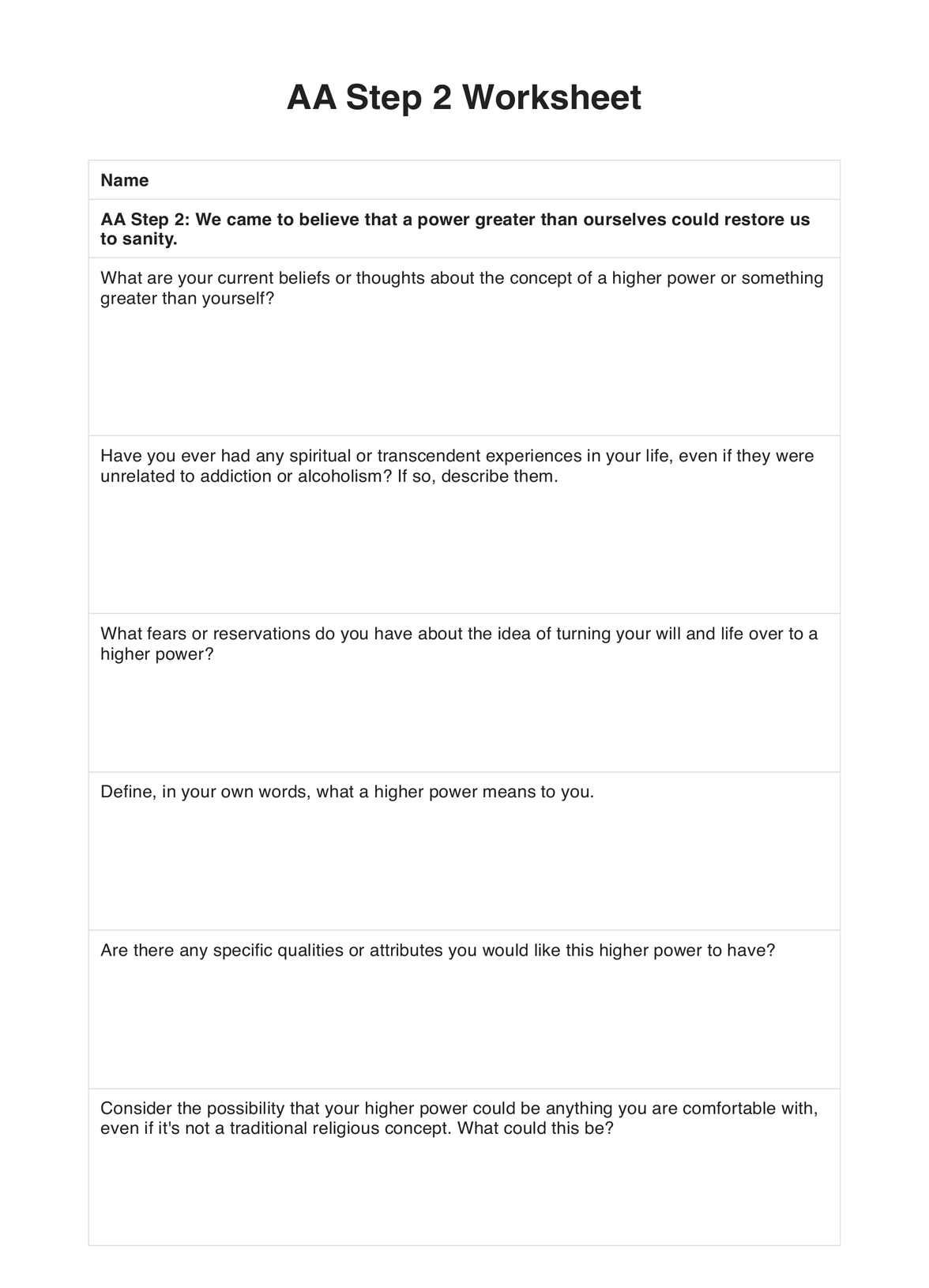
An AA Step 2 Worksheet is a valuable resource for individuals progressing in their recovery journey. This worksheet assists individuals in deepening their understanding of the concept of a higher power, exploring their beliefs, and fostering a sense of willingness to embrace this power in their quest to stay sober.
The worksheet encourages reflection on personal definitions of spirituality, past experiences with control and self-will, and current openness to guidance from a greater power. It provides an opportunity for self-discovery, spiritual growth, and developing an open-minded attitude, key elements for moving forward in the 12-step process and maintaining sobriety.
The AA Step 2 Worksheet is an excellent resource for guiding your client in exploring their belief in a higher power. By working through the prompts, you can provide support as they deepen this spiritual connection and achieve spiritual awakening that may lead them to a better life.
This worksheet is a platform for meaningful discussions between you and your client. The prompts can spark conversations about spiritual beliefs, experiences, and the role of a higher power in their recovery journey, strengthening your therapeutic relationship and enhancing the recovery process.
## **How to use the AA Step 2 Worksheet**
Our free AA Step 2 Worksheet is simple to use. All your patient needs to do is to answer the several questions it asks after reflecting on each one. Here's how to use it:
### **Step 1: Download the worksheet**
Click "Use Template" or "Download" to receive a copy of our free AA Step 2 Worksheet. You can also get a copy from the Carepatron app or our resource library.
### **Step 2: Explain the template to your client**
Introduce the AA Step 2 Worksheet and explain its purpose. Encourage your client to work through the worksheet thoughtfully and openly. Remind them they can take as much time as needed to complete it.
Here are the questions and prompts they need to think about and answer:
- What are your current beliefs or thoughts about the concept of a higher power or something greater than yourself?
- Have you ever had any spiritual or transcendent experiences in your life, even if they were unrelated to addiction or alcoholism? If so, describe them.
- What fears or reservations do you have about the idea of turning your will and life over to a higher power?
- Define, in your own words, what a higher power means to you.
Are there any specific qualities or attributes you would like this higher power to have?
- Consider the possibility that your higher power could be anything you are comfortable with, even if it's not a traditional religious concept. What could this be?
- How willing are you to set aside your doubts and open your mind to the possibility of a power greater than yourself? Rate your willingness on a scale from 1 to 10 (1 being not willing at all, 10 being very willing).
- What steps can you take to increase your willingness and open-mindedness regarding a higher power?
- List some books, resources, or people you can talk to for further exploration and understanding of the concept of a higher power.
- Consider discussing your beliefs and doubts about a higher power with someone you trust or a sponsor. Write down any insights or guidance you receive.
- Write a brief statement of commitment to working Step 2 and being open to the idea of a higher power guiding your recovery.
### **Step 3: Guide your client through the worksheet**
Help your client complete the worksheet and discuss their responses along the way. Use this opportunity to provide additional insights and clarity to any points that may be confusing or difficult for them to understand. Assure them, too, and make sure they're in a safe space to share their thoughts without fear of being judged.
### **Step 4: Follow up with your client**
Maintain regular communication with your client to monitor their progress and the impact of the worksheet. Offer support and encouragement as needed to keep them on their recovery path. Remember that worksheets can make the Twelve Step program more meaningful because they create opportunities to help them reflect and write down their thoughts.
## **Other AA step worksheets you can use**
Please note that we have other worksheets for all the steps with detailed information. Our Step 6 Worksheets are for becoming ready for a higher power or purpose and helping one eliminate one's character "defects." The Step 12 Worksheets are the culmination of the whole program.
We also have worksheets for the other steps:
- **Step 1 Worksheets**: This is meant for coming to terms with failing to fight against alcohol. It's for reflecting on one's relationship with alcohol prior to the AA program.
- **Step 3 Worksheets**: This is for discussing how their views on the concept of a higher power have impacted their recovery journey, what they fear about it, what reservations they have, and how they developed trust in a higher power, whatever that means for the patient/client.
- **Step 4 Worksheets**: This is used to reflect on one's own fears, resentment, and character defects, all of which could be factors as to why one became addicted/dependent on alcohol in the first place. This also aims to identify any behavioral and emotional patterns that develop because of their fears, resentment, and character defects.
- **Step 5 Worksheets**: This is used to reflect on what they wrote in the Step 4 Worksheet. They will discuss what they're ashamed about and what they are afraid to admit to themselves, while admitting it to themselves. They will also reflect on how they can accept these flaws as something part of them without self-condemnation.
- **Step 7 Worksheets**: This is for reflecting on one's shortcomings. They will think about how these shortcomings persisted, if they're ready to let go of these shortcomings, and what changes they want to happen or expect after letting them go.
- **Step 8 Worksheets**: This is for reflecting on the people they've harmed. Friends, family, co-workers, everybody they've harmed. This is where they can discuss how they've caused harm, how bad it got, and how they plan to make amends.
- **Step 9 Worksheets**: This is still about making amends. Here, they will list all the people one wants to make amends with. They will also discuss anything that might make them hesitant, as well as what their sponsor thinks of the list and reasons for wanting to make amends or not (just in case it is deemed that trying that might make things worse for certain people).
- **Step 10 Worksheets**: This serves as a self-checkup. Those engaging with this worksheet will reflect on whether they've been resentful, dishonest, and fearful throughout the day. But it's not just feeling negative emotions. They will also discuss if they were kind and loving to people, and how they took care of themselves throughout the day.
- **Step 11 Worksheets**: This is for discussing morning and evening prayer and meditation rituals, how they feel when engaging in either one, and what insights they've obtained from these rituals.
## **References**
Alcoholics Anonymous. (2025). The Twelve Steps. www.aa.org. https://www.aa.org/the-twelve-steps
Alcoholics Anonymous. (2024). What is A.A.? www.aa.org. https://www.aa.org/what-is-aa
What Is Step 2 of Alcoholics Anonymous? (n.d.). alcohol.org. https://alcohol.org/alcoholics-anonymous/step-2/
Commonly asked questions
AA Step 2 Worksheets are typically used by individuals in the early stages of recovery from alcohol use disorder. These worksheets provide a structured tool to help clients explore their beliefs in a higher power and foster a willingness to embrace this concept in their journey to sobriety.
AA Step 2 Worksheets are typically used after a client has completed AA Step 1 and is ready to delve deeper into their spiritual beliefs and the idea of a higher power. They are a valuable resource during the early stages of recovery.
The AA Step 2 Worksheet can aid a person in recovery by providing a structured framework for exploring beliefs in a higher power and developing a willingness to accept the assistance of this higher power in their journey to sobriety.