Everyone has a story to tell, and here we share and celebrate those who chose care as their life's work.
These are their words, their work and we're grateful to share them.
Elizabeth and Dennis handed their billing to Carepatron and grew My Therapeutic Concepts from five clients to seventy in two months, without losing their evenings.
Looking for a way to gauge the severity of a patient's anxiety? Read our guide to learn about what happens if anxiety is left unchecked and unaddressed, then use the Hamilton Anxiety Scale to assess your patients for the severity of their anxiety. It's a great tool to have when you're working to diagnose them with an anxiety disorder.
## **What is the Hamilton Anxiety Rating Scale?**
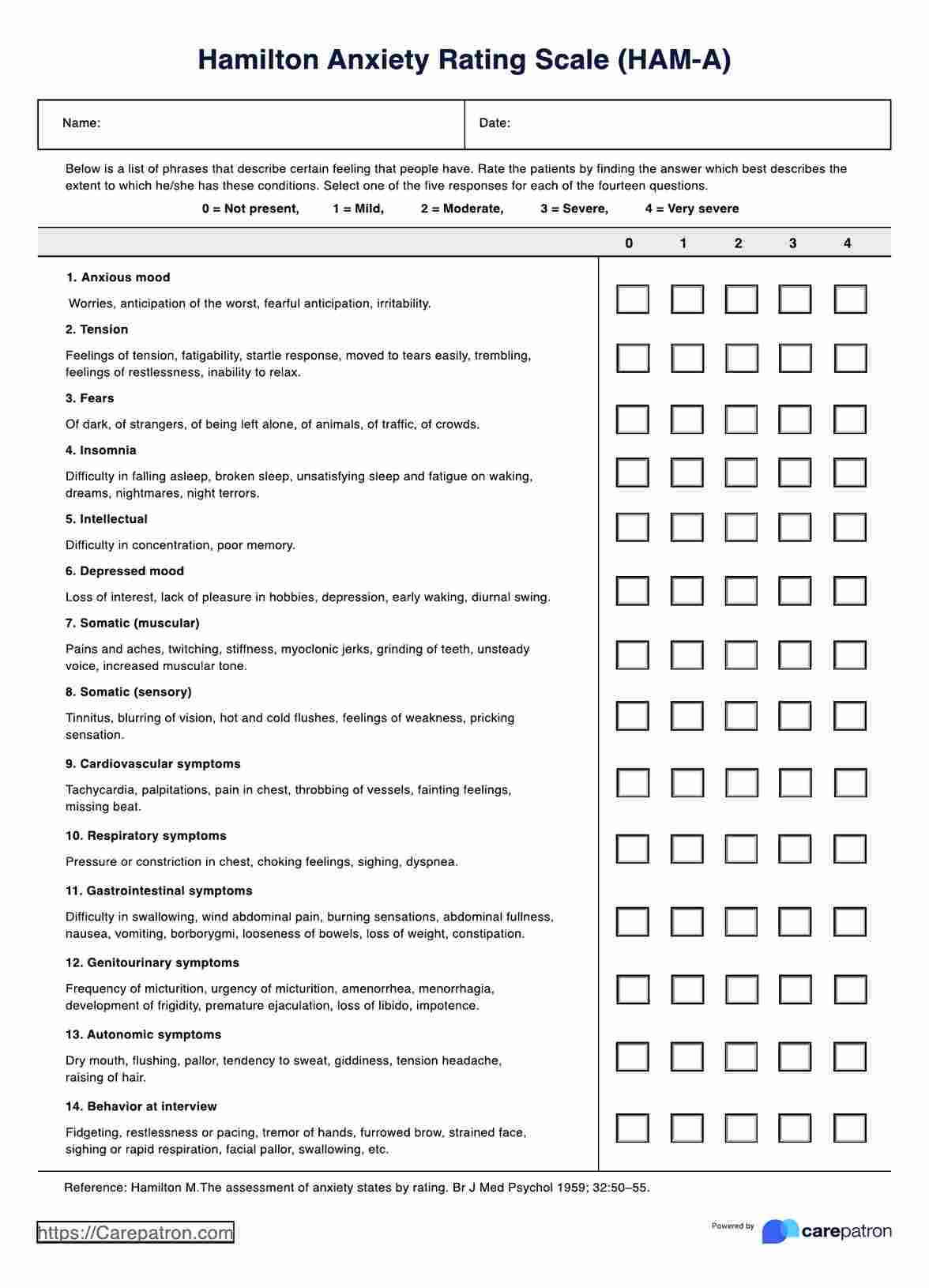
The Hamilton Anxiety Rating Scale (HAM-A/HARS) is a tool that measures the severity of the patient's anxiety symptoms. Initially, Dr. Max Hamilton, the developer of this scale, created HARS in 1959 as an evaluation tool for anxiety symptoms in those with “anxiety neurosis.” The scale is used to assess and understand the nature and intensity of anxiety disorders.
The Hamilton Anxiety Rating Scale helps objectify the severity of the patient's anxiety. It is composed of 14 indicators that are based on clinical questions. Several generalized anxiety symptoms define each indicator.
Here are the 14 indicators, all of which cover psychological and physical symptoms:
- Anxious mood
- Tension
- Fears
- Insomnia
- Intellectual
- Depressed mood
- Somatic (muscular)
- Somatic (sensory)
- Cardiovascular symptoms
- Respiratory symptoms
- Gastrointestinal symptoms
- Genitourinary symptoms
- Autonomic symptoms
- Behavior at the interview
The indicators are further expounded in the evaluation. Each item briefly stated specific examples or descriptions of the feeling or observation.
The HAM-A is typically administered at the beginning of therapy to assess the patient's status before receiving assistance. The test is then administered again to see if the treatment has made a difference to physical and psychological symptoms following a course of therapy.
A regular clinic visitation for initial screening would be another typical time to use HARS. It is used when a patient confides in feeling some anxiety traits or somatic symptoms like tension headache, trouble sleeping, muscle tension, faster breathing, fatigue, wind abdominal pain, and hot and cold flushes.
### **Is the Hamilton Anxiety Rating Scale (HAM-A/HARS) reliable?**
But the Hamilton Anxiety Scale is old? Is it still reliable?
You're probably asking those questions right now, and the answer is yes! Of course, it's safe to assume that this isn't an all-encompassing test, but it's still a valuable resource that you should take advantage of in clinical and research settings.
Maier and their research group have tested this tool on two groups: one of people with anxiety disorders, and the other with depressive disorders. Through their research, they have determined that the tool has sufficient reliability and concurrent validity. However, it isn't able to distinguish the effects of anxiolytics and antidepressants, thus it would be best not to rely solely on this scale and use other anxiety scales that focus on other aspects of anxiety disorders as well (Maier et al., 1988).
This is supported by the research conducted by Clark and Donovan (1994), but in a more positive light. They used this scale to assess adolescents, specifically those between the ages of 12 to 18. Just like with Maier's research, they have determined that this tool has sufficient reliability and concurrent validity and is a great tool for assessing global anxiety in the adolescent population. They've also concluded that, based on its good construct validity, the HAM-A/HARS showed statistically significant relationships with independent self-report measures of generalized anxiety and other anxiety variables
Even translated versions of this tool have been deemed reliable, such as the Korean version, which is said to favorable reliability and item characteristics, and that "confirmatory factor analyses identified a two-factorial structure of psychic/psychological and somatic with a moderate correlation between the two latent constructs, thus suggesting a single overarching construct of anxiety" (Jeong & Lee, 2024).
## **How do you use this Hamilton Anxiety Rating Scale?**
To make the most out of this resource, you can follow these steps:
### **Step 1: Download the PDF**
This template may be administered through printed material or digital software. To get a copy of the anxiety scale, click the "Download PDF Template" button or access it through Carepatron's template library.
### **Step 2: Brief the client/patient**
Explain the process to the patient or client and set proper expectations. Ensure that they pledge honesty and are truthful about their behavior. Ensure that they truly understand the point of the assessment and how to go about rating themselves.
### **Step 3: Go through each statement**
Discuss each item thoroughly and have them think about their answers. Here are some of the items they need to answer:
- **Anxious mood**: Worries, anticipation of the worst, fearful anticipation, irritability
- **Fears**: Of dark, of strangers, of being left alone, of animals, of traffic, of crowds
- **Insomnia**: Difficulty in falling asleep, broken sleep, unsatisfying sleep and fatigue on waking, dreams, nightmares, night terrors
- **Intellectual**: Difficulty in concentration, poor memory
- **Cardiovascular symptoms**: Tachycardia, palpitations, pain in chest, throbbing of vessels, fainting feelings, missing beat
Have them rate themselves with any of the following self-ratings:
- 0 = Not present
- 1 = Mild
- 2 = Moderate
- 3 = Severe
- 4 = Very severe
### **Step 4: Record the observations**
Be active in noticing the apparent behaviors of the client/patient. As a mental health practitioner, being able to determine traits and recognize non-verbal symptoms should be a basic expectation. Their self-ratings can also be points for discussion in later sessions.
### **Step 5: Properly store the documentation**
If you are using Carepatron, you don't have to worry about storage. The health compliance software is a cloud-based company where your documents are securely stored and properly organized. If you decide to document it through print, it is best to collate it in a folder. This survey may be helpful in comparative analysis or for future evaluation to measure progress.
## **Scoring**
The Hamilton Anxiety Rating Scale (HAM-A) is a widely used instrument for assessing anxiety severity by evaluating psychological and somatic symptoms. It comprises 14 items, each rated on a scale from 0 to 4, where 0 indicates the absence of anxiety and 4 denotes severe anxiety. The cumulative score, ranging from 0 to 56, quantitatively measures anxiety intensity.
Scores are interpreted as follows:
- **17 and below**: Suggests mild anxiety
- **Between 18-24**: Indicates moderate anxiety
- **Between 25-30**: Reflects severe anxiety
## **Next steps**
After administering the Hamilton Anxiety Rating Scale (HAM-A) and obtaining the scores, the subsequent steps involve a comprehensive approach to treatment and management. Initially, the total score is interpreted to ascertain the severity of anxiety, from mild to moderate and severe. Do note, though, that the scale may not effectively distinguish between various subtypes of anxiety disorders, such as generalized anxiety disorder.
Following the interpretation, a detailed clinical assessment is essential. This involves considering additional information, including the patient's medical history, physical health conditions, specific symptoms, the overall context of their condition, and how anxiety affects their patient's daily functioning and quality of life.
A tailored treatment plan should be developed based on the severity and individual needs. Interventions may be psychoeducational, lifestyle modifications, strategies, psychotherapy, and/or pharmacotherapy.
Regular monitoring of the patient's progress is crucial. This includes periodic reassessment of symptoms using the HAM-A or other relevant scales. The treatment plan should be adjusted based on the patient's response and progress, ensuring optimal anxiety management over time.
## **Similar tools you can use**
Earlier, it was stated that the Hamilton Anxiety Scale should be used alongside other anxiety measures. Here are examples of other tools you can use to assess anxiety in patients:
- **Taylor Manifest Anxiety Scale**: The [Taylor Manifest Anxiety Scale](Similar tools you can use) is one of many other anxiety measures you can use. Unlike this scale and most others, this scale only has two answer choices: true or false. Patients answering this will simply need to pick if certain statements apply to them or not. This scale zooms into somatic anxiety, worry and oversensitivity, tension and irritability, fearfulness and inhibition, social concerns, and cognitive instability.
- **Social Interaction Anxiety Scale**: The [Social Interaction Anxiety Scale](https://www.carepatron.com/templates/social-interaction-anxiety-scale) focuses on social anxiety. It has 20 items, and they need to rate themselves between 0 to 4 based on how each statement is characteristic of them.
- **Short Health Anxiety Inventory (HAI-18)**: The [Short Health Anxiety Inventory (HAI-18)](https://www.carepatron.com/templates/short-health-anxiety-inventory-hai-18) focuses on health worries and anxiety, and how these worries negatively impact a person's mental health. There are no scoring numbers here, but they must select the specific statement that applies to them per item.
- **Zung Self-rating Anxiety Scale**: The [Zung Self-rating Anxiety Scale](https://www.carepatron.com/templates/zung-self-rating-anxiety-scale) is another self-rated assessment that tackles both mental and physical effects of anxiety, and certain experiences related to it. They will answer 20 items and rate themselves between 1 and 4 based on how frequently they experience certain symptoms of anxiety.
## **References**
Clark, D. B., & Donovan, J. E. (1994). Reliability and validity of the Hamilton Anxiety Rating scale in an adolescent sample. Journal of the American Academy of Child & Adolescent Psychiatry, 33(3), 354–360. https://doi.org/10.1097/00004583-199403000-00009
Jeong, H., & Lee, B. (2024). Psychometric Properties and Factor Structure of the Hamilton Anxiety Rating Scale among Korean University Students during COVID-19. The Open Psychology Journal, 17(1). https://doi.org/10.2174/0118743501268244231108104216
Maier, W., Buller, R., Philipp, M., & Heuser, I. (1988). The Hamilton Anxiety Scale: Reliability, validity and sensitivity to change in anxiety and depressive disorders. Journal of Affective Disorders, 14(1), 61–68. https://doi.org/10.1016/0165-0327(88)90072-9
Commonly asked questions
The Hamilton Anxiety Rating Scale is primarily designed for use by trained mental health professionals. While it is accessible to anyone, interpreting its results accurately requires a background in psychology or psychiatry. Individuals without a medical background may find it challenging to understand the nuances of the scale and risk misinterpreting the results. Therefore, it's advisable to use this tool under the guidance of a qualified mental health practitioner.
The highest possible score on the Hamilton Anxiety Rating Scale is 56. This score is obtained by summing the highest possible ratings (4) for each of the 14 items on the scale. A score of 56 would indicate extremely severe anxiety symptoms. However, it's important to note that such a high score is rare and typically signifies a need for immediate and comprehensive mental health intervention.
The Hamilton Anxiety Rating Scale measures the severity of a person's anxiety symptoms. It evaluates various aspects of anxiety, including mood, physical symptoms, cognitive aspects, and behaviors.