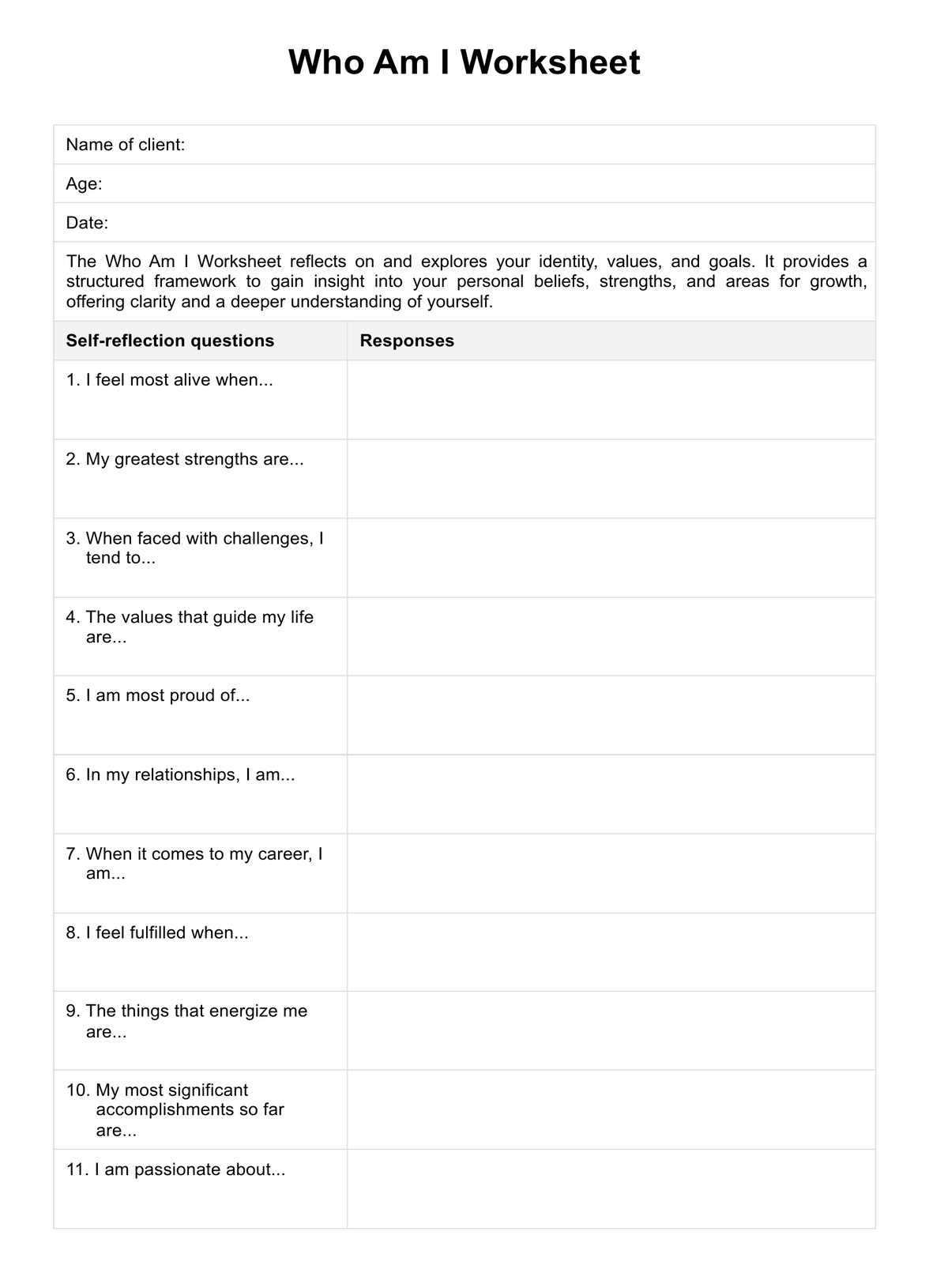
Looking for a tool to help your clients become more self-aware? Then read our guide to learn more about self-awareness and how our Who Am I Worksheet can help your clients recognize aspects of themselves they may not have noticed or remembered before.
## **Why is self-awareness important in mental health?**
The pursuit of self-awareness, rooted in ancient wisdom like the Greek maxim “Know thyself,” is critical for making informed decisions and grasping personal strengths and weaknesses. This understanding empowers individuals to set realistic goals, leading to a more authentic and fulfilling life. With self-awareness, people can navigate challenges with confidence and resilience, cultivating stronger relationships and personal growth.
Modern psychological research consistently supports this. Studies have found that higher self-awareness is linked to better [emotional regulation](https://www.carepatron.com/guides/emotional-regulation-skills/), stronger interpersonal relationships, and greater overall psychological well-being (Silvia & O’Brien, 2004; Sutton, 2016). People who are more self-aware are better at identifying emotional triggers, understanding how their thoughts influence behavior, and taking proactive steps toward healthier coping strategies.
In therapy, fostering self-awareness is a core part of most evidence-based interventions. For example, mindfulness-based cognitive therapy (MBCT) and dialectical behavior therapy (DBT) both rely on developing moment-to-moment awareness of thoughts and emotions to reduce automatic, maladaptive reactions (Kabat-Zinn, 2003). This awareness allows clients to pause before reacting, helping them regulate emotions and respond more intentionally.
Even outside clinical settings, studies show that self-awareness correlates with higher life satisfaction, job performance, and emotional intelligence (Eurich, 2018). It’s a skill that strengthens mental health over time, encouraging reflection, compassion, and resilience through both challenges and change.
## **What is a Who Am I Worksheet?**
The Who Am I Worksheet is a structured reflection tool that helps individuals explore their core values, strengths, and passions to build a clearer sense of identity. Through guided prompts and questions, it encourages honest introspection and a deeper understanding of what truly defines and motivates a person.
This worksheet is often used by adults navigating life transitions, such as career changes, new relationships, or personal milestones. It’s also valuable for those seeking ongoing personal growth or self-improvement. Therapists, counselors, and coaches may use it to help clients clarify their goals, recognize emotional patterns, and align decisions with their authentic selves.
Using the worksheet can enhance self-awareness, improve emotional understanding, and promote a greater sense of purpose and direction. However, while it offers meaningful insight, it isn’t a substitute for professional therapy. Some reflections may bring up complex emotions that require additional support. When used thoughtfully, the Who Am I Worksheet serves as a simple yet powerful guide to understanding oneself and fostering personal growth.
## **How do you use the Who Am I Worksheet?**
The Who Am I Worksheet transforms into a dynamic instrument for ongoing self-discovery and personal development. The organized style and guiding statements guide your clients through a meaningful investigation of their identity, equipping them to navigate life with greater clarity and purpose. To use the worksheet, follow these simple steps:
### **Step 1: Save the worksheet**
Download the worksheet template by clicking the "Use template" button. This lets you edit the template via the Carepatron app. For a PDF copy, choose "Download."
### **Step 2: Prepare the environment**
Encourage your client to find a quiet, comfortable place to concentrate without distraction. They may play soothing music or light candles to create a reflective mood.
### **Step 3: Start with personal information**
To establish context, enter your client's name, the current date, and, if relevant, your name as a counselor or life coach on the worksheet.
### **Step 4: Respond to the guiding statements**
Guide your clients as they work through the worksheet, responding to the 25 guiding statements to elicit self-reflection. Encourage them to answer truthfully and deliberately, digging into their thoughts, feelings, and values.
### **Step 5: Reflect on insights**
After finishing the worksheet, consider the patterns, themes, and insights their responses offer. Help them process the meaning behind those.
### **Step 6: Set actionable goals**
Help them identify concrete goals or activities that align their life with their thoughts, beliefs, and aspirations. This step converts reflection into measurable development.
### **Step 7: Save and revisit**
You can save the completed worksheet for later use. Provide a copy and encourage them to return to it regularly to track personal development and adjust their goals as their individuality evolves.
## **Other strategies to help clients foster better self-awareness**
Helping clients foster self-awareness involves more than reflection worksheets. It means creating consistent opportunities to explore identity, emotions, and personal values across different stages of life. Whether working with young adults exploring identity or adults reassessing their purpose in the world, therapists can use various evidence-based approaches to help clients understand themselves more deeply.
### **Journaling and expressive writing**
Encouraging clients to keep a [reflective journal](https://www.carepatron.com/templates/self-reflection-journals/) can be a helpful tool for identifying patterns in thoughts, emotions, and behaviors. Writing about experiences and favorite memories helps clients explore personal qualities and evaluate how they’ve grown over time. Research shows that expressive writing enhances emotional regulation and supports insight into self-concept and well-being (Pennebaker & Chung, 2011).
### **Mindfulness-based awareness**
Mindfulness practices such as deep breathing, [grounding](https://www.carepatron.com/guides/grounding-techniques), and body scans promote moment-to-moment awareness. By paying attention to their internal states without judgment, clients become more aware of triggers, reactions, and values that guide their decisions. Kabat-Zinn (2003) found that mindfulness helps individuals stay present and regulate emotions, fostering clarity and acceptance during identity exploration.
### **Values clarification and goal alignment**
Helping clients [articulate and prioritize personal values](https://www.carepatron.com/nb-NO/templates/values-clarification-worksheet/) gives meaning to their goals and actions. Discussing important aspects of life, such as relationships, achievements, and challenges, enables clients to align behavior with what truly matters. Reflecting on different roles they play, such as partner, caregiver, or professional, also helps clients set boundaries and live more authentically.
### **Exploring roles and social identity**
Therapists can guide clients through activities that explore how social, cultural, and environmental influences shape their identities. This includes examining how social justice, privilege, and cultural expectations impact identity formation. Goodman et al. (2004) emphasize that recognizing these influences enhances empathy and helps clients make sense of how their lived experiences intersect with larger societal systems.
## **References**
Eurich, T. (2018). Insight: the surprising truth about how others see us, how we see ourselves, and why the answers matter more than we think. Nashville Public Library. https://catalog.library.nashville.org/Record/CARL0000905427
Goodman, L. A., Liang, B., Helms, J. E., Latta, R. E., Sparks, E., & Weintraub, S. R. (2004). Training counseling psychologists as social justice agents. The Counseling Psychologist, 32(6), 793–836. https://doi.org/10.1177/0011000004268802
Kabat-Zinn, J. (2003). Mindfulness-Based interventions in context: Past, present, and future. Clinical Psychology: Science and Practice, 10(2), 145. https://doi.org/10.1093/clipsy.bpg016
Pennebaker, J. W., & Chung, C. K. (2011). Expressive writing: Connections to physical and mental health. In H. S. Friedman (Ed.), The Oxford Handbook of Health Psychology (pp. 417–437). Oxford University Press.
Silvia, P. J., & O’Brien, M. E. (2004). Self-Awareness and constructive functioning: Revisiting “the human dilemma.” Journal of Social and Clinical Psychology, 23(4), 475–489. https://doi.org/10.1521/jscp.23.4.475.40307
Sutton, A. (2016). Measuring the effects of self-awareness: Construction of the self-awareness outcomes questionnaire. Europe’s Journal of Psychology, 12(4), 645–658. NCBI. https://doi.org/10.5964/ejop.v12i4.1178