
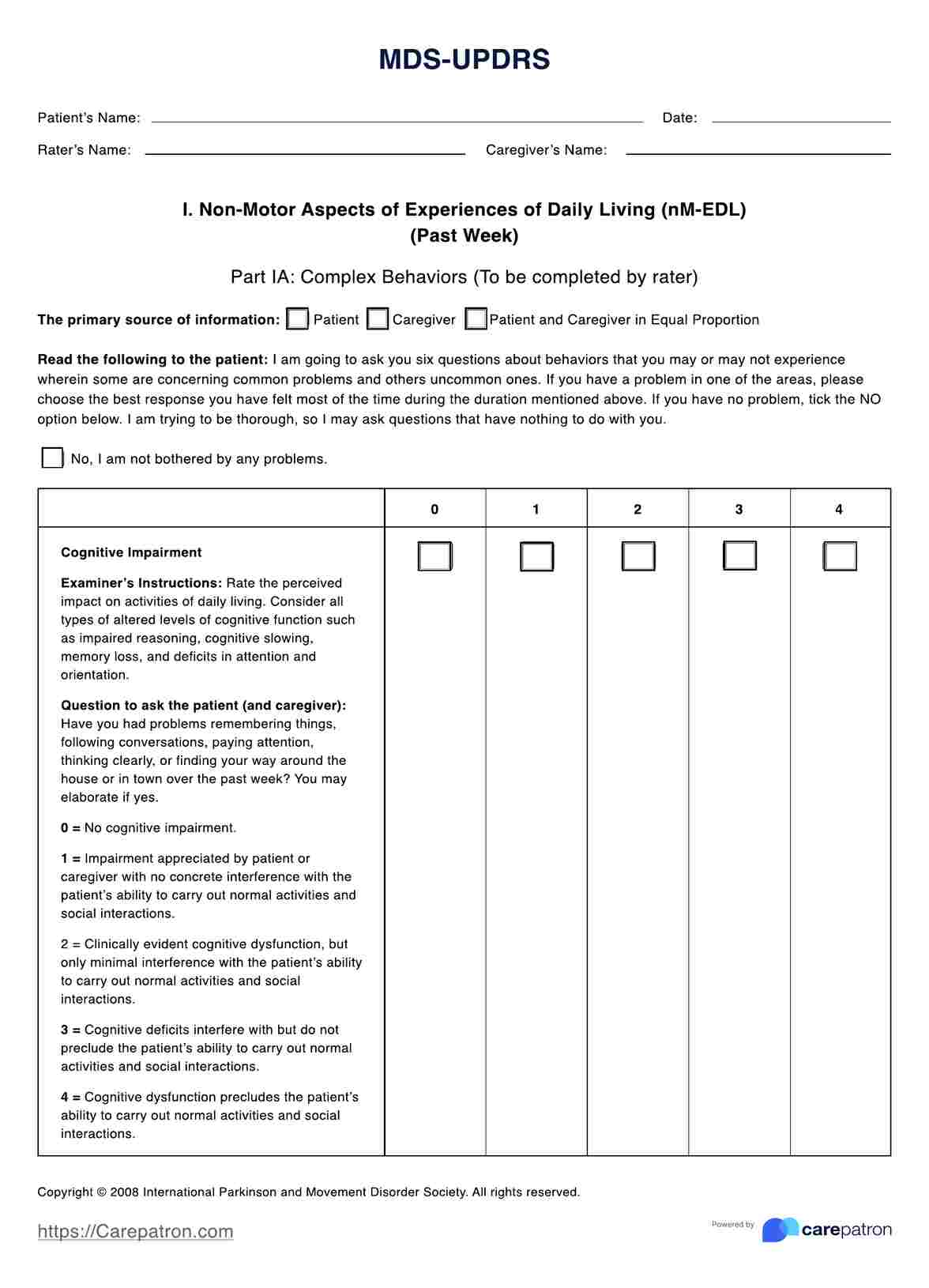




What is a Movement Disorder Society-Sponsored Unified Parkinson's Disease Rating Scale (MDS-UPDRS)?
Similar to the Unified Parkinson's Disease Rating Scale (UPDRS), the Movement Disorder Society-Sponsored Parkinson's Disease Rating Scale (MDS-UPDRS) is a rating tool a practitioner can use to measure a patient's Parkinson's disease severity and progression. However, there are two major differences between the two tests.
The first difference is that the MDS-UPDRS is a modified version developed by the MDS review task force. In this version, they address problematic sections and shortcomings in the UPDRS by including nonmotor symptoms, differentiating mild signs and symptoms of Parkinson's better, and providing clearer instructions for the patient, their caregiver, and the rater. Between the two rating scales, this one is the better choice.
The second is that the updated and modified version includes, changes, removes, and moves certain sections around. Here's a list of the sections concerning Parkinson's disease highlighted by the MDS-UPDRS:
- Non-motor experiences of daily living (nM-EDL)
- Motor experiences of daily living (M-EDL)
- Motor examination
- Motor complications (which include motor fluctuations and movement disorders)
The nM-EDL and M-EDL comprise the daily living scale portion of this assessment.
The original had six sections:
- Mentation, behavior, and mood
- Activities of daily living
- Motor examination
- Complications of therapy in the past week
- Modified Hoehn and Yahr staging
- Schwab and England Activities of Daily Living Scale
The nM-EDL and M-EDL comprise the daily living scale portion of this assessment.
As for scoring, MDS-UPDRS follows most of the process of calculating the regular UPDRS total score. To refresh your memory, raters will score 0 to 4, with 0 being the highest and 4 being the lowest. If it's impossible to test a patient, there's also a “UR” option or “unable to rate.”









