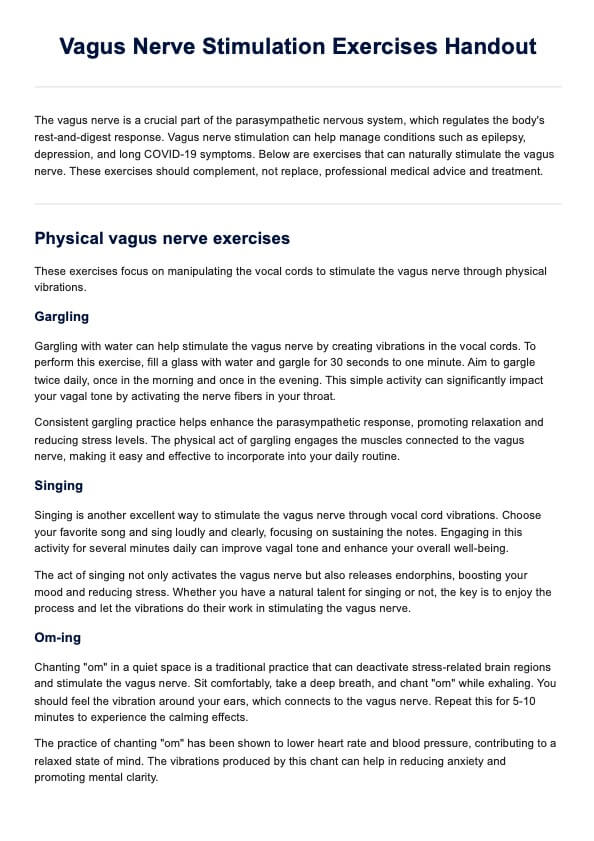
Examples of vagus nerve stimulation exercises
Vagal nerve stimulation can help enhance vagal tone, promote overall well-being, improve mental health, and relieve stress. Below are eight exercises that can be easily incorporated into daily routines. Below are eight exercises that can be easily incorporated into daily routines. This list includes both physical and mental exercises.
Gargling
Instruct patients to gargle with water twice daily for 30 seconds to one minute. The physical vibrations from the vocal cords stimulate the vagus nerve, enhancing the parasympathetic response and reducing stress levels.
Singing
Encourage patients to sing loudly and clearly for several minutes each day. The vibrations from the vocal cords during singing activate the vagus nerve, improving vagal tone, boosting mood, and promoting relaxation.
Om-ing
Have patients chant "om" in a quiet space, focusing on creating vibrations around their ears. This practice helps deactivate stress-related brain regions and promotes a state of calm by stimulating the vagus nerve.
Laughing
Advise patients to watch a funny TV show or movie or spend time with friends who make them laugh. Genuine laughter activates the parasympathetic nervous system, stimulating the vagus nerve and enhancing relaxation and overall well-being.
Deep breathing
Teach patients to practice Box Breathing: inhale for 4 counts, hold for 4 counts, exhale for 4 counts, and hold again for 4 counts. Other breathing exercises you can use are ujjayi breathing and kaki pranayama. Deep breathing exercises stimulate the vagus nerve, reduces stress, and slows the heart rate.
Meditation and yoga
Instruct patients to meditate for at least five minutes daily using apps like Headspace or Calm. In addition, positions like forward folds (uttanasana, paschimottanasana), backbends (cobra, camel, and bow positions), inversions (sirsasana, salamba sarvangasana), and twists (jathara parivartanasana, ardha masyendarasana) stimulate and exercise the vagus nerve.
Reflexology
The feet have over 7,000 nerve endings per foot. Reflexology techniques work these nerve endings, creating activity in the "default mode network" part of the brain and stimulating neural pathways. This helps activate the parasympathetic nervous system which promotes relaxation, digestion, and other restorative functions, counteracting the "fight-or-flight" stress response of the sympathetic nervous system.
Gratitude journaling
Recommend that patients write down three things they are grateful for daily. This practice helps calm the parasympathetic nervous system, fostering a positive mindset and promoting positive emotional responses through vagus nerve activation.
Exposure to beauty
Encourage patients to engage with beautiful things like nature, sunsets, or art. Positive emotional experiences from these activities stimulate the vagus nerve and reduce the stress response, improving vagal tone and physical health.