








What is the Isometric Mid Thigh Pull Test?
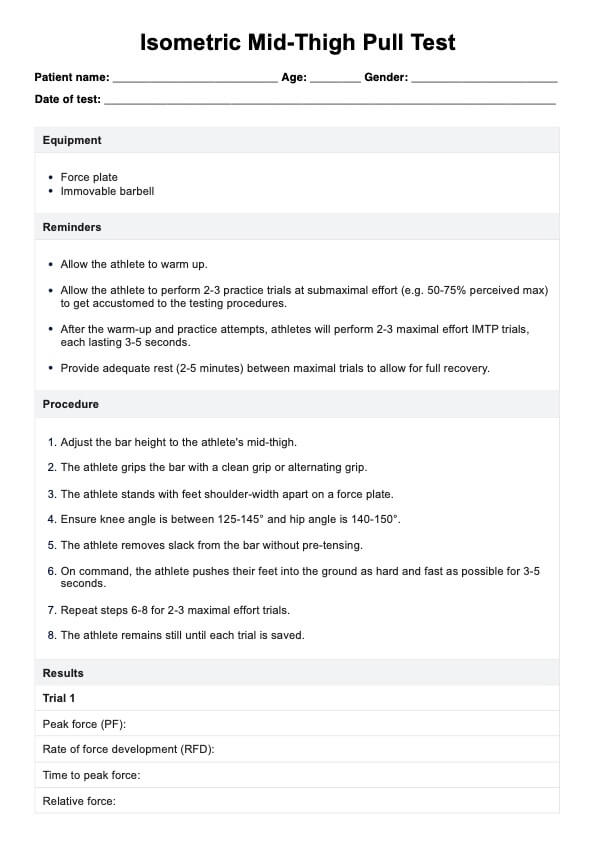
The isometric mid-thigh pull (IMTP) test is a strength assessment tool used to measure maximal strength and the rate of force development (RFD) in athletes. The IMTP test involves the athlete standing on a force plate, gripping the bar, and exerting maximal effort to pull against the bar. This test evaluates an athlete's ability to generate force by having them pull against an immovable bar positioned at mid-thigh height. It is particularly useful for assessing overall body power, crucial for sports requiring explosive strength and rapid force generation, such as rugby, weightlifting, and track and field.
The reliability of the IMTP test is high, with intraclass correlation coefficients (ICCs) for peak force ranging from 0.73 to 0.99, with a median ICC of 0.96. Additionally, the coefficient of variation (CV) for peak force ranges from 0.7% to 11.1%, with a median CV of 4.9%. These values indicate excellent to good reliability, making the IMTP a reliable method for measuring force output and monitoring an athlete's development and performance over time.
Importance of the Isometric Mid Thigh Pull Test
This test helps identify strengths and weaknesses in an athlete's performance, guiding training and conditioning programs. It provides insights into their maximal strength and RFD, which are key indicators of overall athletic performance. The outcome of the IMPT test can also be used in conjunction with the results of a countermovement jump test to calculate the dynamic strength index (DSI) and for force-velocity profiling.
Insight from the IMTP test allows coaches and personal trainers to tailor strength training programs to enhance specific areas, improve overall strength, and reduce the risk of injury.









