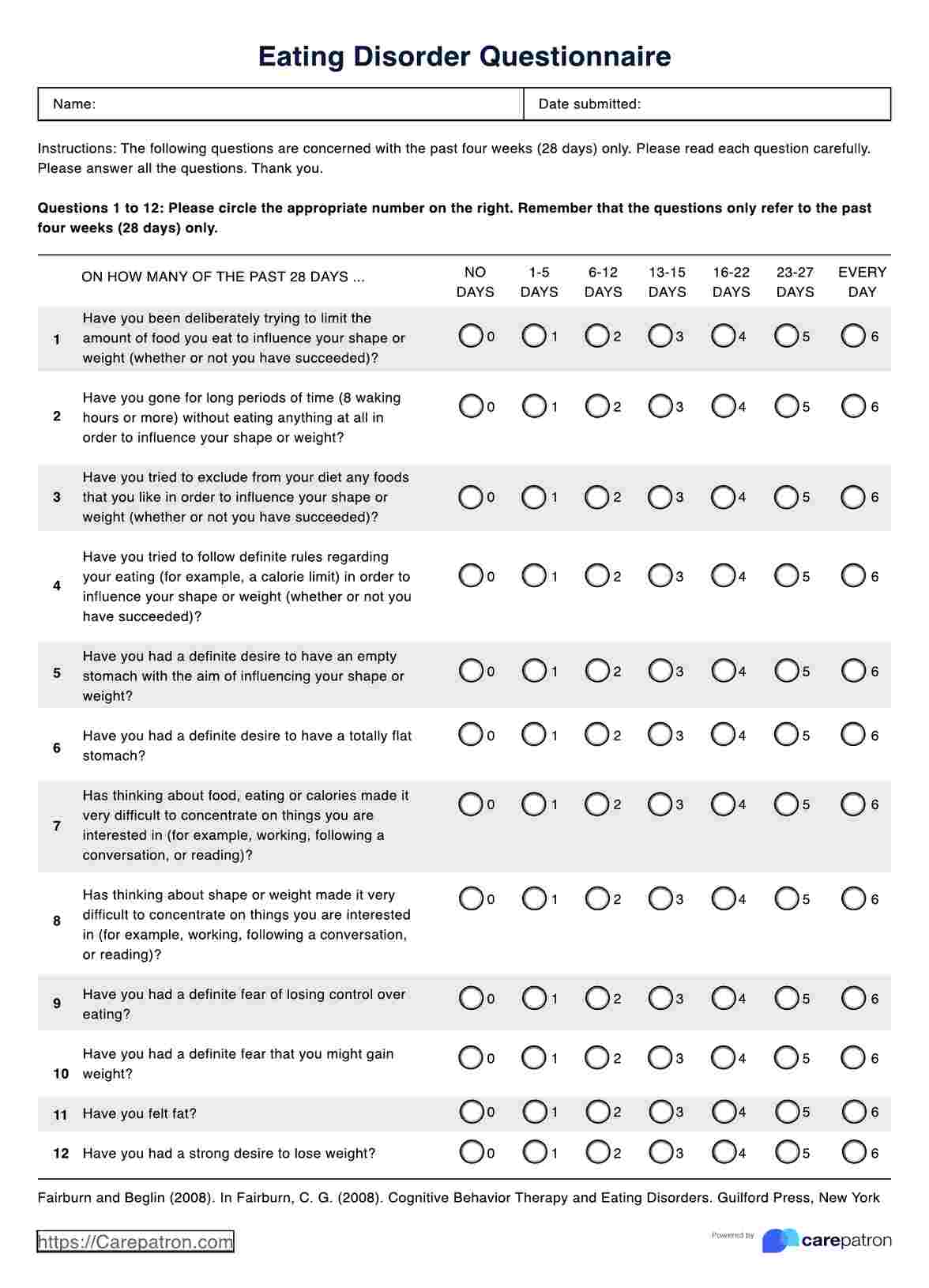
How to use the Eating Disorder Questionnaire
Your client's journey to eating disorder recovery may be challenging, especially if they are grappling with physical health conditions. First, use this disordered eating quiz to help them navigate such challenges. Follow the steps below:
Step 1: Download the test and distribute it to clients
Download the test. If you've reached the point in your sessions with your patient where you are now going to have to assess the severity of their eating disorder properly, then it's best to issue this assessment to them.
Step 2: Instruct them on how to answer and wait for them to give it back
The questionnaire is easy. They must follow the instructions per section, rating themselves based on the past four weeks (twenty-eight days). The ratings range from 0 to 6. These ratings stand for different things per section, so make sure they carefully read what each number stands for per section.
That's mostly what they need to do. Toward the end of the questionnaire, they must indicate their current weight and height. If they're unsure about those, they can give their best estimate. If they're seeing you face-to-face, then it's best that you have the equipment to measure them in your clinic.
There's also a section only meant for females, which asks them if they have missed any menstrual periods over the past three to four months, how many they have missed, and if they take birth control pills.
Step 3: Tally the scores
This version of the Eating Disorder Questionnaire has a simplified scoring system. You have to tally the scores per category (Restraint, Eating Concern, Shape Concern, and Weight Concern), then do the following:
- For each category, calculate its total score by dividing its respective sum by the respective number of items it has
- Then, combine all the total scores and divide by the total number of categories (always 4) to get the global score.
- If they get a score of 4 or higher, whether for a category or global score, it's a cause for concern and should be looked into as soon as possible.
There is no clear designation for whatever score they get. You must know that the higher the score, the higher the concern. If they score below 4, that doesn't mean they don't have an eating disorder. You're going to have to base your interpretations on the ratings themselves.
Step 4: Develop a care plan
After tallying all the scores, you can indicate if they have a severe eating disorder based on what they got per category and what they got as a global score. To reiterate, there is no specific designation for each score, except that 4 or higher means that their eating disorder severity is at the point where there should be cause for concern. Whether they scored higher or lower than 4, your plan will be based on their specific ratings and whatever you have discussed with them. Make sure to tailor-fit the plan to their needs.