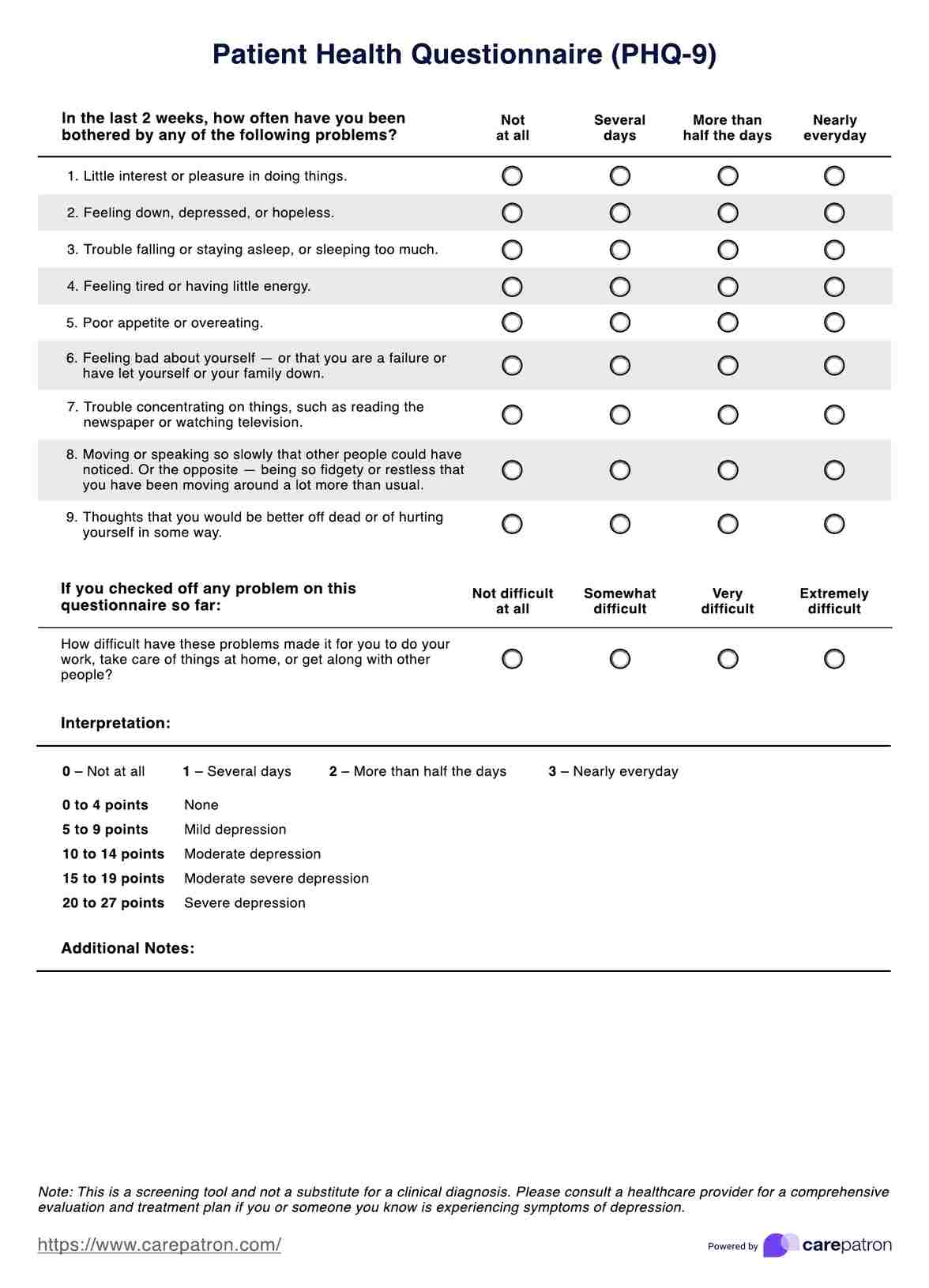
Looking for a good screening tool that can help you make a preliminary assessment of a patient to see if they have signs of depression? Read our guide to learn more about assessing depression, then use the Patient Health Questionnaire (PHQ-9) to do just that and gauge a patient's depression symptoms.
## **Why detecting depression early is important**
Depression, whether it's mild, moderate, or major depression, is one of the most common mental disorders in the world. According to the World Health Organization, an estimated 5.7% adults globally have a depressive disorder, and women are more likely to have it than men (World Health Organization, 2025). Chronically ill elderly patients may also develop depression because of disabilities and severe impairment caused by their age and illnesses. Some people also develop depression as a result of a traumatic brain injury (Bombardier & Hart, 2025). Depression is also common in people with coronary artery disease (Askin, 2020).
Those who have depression will likely have poor appetite, trouble concentrating, have little interest in anything, have low self-esteem and self-worth, feel hopeless, feel guilty about something even if there's nothing to be guilty about, they're always feeling tired, have little energy, have trouble sleeping and staying asleep, and have thoughts about self-harm and suicide.
It's important to detect depression as early as possible, so mental health professionals can help prevent it from becoming worse by teaching healthy coping mechanisms and finding ways to reconfigure negative thoughts that could lead to unwanted problems, like self-harm.
## **What is the PHQ-9?**
The Patient Health Questionnaire-9 (PHQ-9) is a self-administered diagnostic tool for common mental health conditions, specifically depression. It is a simple tool used for measuring depression severity that can also be used to monitor response to treatment (Kroenke et al., 2001). Known for its conciseness and high sensitivity, the PHQ-9 prompts individuals to reflect on the frequency of specific symptoms, such as depressed mood experienced over the past two weeks (Kroenke et al., 2010).
It's used by various mental healthcare professionals, like clinical psychologists, psychotherapists, counselors, primary care physicians, mental health nurses, psychiatrists, and psychiatric nurses.
### **What to expect from this tool**
Each question in the PHQ-9 corresponds to one of the nine diagnostic criteria for major depressive disorder in the Diagnostic and Statistical Manual of Mental Disorders (DSM). The responses are then scored on a scale from 0 (not at all) to 3 (nearly every day). The total score ranges from 0 to 27, with higher scores indicating more severe depression. The tool provides a quick and efficient way to identify the presence of depression, measure depression symptoms, and facilitate diagnosis.
The PHQ-9 can be used in various healthcare settings to assess and monitor depression. Here are some common situations where administering the PHQ-9 is recommended:
- **Initial screening**: The PHQ-9 is an effective tool for screening patients for depression during routine primary care visits, annual check-ups, or when there is a suspicion of depressive symptoms.
- **Monitoring treatment response**: After initiating treatment for depression, the PHQ-9 can be used to monitor the patient's response to therapy, whether it involves medication, psychotherapy, or a combination of both.
- **Follow-up assessments**: The PHQ-9 can be administered periodically to track the progression or remission of depressive symptoms over time, allowing healthcare providers to adjust treatment plans as needed.
- **Specialized care settings**: The PHQ-9 is helpful in various specialized healthcare settings, such as primary care settings, mental health clinics, psychiatric units, and chronic care management programs, where depression is a common comorbidity.
- **Research and clinical trials**: The PHQ-9 is widely used in research studies and clinical trials related to depression. It provides a standardized measure of symptom severity and treatment outcomes, which can help identify risk factors and those that perpetuate the condition.
It's important to note that while the PHQ-9 is a valuable tool, it should not be used as a sole diagnostic instrument. Healthcare providers should interpret the results with a comprehensive clinical assessment that includes a structured clinical interview and follow-up evaluations as needed (Manea et al., 2012).
### **Why should I use this tool?**
The Patient Health Questionnaire (PHQ-9) is a staple in depression modules and tool kits because it has been widely regarded for having a sensitivity rating of 88% and specificity rating of 88% for major depression (Kroenke et al., 2001), meaning it has a positive predictive value. It was also used alongside the 20-item Short Form General Health Survey, which can assess the functional status of a patient. It was found that, whenever the PHQ-9 depression severity increased, there was a substantial decrease in functional status on all of the Short Form General Health Survey's subscales (Kroenke et al., 2001).
Besides being a reliable tool, especially alongside the 20-item Short Form General Health Survey, here are other reasons why you should use it:
- The PHQ-9 is concise, with just nine core questions. This allows for quick administration during busy appointments. This translates to more time for in-depth discussions about potential depression and its impact.
- It uses a consistent format and scoring system, ensuring reliable results across settings and healthcare providers. This standardization is crucial for accurate comparisons and tracking progress over time.
- By allowing patients to complete the PHQ-9 independently, psychologists can access potentially more genuine responses than a direct interview. This can be particularly helpful for individuals who might be hesitant to disclose depressive symptoms verbally.
- The PHQ-9's straightforward scoring system gives psychologists a clear picture of potential depression severity. This score is a springboard for further evaluation and discussion, guiding treatment decisions.
The PHQ-9 has been translated into numerous languages and validated across diverse populations and different ethnic groups, making it a valuable tool for culturally sensitive mental health care.
## **How to use the Patient Health Questionnaire (PHQ-9) assessment**
Using the Patient Health Questionnaire-9 (PHQ-9) as part of your clinical practice is a strategic approach to detecting, monitoring, and assessing depression severity in patients. The following five steps can help you effectively integrate this depression scale within your practice:
### **Step 1: Introduce the PHQ-9 to the patient**
Explain that the PHQ-9 is a questionnaire used to assess the presence and severity of depressive symptoms. Assure the patient that their responses will be kept confidential and will help provide better care. Emphasize the importance of honest and thorough responses to each item to assess their mental health status accurately.
### **Step 2: Administer the PHQ-9**
Provide the patient with the PHQ-9 questionnaire. It can be administered in various formats — paper-based, digital, or verbal, depending on the patient's comfort level and the resources available in your practice. Instruct them to indicate how often they have been bothered by each problem over the past two weeks, using the provided response options (0 = Not at all, 1 = Several days, 2 = More than half the days, 3 = Nearly every day).
### **Step 3: Score their responses**
Once the patient has completed the questionnaire, calculate the total score by summing up the scores for each of the nine questions. The total score can range from 0 to 27, with higher scores indicating more severe depressive symptoms (Kroenke et al., 2001).
### **Step 4: Interpret the PHQ-9 score**
Interpret the total score in the patient's overall clinical presentation. A higher PHQ-9 score indicates greater severity of depression, which may warrant further clinical assessment, psychoeducation, and discussion about potential treatment options.
### **Step 5: Develop a treatment plan**
Determine the appropriate course of action. This may include initiating or adjusting treatment, referring the patient to a mental health professional, or providing support and resources for self-management.
The PHQ-9 tool should be integrated into a holistic clinical assessment. This can be used alongside other depressive symptom scales or other diagnostic tests. When interpreting the results and planning care, it's vital to consider the patient's broader medical and psychosocial context.
## **Scoring and interpreting PHQ-9 results**
The Patient Health Questionnaire-9 (PHQ-9) is a valuable tool for assessing depression. This nine-item depression scale offers healthcare practitioners a structured and straightforward method for evaluating the severity of depressive symptoms. Here's a guide on scoring and interpreting the PHQ-9 results effectively.
### **Scoring the PHQ-9**
Every item on the PHQ-9 corresponds to one of the nine DSM-IV criteria for major depressive disorder. Patients rate their experience of each symptom over the past two weeks on a scale of 0 (not at all) to 3 (nearly every day). The total score is the sum of all nine items, ranging from 0 to 27.
- **0-4**: None
- **5-9**: Mild depression
- **10-14**: Moderate depression
- **15-19**: Moderately severe depression
- **20-27**: Severe depression
### **Interpreting the results**
The total scores provide an indication of the severity of depressive symptoms the patient is experiencing.
- **No depression**: Scores in this range usually do not indicate a need for clinical intervention unless there are other indicators of functional impairment or distress.
- **Mild to moderate depression**: These scores suggest the presence of depressive symptoms that may warrant a more detailed clinical interview and further assessment. Patient education and active monitoring are often recommended.
- **Moderately severe to severe depression**: Scores within these ranges indicate a more significant level of depression. A comprehensive assessment to explore treatment options, including psychotherapy, pharmacotherapy, or a combination of both, is generally advised.
## **Other depression screening tools you can use**
While using the PHQ-9 and the 20-item Short Form General Health Survey together is a reliable and valid method of assessing people for depression, it's important to cover as much ground and gather consistent results to satisfy the criteria of the current edition of the DSM. Please note that the DSM IV Depressive Disorders criteria is no longer in use because the DSM is currently in its fifth edition, so please refer to that criteria.
Here are three examples of other tools you can use:
- **[Geriatric Depression Scale (Long Form)](https://www.carepatron.com/templates/geriatric-depression-scale-long-form)**: Given that elderly people are susceptible to depression because of any age-related or chronic illness-related disabilities and impairments, it would be good to use a tool specific to assessing geriatric depression. This scale has 15 items, and all they need to do is to select Yes or No per item.
- **[Zung Self-Rating Depression Scale](https://www.carepatron.com/templates/zung-self-rating-depression-scale)**: For this scale, the patient/client just needs to rate themselves for each item based on how often each one applies to them (e.g., a little of the time, most of the time).
## **References**
Askin, L. (2020). The relationship between coronary artery disease and depression and anxiety scores. Northern Clinics of Istanbul. https://doi.org/10.14744/nci.2020.72602
Bombardier, C. H., & Hart, T. (2025). Depression after traumatic brain injury [Factsheet]. Model Systems Knowledge Translation Center (MSKTC). https://msktc.org/tbi/factsheets/depression-after-traumatic-brain-injury.
Kroenke, K., Spitzer, R. L., & Williams, J. B. (2001). The PHQ-9: validity of a brief depression severity measure. Journal of General Internal Medicine, 16(9), 606–613. https://doi.org/10.1046/j.1525-1497.2001.016009606.x
Kroenke, K., Spitzer, R. L., Williams, J. B., & Löwe, B. (2010). The Patient Health Questionnaire Somatic, Anxiety, and Depressive Symptom Scales: A systematic review. General Hospital Psychiatry, 32(4), 345–359. https://doi.org/10.1016/j.genhosppsych.2010.03.006
Manea, L., Gilbody, S., & McMillan, D. (2012). Optimal cut-off score for diagnosing depression with the Patient Health Questionnaire (PHQ-9): A meta-analysis. Canadian Medical Association Journal, 184(3), E191–E196. https://doi.org/10.1503/cmaj.110829
World Health Organization. (2025, August 29). Depressive disorder (depression). World Health Organization. https://www.who.int/news-room/fact-sheets/detail/depression
Commonly asked questions
While the PHQ-9 is a valuable screening tool for depression, it is not sufficient for a diagnosis. A full clinical assessment, along with other depression scales and other measures, is required to diagnose major depression accurately.
Yes, the PHQ-9 is both reliable and valid. Studies have shown it to be highly reliable and valid for diagnosing depression across different settings and populations. It has relatively sound psychometric properties compared to other depression screening instruments.
It typically takes about 3 to 5 minutes for a patient to complete the PHQ-9, making it a quick and efficient tool for assessing depression severity.